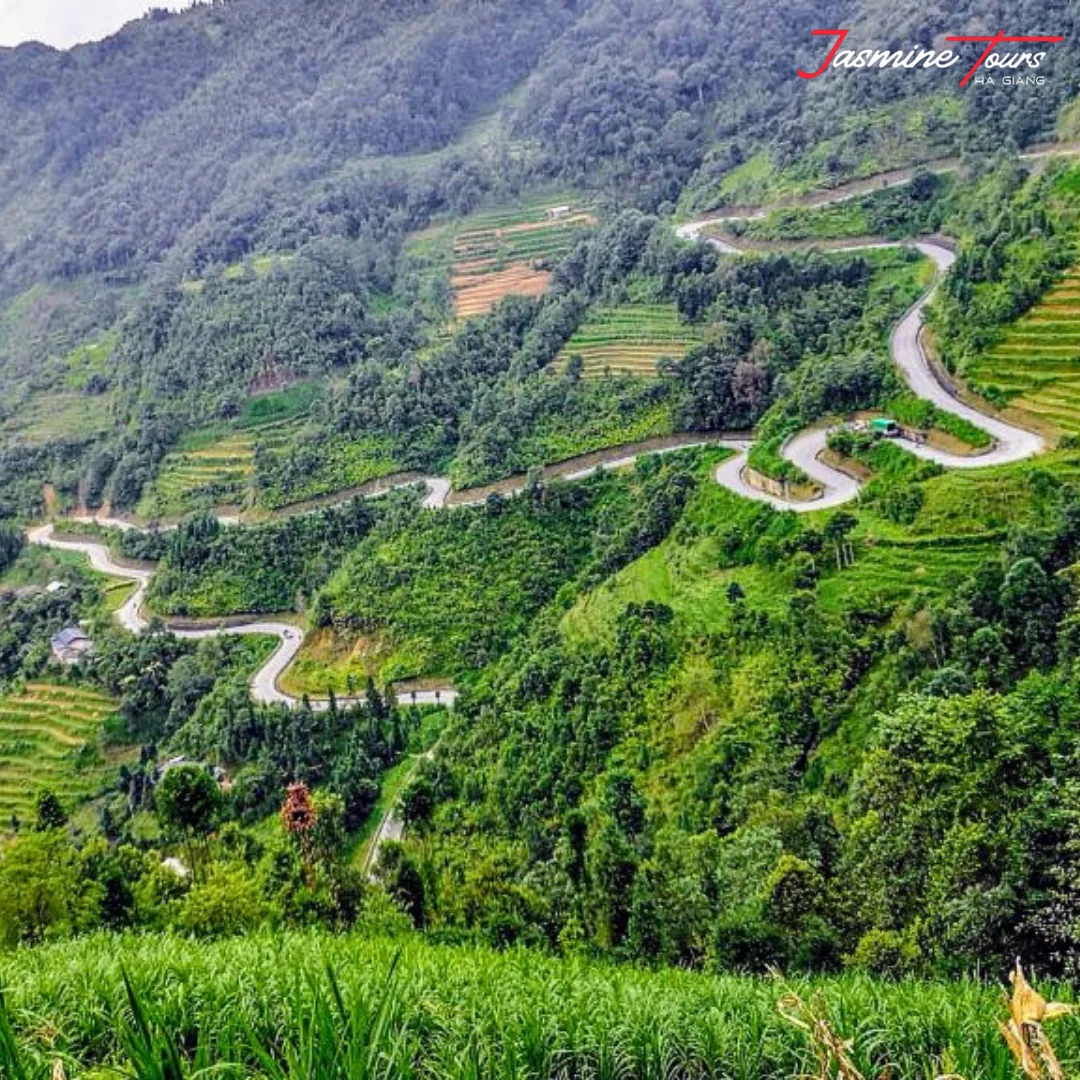
Every version of this question I see asked is about the seat. Sleeper or limousine. Which company. Whether the reclining one is worth the extra.
That’s not the decision that changes your trip.
The decision that changes your trip is whether you arrive rested.
Because what happens on the other end of this bus ride is roughly 450 km of mountain road over three or four days, and one of the nine things you genuinely control up there is whether you ride tired.
So this page covers the fares and the timetables, because you need them. Then it covers the part nobody sells you: which of these options puts you on the start line in a fit state to ride.
The short version
- It’s about 300 km and takes 5 to 9 hours, depending entirely on which option you pick and the traffic getting out of Hanoi.
- Four real options: local bus, shuttle or limousine van, private car, or riding a bike up yourself. Published fares run from 250,000₫ (about US$10) for a local bus to 3,600,000₫ (about US$160) for a private car (Vietnam Airlines guide, accessed 3 August 2026).
- The night bus is the default, and it is the one that needs thinking about. It saves a day and a night’s accommodation only if you ride out the same morning, which is exactly when it costs you most.
- Departures cluster early morning and early evening — around 05:00 to 08:00, and around 18:00.
- The ticket rarely covers the last mile. Check where the bus actually drops you against where you are sleeping.
How far is it, and how long does it really take?
About 300 km, on Vietnam Airlines’ own Hanoi to Hà Giang travel guide, accessed 3 August 2026. That is the figure and the source. Every fare and every timing below comes from that same page on that same date, and the US dollar brackets are the guide’s own, published beside the dong.
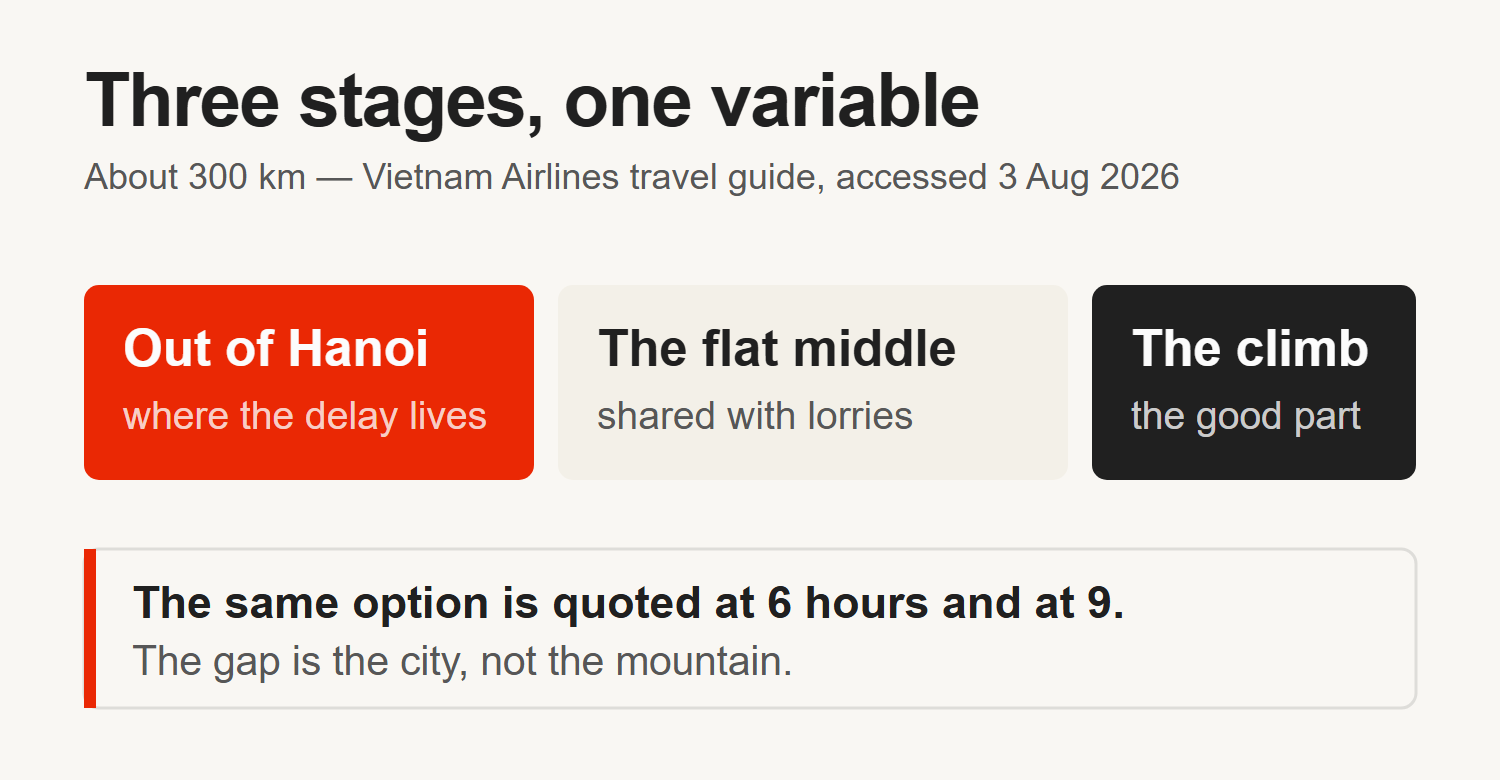
The spread on journey time is wide, and it is not mostly about the vehicle. A private car is quoted at 5 to 8 hours and a local bus at 6 to 9. The spread inside one option is about three hours; the gap between the options themselves is about one. Which vehicle you pick matters less than what the road does that day.
That’s Hanoi’s fault, not the mountain’s. I ride this road, and the last two hours of it are quick — it’s the first hour, getting out of the city, where the variance lives.

What are your actual options?
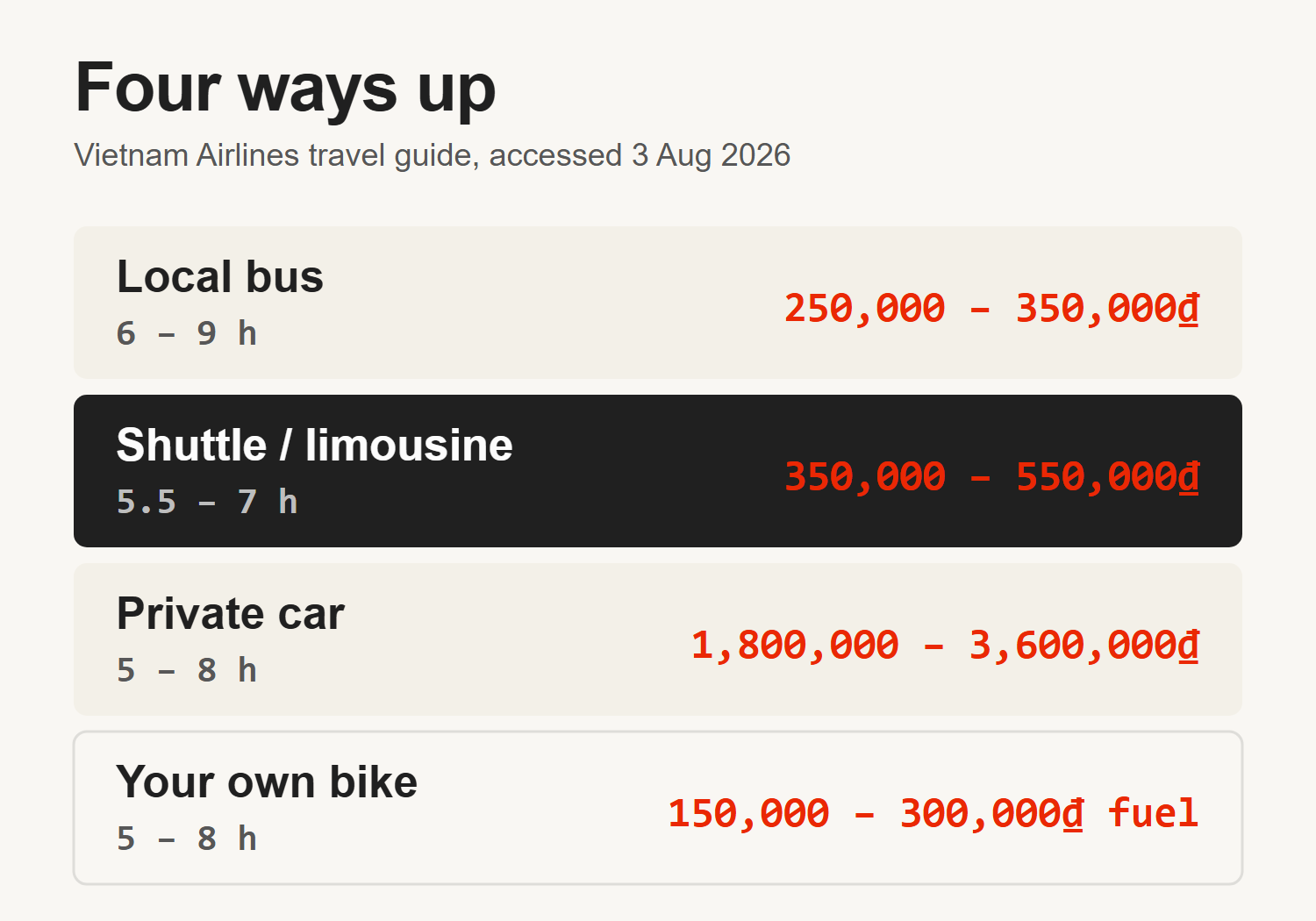
Local bus — 250,000₫ to 350,000₫ (about US$10–14), 6 to 9 hours. Run by companies including Truly Ha Giang and Vietnam Local Bus (Vietnam Airlines guide, accessed 3 August 2026). The cheapest way up and the least predictable. Usually a sleeper layout with three columns of flat berths.
It’s a real option and plenty of people take it. What you’re buying is the fare, not the schedule.
Shuttle bus or limousine — 350,000₫ to 550,000₫ (about US$15–22), 5.5 to 7 hours (Vietnam Airlines guide, accessed 3 August 2026). In Vietnam a “limousine” means a converted 9–16 seat van, not a stretch car. Fewer seats, more legroom, and usually a pick-up option in the Old Quarter rather than a trip out to the bus station.
For most travellers this is the sweet spot, and the extra 100,000₫ to 200,000₫ over a local bus mostly buys you a tighter schedule and a shorter journey.
Private car — 1,800,000₫ to 3,600,000₫ (about US$80–160), 5 to 8 hours (Vietnam Airlines guide, accessed 3 August 2026). Expensive alone, reasonable split four ways, and the only option where you choose the departure time and the stops.
Your own motorbike — 5 to 8 hours. The Vietnam Airlines guide puts the cost at 150,000₫ to 300,000₫ (about US$6–12), which is fuel and wear rather than a ticket. I have a whole section on this below, because the honest answer is more complicated than the price.
Where the buses actually leave from
Two answers, and which one applies to you depends on what you booked.
Local buses generally run from Mỹ Đình bus station, on the west side of Hanoi. Getting there from the Old Quarter is a taxi ride you should budget time for, especially at rush hour.
Shuttle and limousine services usually offer Old Quarter pick-up, which removes that problem entirely. If you are staying in the Old Quarter, that convenience is a real part of what the higher fare buys.
The Vietnam Airlines guide names two operators with published times: Truly Ha Giang, departing 05:00, 05:30 and 18:00, and Vietnam Local Bus, departing 08:00 and 18:00.
That is the shape of the timetable across the route — a morning cluster and an evening cluster, with very little in between.
Why is night bus versus day bus the real decision?
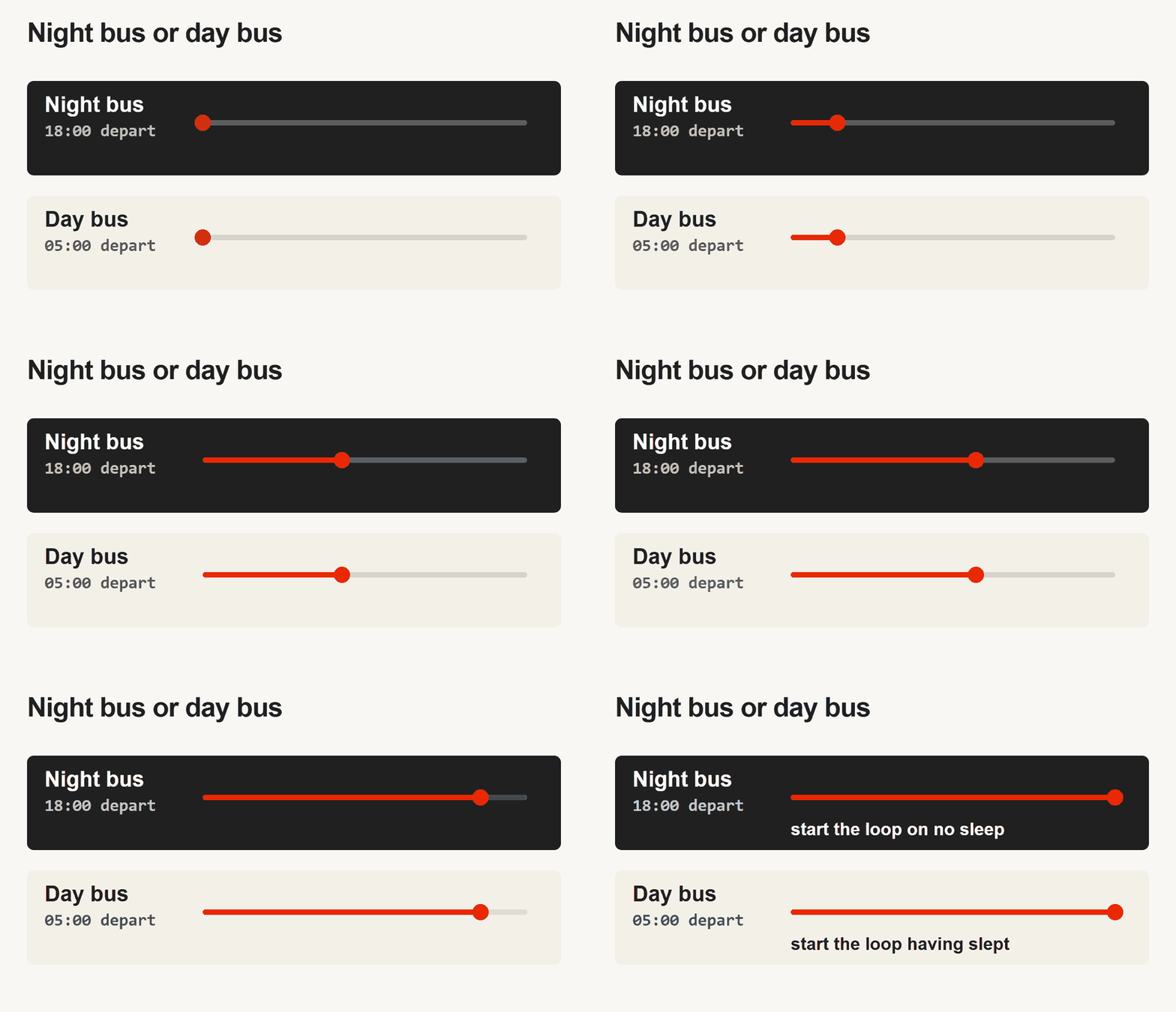
Take the evening departure and you arrive in Hà Giang somewhere in the small hours. Plenty of loop departures go early the same morning, and that single fact decides this whole question, so find out what time yours actually leaves.
That means the sequence for a lot of people is: a night half-asleep on a bus, an arrival before dawn, a coffee, and then the first mountain day.
On the page where I set out where risk on this loop actually concentrates, “whether you ride tired” is one of the nine things on the list you control, against five you do not. This is the moment you spend that control, before you have even seen a bike.
If your loop leaves the same morning you land, the day bus costs you a night’s accommodation in Hà Giang and half a day of holiday. What it buys is starting the loop having slept lying down.
I’m not going to tell you that everyone must take the day bus. Plenty of people ride the night bus, sleep fine, and are completely all right.
But if you are the kind of person who does not sleep sitting up, you already know it, and you should pay the extra night rather than find out on Mã Pí Lèng.
What time do you actually arrive, and does it matter?
It matters more than the fare does.
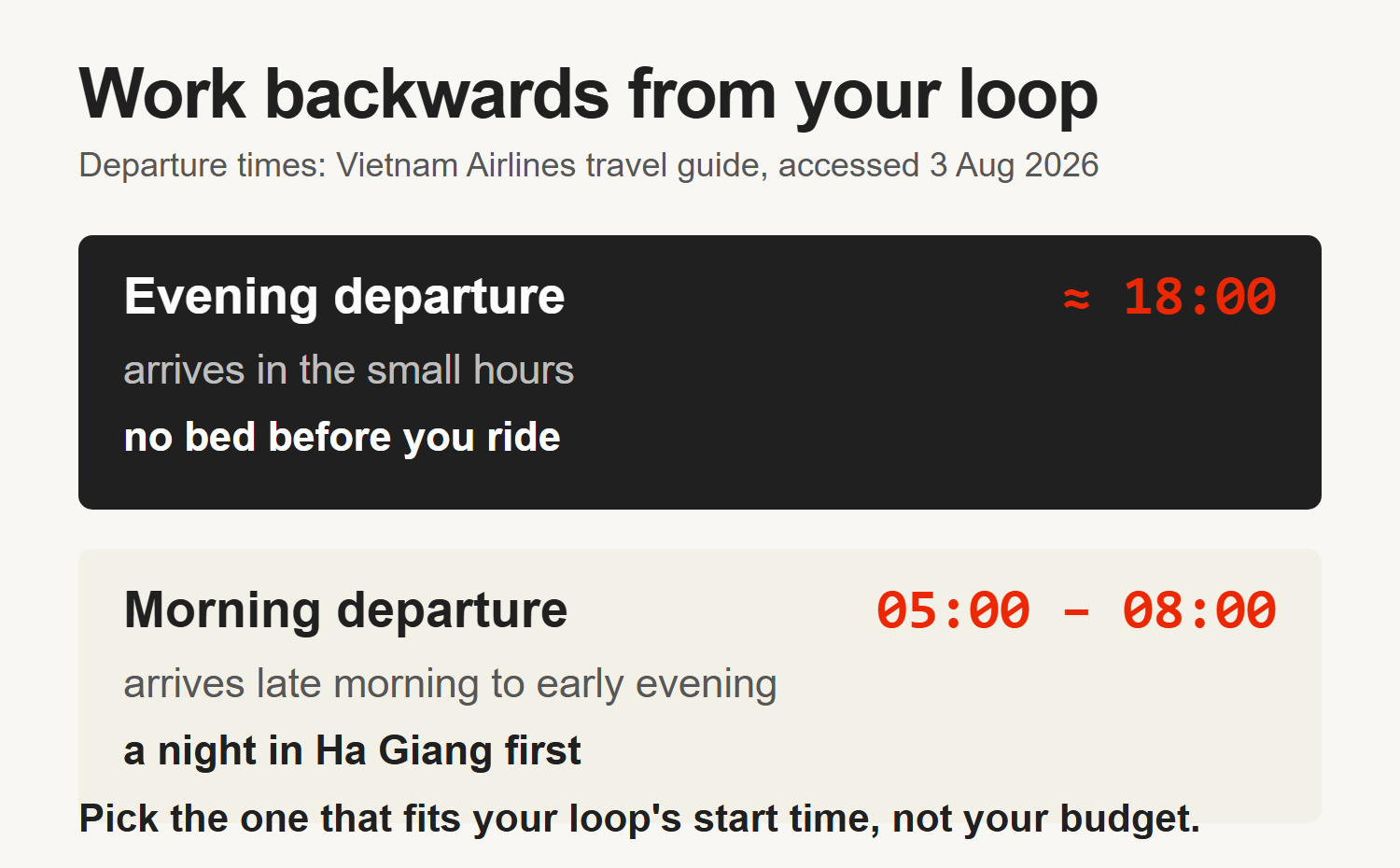
Work it backwards. Find out what time your loop actually departs, then pick the bus that puts you in Hà Giang with enough margin to eat, repack and sleep.
A morning departure between 05:00 and 08:00 lands you anywhere from late morning to early evening, depending which end of the five-to-nine-hour range you get. Either way you get an evening in Hà Giang and a proper night before you ride.
An evening departure around 18:00 lands you overnight. If your loop starts that same morning you save a bed and pay for it in sleep; if it starts the next day you have paid for the bed anyway. The recommendation below sorts the two cases.
Should you ride your own bike up from Hanoi?

Some people do, and I understand why. It’s 300 km of real riding and it makes the trip one continuous journey rather than a transfer and then a holiday.
Here’s the case against, and it’s not about difficulty.
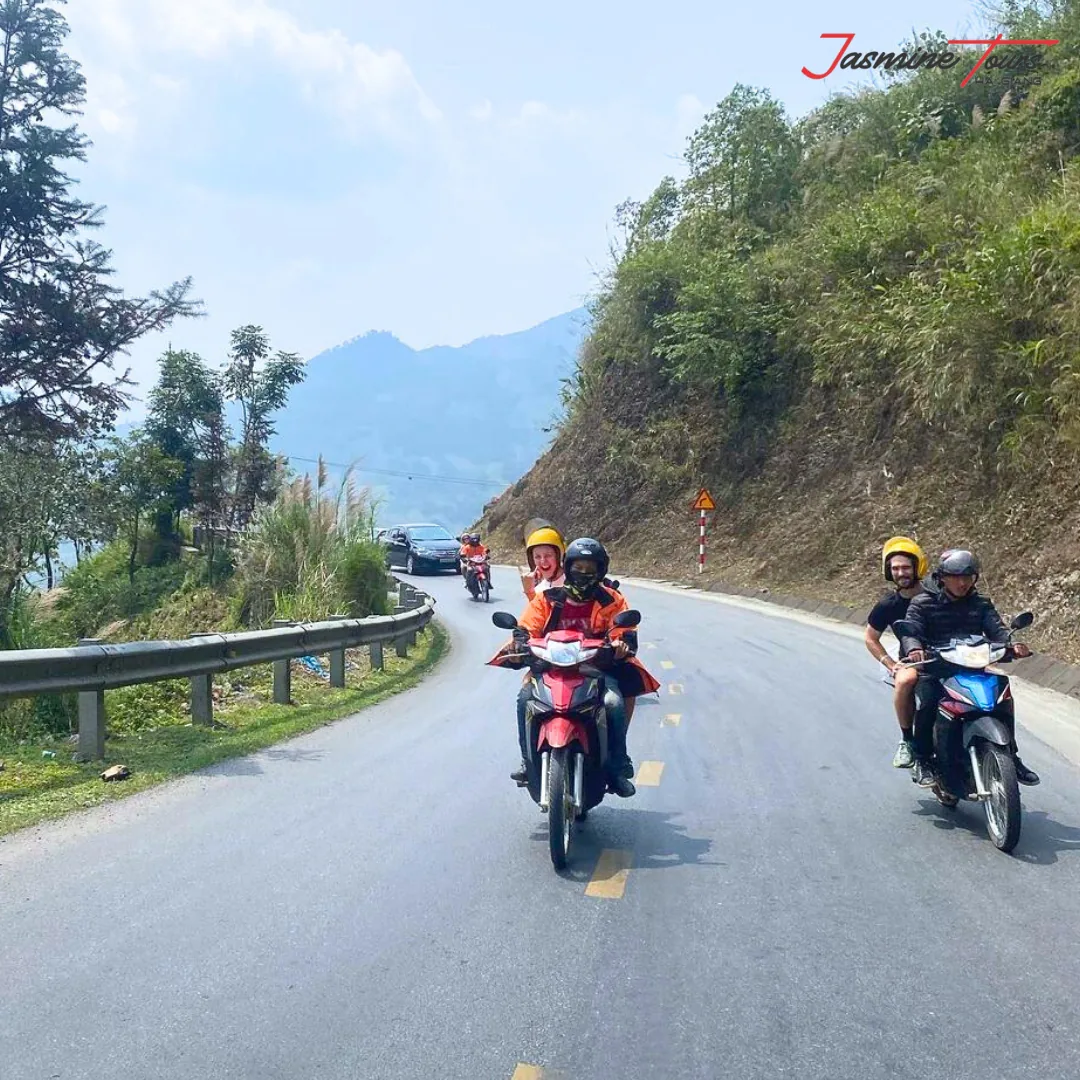
You’ll arrive having already ridden 5 to 8 hours, and then start a loop of roughly 450 km with about eight hours a day on the road, door to door. You are spending your freshest day on the least interesting road of the whole trip.
The road from Hanoi is busy, flat for a long stretch, and shared with lorries. Nothing on it is the reason anyone comes to Hà Giang.
The case for is genuine, though, and I won’t pretend otherwise. If you have a bike you trust, time to spare, and you actively want the door-to-door ride, it is a good day out. Just don’t do it the day before the loop starts.
What does the ticket not include?
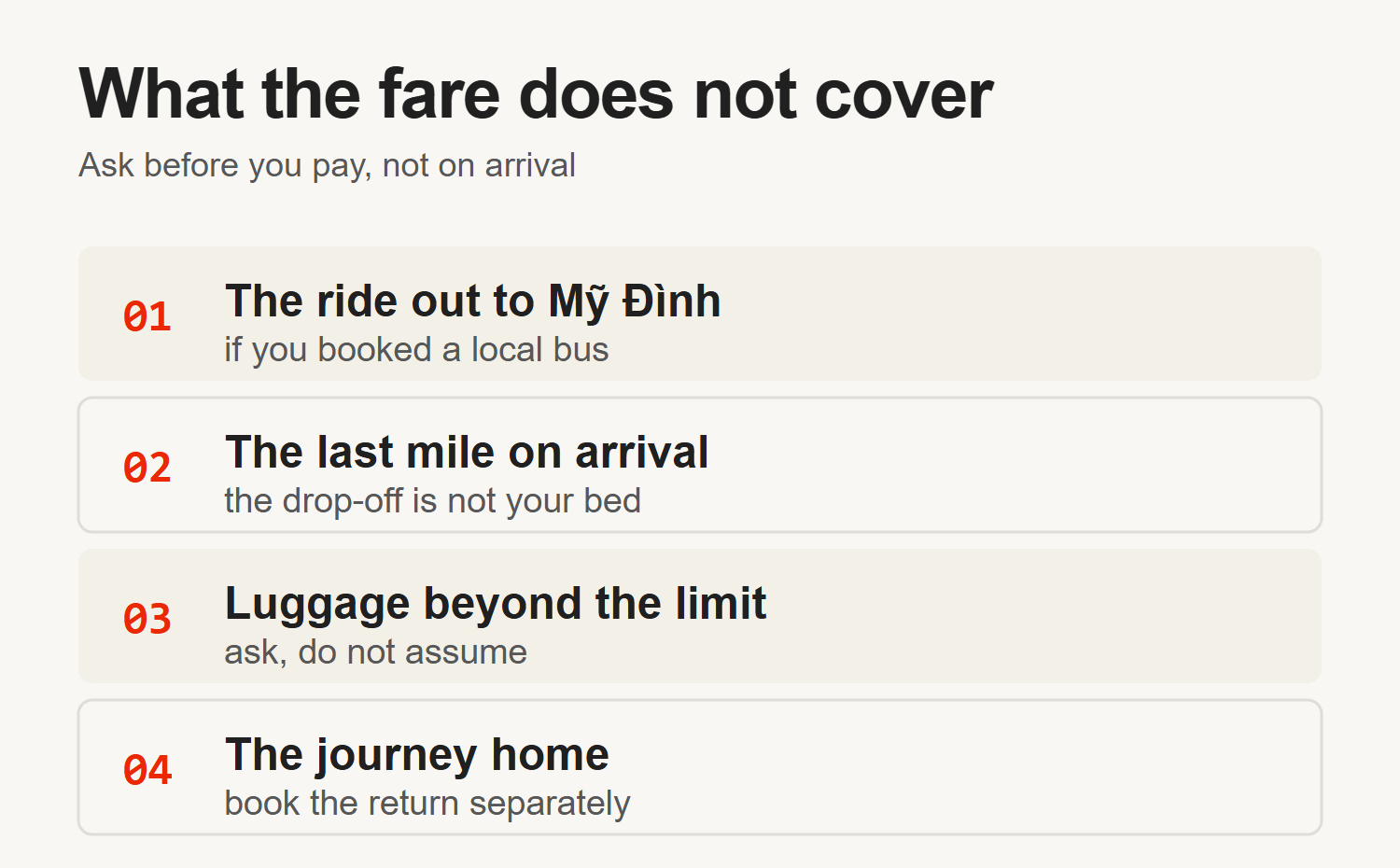
The fare gets you between two points that may not be the two points you had in mind.
If you booked a local bus, the taxi out to Mỹ Đình is yours, and so is the ride from wherever the bus stops in Hà Giang to wherever you are sleeping. Neither is expensive. Both are annoying at four in the morning with luggage.
Ask the operator two questions before you pay: where exactly does this drop me, and how far is that from my accommodation. A hostel that includes a pick-up has quietly saved you both problems.
Does the province merger change how you book?
It changes what you type, occasionally.
Hà Giang stopped being a province on 1 July 2025, when it was merged into Tuyên Quang province and the district tier was abolished nationwide. The city is still Hà Giang. The bus still goes there. Every place name on your itinerary is unchanged.
What changes is the booking form. A few operators and ticketing systems have switched their destination field to Tuyên Quang while most still list Hà Giang, so if the province you expect is not in the dropdown, try the other one, or search the city name on its own. The bus itself is unaffected. What the merger actually changed is on the province page.
So which should you book?

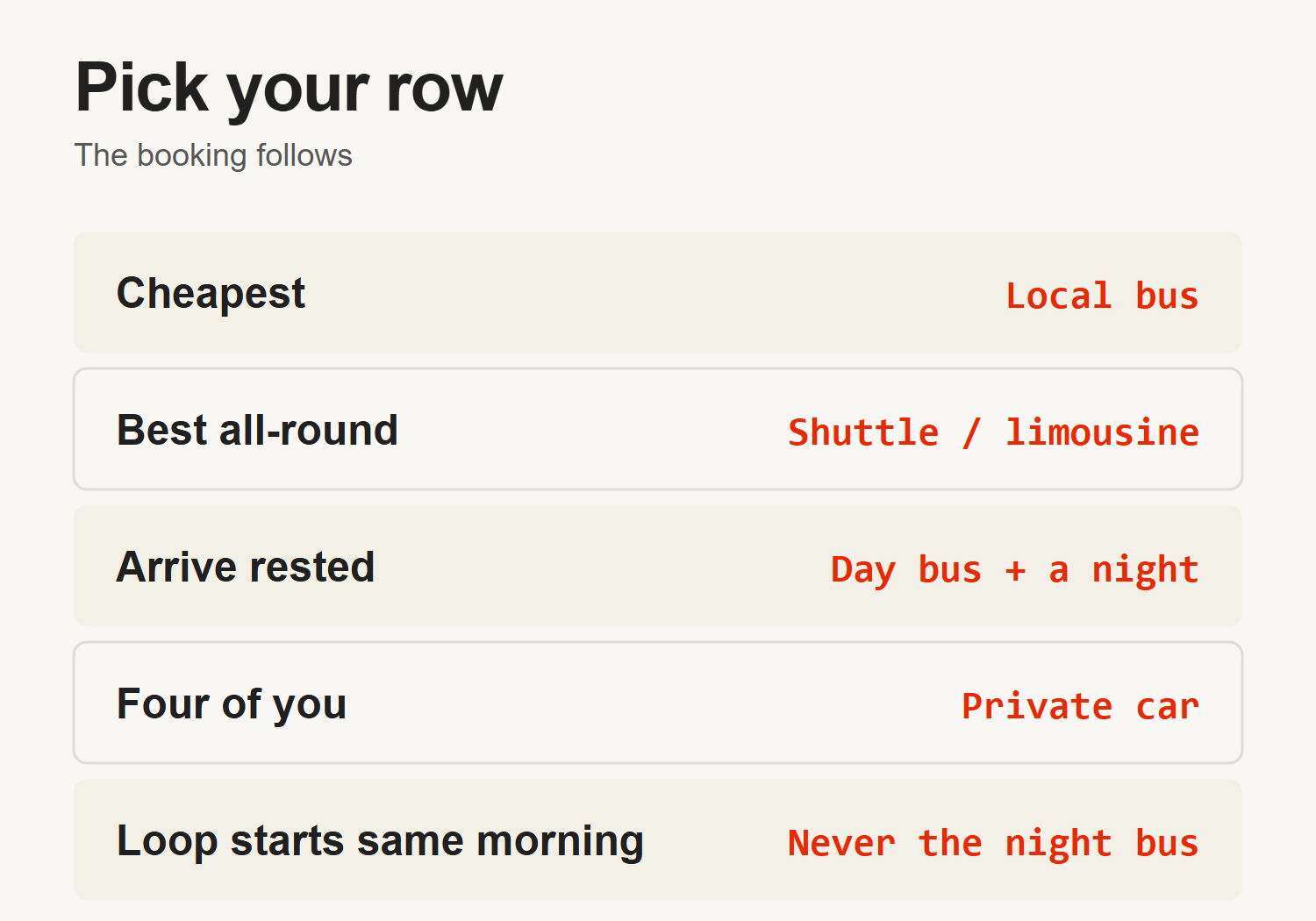
The sorting question is not “what is my budget”. It is this:
What time does my loop leave, and can I sleep sitting up?
If your loop leaves the same morning you land, the night bus is the efficient choice on paper: no hotel bill, no day lost to travelling. It’s also the case where you pay for it hardest, because you start the first mountain day without having slept lying down.
If your loop leaves the day after you land, the night bus saves you nothing at all. You’re paying for a bed that night either way, so take a daytime departure, arrive with the light, and start the loop rested.
For everyone else, the shuttle or limousine at 350,000₫ to 550,000₫ (about US$15–22) with an Old Quarter pick-up is the option I would point most people at. It’s not the cheapest. It’s the one with the fewest ways to go wrong.
Once you are up here, the route itself is a separate problem — about 450 km all in with the Lũng Cú spur, and about eight hours a day door to door once you count stops, photographs and lunch.
Common questions
How far is Hanoi from Ha Giang?
About 300 km by road, according to Vietnam Airlines’ own travel guide for the route. Journey times run from 5 hours in a private car to 9 hours on a local bus.
How much is the bus from Hanoi to Ha Giang?
Published fares are 250,000₫ to 350,000₫ (about US$10–14) for a local bus and 350,000₫ to 550,000₫ (about US$15–22) for a shuttle or limousine, on the Vietnam Airlines guide accessed on 3 August 2026. A private car is quoted at 1,800,000₫ to 3,600,000₫ (about US$80–160).
Is there a night bus from Hanoi to Ha Giang?
Yes. Evening departures cluster around 18:00 and arrive in the small hours. It saves a night’s accommodation only if your loop rides out that same morning. If your loop leaves the day after, you are paying for a bed either way and the night bus saves you nothing.
Where does the bus to Ha Giang leave from in Hanoi?
Local buses generally leave from Mỹ Đình bus station on the west side of the city. Shuttle and limousine services usually offer an Old Quarter pick-up instead.
Is there a train or a flight to Ha Giang?
No. The Vietnam Airlines guide states there are no direct train or flight services to Hà Giang, which is why every option on this page is a road option.
Can I ride a motorbike from Hanoi to Ha Giang?
Yes, and it is 5 to 8 hours on a busy, mostly flat road. The problem isn’t difficulty, it’s timing: you arrive tired and then start a loop of about 450 km. If you want to ride it, put a rest day between the two.
A note on this page. Every fare, journey time, departure time and operator name here comes from Vietnam Airlines’ own Hanoi to Hà Giang travel guide, accessed on 3 August 2026, and is linked.
That page carries no publication date and no last-updated stamp, so treat these as indicative bands rather than this week’s prices. Its own dollar figures are not even on one basis: the bus and motorbike brackets imply about 25,000₫ to the dollar, the private-car bracket about 22,500₫, as at 3 August 2026. I quote it because it is the most accountable published source I found, not because it is live — a bus company’s own booking page will always be more current than mine.
These are published bands, not fares I have paid. When I have my own receipts for these buses, they will replace them here. The route and timing judgements are my own, from riding and working these roads.
The photographs were taken on our own trips — our logo is visible on each one — and each caption carries its own date.