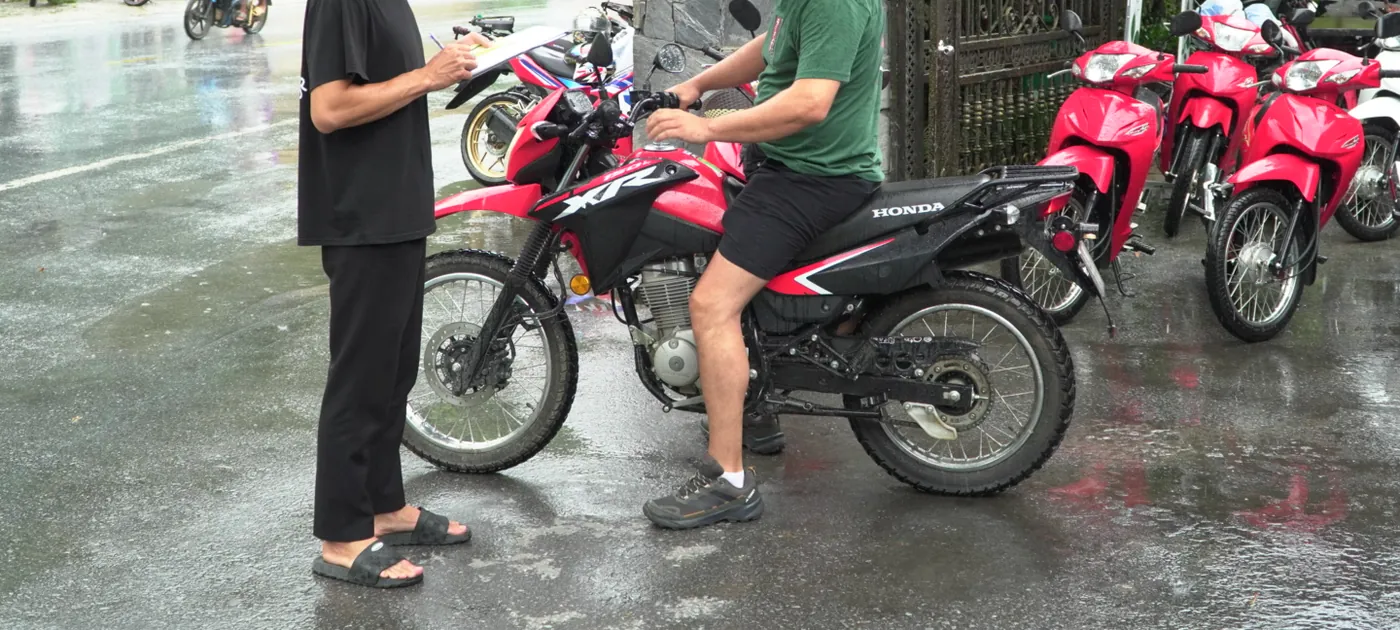
A row of red Hondas standing in water deep enough to reflect them, and a man sitting on one of them in shorts and running shoes while somebody with a clipboard stands alongside.
He has packed a quick-dry towel and a power bank. What he has not packed is the second piece of paper that makes his International Driving Permit worth anything. Vietnamese law prices that omission at 2.000.000₫ to 4.000.000₫ — about US$76 to US$152 at 26.246,10₫ to the dollar (XE mid-market, 06:45 UTC) on 5 August 2026.
Every packing list for this road is a list of objects. Towel, power bank, poncho, dry bag. None of them tells you that the most expensive thing you can leave behind is paper, or that half of what they want you to buy is already in the price you paid.
The short version
- This page quotes my own company’s published prices and inclusion list, dated, not as a survey.
- Three documents matter more than anything in the bag — your own driving licence, a 1968 International Driving Permit, and your passport. The permit alone is not enough, and the fine for that is 2.000.000₫–4.000.000₫ on a 125 cm³ bike.
- Add a border area permit. 260.000₫, about US$9.91 at 26.246,10₫ to the dollar on 5 August 2026 — my own figure, from selling these permits. It is not written into the decrees.
- Pack for rain, not for the chance of rain. July here averages 379 mm across 19 rain days in the 1991–2020 normals.
- Check what your booking already covers before you buy anything. The package I priced lists the bike, the beds, the meals and a guided group — and its published list says nothing about injury to you.
- You are packing two bags. One rides on the bike and gets wet. One stays on your body and must not.
What actually goes in the bag?
Less than you think, and it divides cleanly.
You are riding for three days in a place where the shops sell what the people who live here need, which is not what you forgot. Đồng Văn has a market. Mèo Vạc has a market. Neither of them stocks a replacement for the licence sitting in a drawer in Hanoi.
So the list works in four parts: the paper, the wet-weather kit, what you wear, and the ordinary luggage left over. Most published lists start at part four and stop there.
One practical figure before the list, and it belongs to the route rather than to the bag: a day out here runs to about eight hours door to door — riding, stops, photographs and lunch together. That is my figure, from working these roads, not a measurement. It is the reason a bag you cannot reach without unstrapping it is a bag you will not open. The route itself, the distances and the day-splits are laid out in the loop map.
Which pieces of paper do you have to be carrying?
Four, and only one of them is specific to Hà Giang.
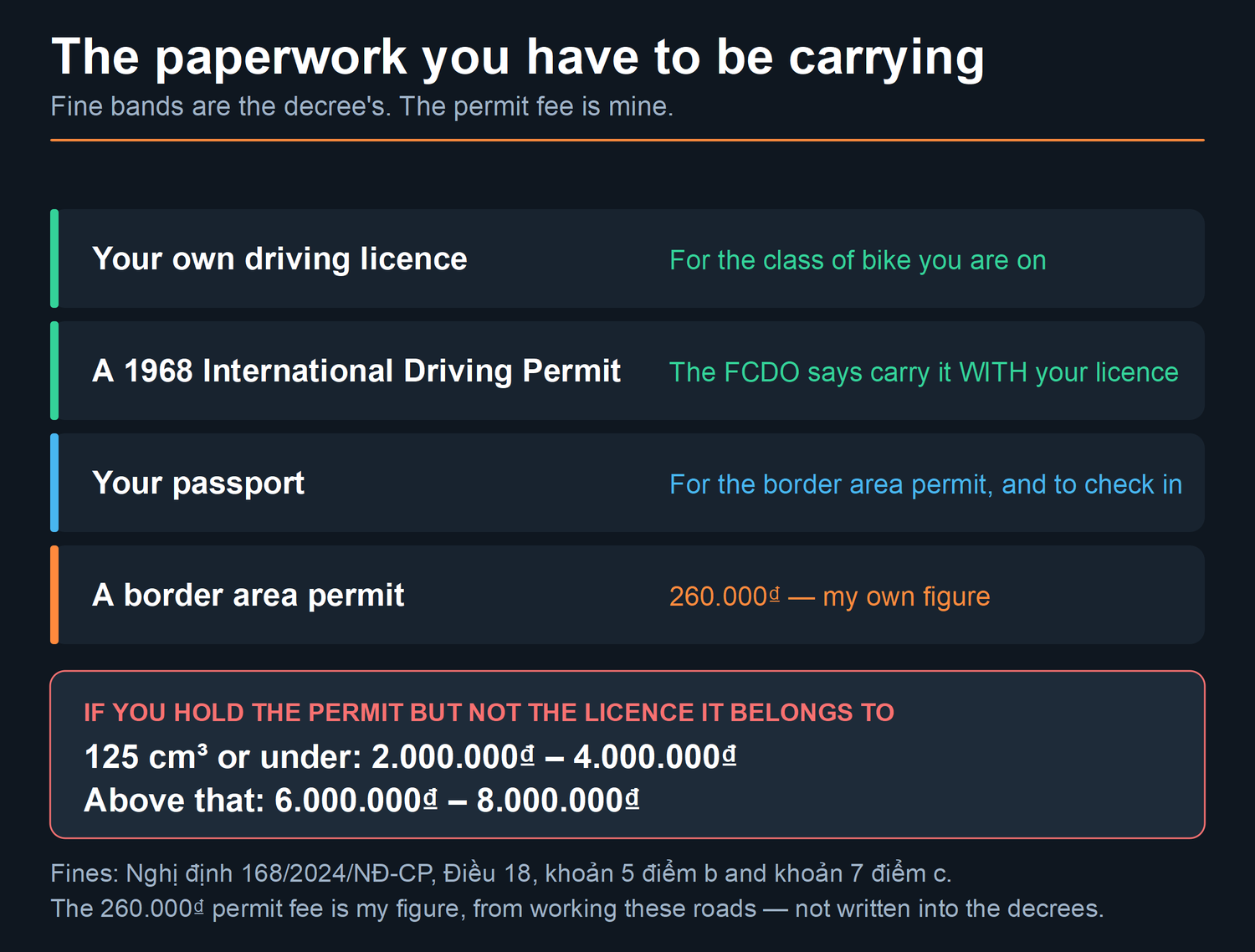
The one that catches people is the pairing. An International Driving Permit is not a licence — it is a translation of one, and it is worth nothing on its own. The UK Foreign, Commonwealth & Development Office puts it plainly: “You’ll need to have both the 1968 version of the international driving permit and your UK driving licence with you whilst driving a car or motorbike in Vietnam.”
Both. With you. Not in the hostel safe in Hanoi.
What happens if you have the permit and not the licence is written down. Under Nghị định 168/2024/NĐ-CP, Điều 18 (read 8 August 2026, server-side fetch), a two-wheeler of 125 cm³ or under, or 11 kW or under, falls in khoản 5 điểm b at 2.000.000₫ to 4.000.000₫. Anything bigger falls in khoản 7 điểm c at 6.000.000₫ to 8.000.000₫, about US$229 to US$305 at the same rate. Almost every bike rented here sits in the first band — my own observation, from working these roads.
Put that next to what the trip costs. My own company publishes a three-day self-ride package at 3.408.000₫, about US$129.85 at 26.246,10₫ to the dollar, read 3 August 2026. The top of the lower fine band is 4.000.000₫. A document you could have carried in a pocket is worth more than the tour.
The fourth paper is the border area permit. The loop road runs into the land border area early — by my own reckoning around Minh Tân, and that is my reading rather than the decree’s. The decree exempts designated tourist, service and economic zones, and you cannot assume Đồng Văn or Mã Pí Lèng is one because it is full of visitors. It costs 260.000₫, about US$9.91 — my figure, from working these roads and selling them. It is not written into the decrees, though a different operator publishes the same 260.000₫ under Tour excludes on its own booking pages, while that operator’s terms page says 250.000₫ — both read 9 August 2026. If you booked through a company, they buy and register it for you. If you did not, you buy it yourself. The full treatment, with the decrees, is in the border permit guide.
Which leads to the least glamorous item on this page. Put every document in a sealed plastic bag. Not a folder, not a pocket — a bag that closes. You will be taking them out at the side of a road in the rain. A passport that has been through one wet morning is one you spend the rest of the trip apologising for.
What is already in the package you booked?
Before this goes further, the thing you should know about me: The package priced below is my own company’s. I am not showing you a competitor’s price and I have not surveyed the market — I use it because its inclusion list is published in full, and I have quoted all eight items of it verbatim below.
It is published at 3.408.000₫ for three days and two nights, bus excluded, with the inclusion list alongside it. Read on 3 August 2026, that list covers a dorm bed, following the group with a local guide, a “new generation semi-automatic motor-bike” — one you change gear on with your foot but with no hand clutch — three breakfasts, three lunches, two dinners, two nights in a homestay — a guest room in a family house — tickets for the sightseeing and the Nho Quế riverboat, something my own list words as “Gasoline cars” without saying whose fuel it means — that wording is ambiguous and I am having it changed — and something it words as “Motorcycle damage insurance”.
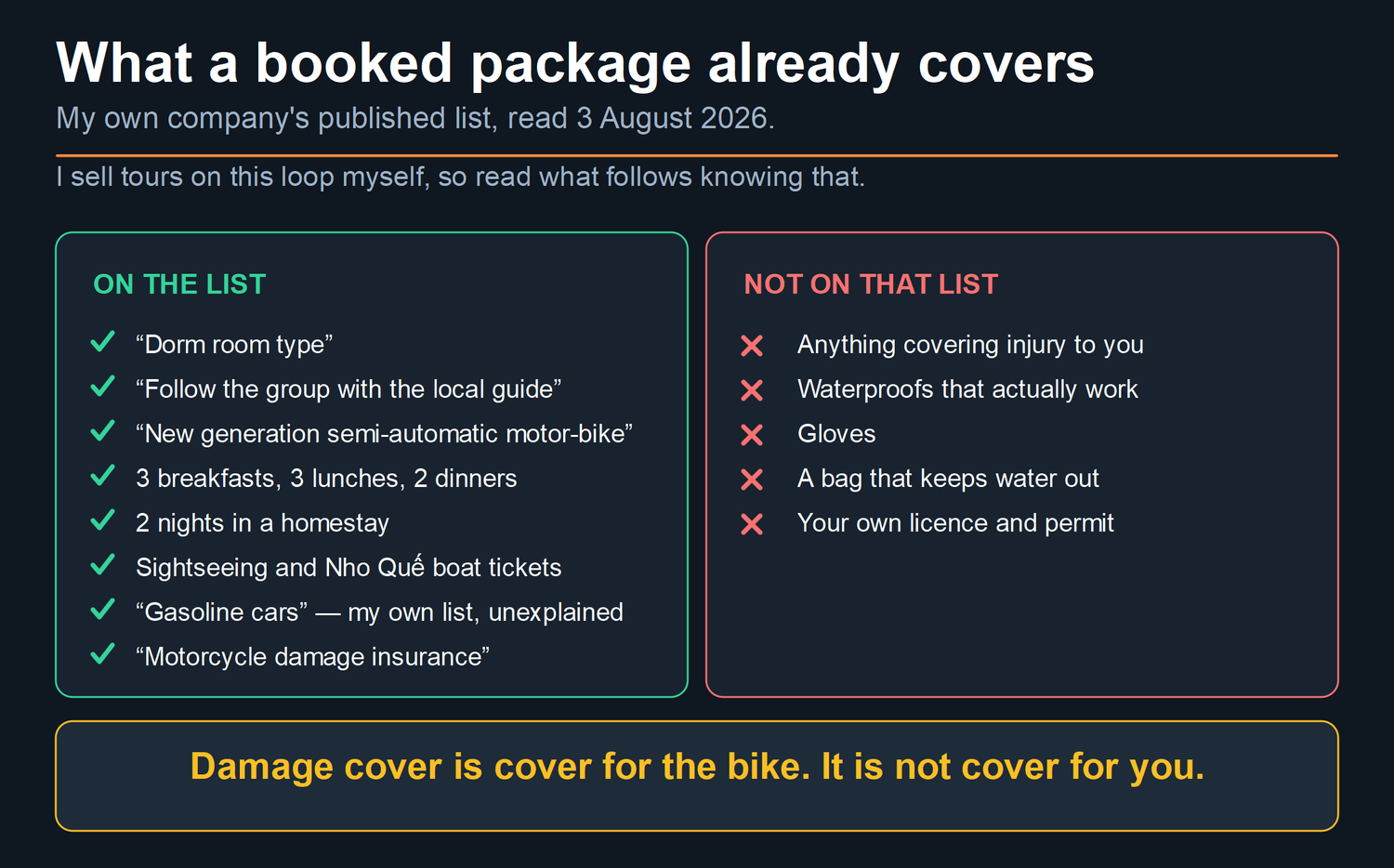
Now read the four words in the middle of that list again. Motorcycle damage insurance. That is cover for the bike. It says nothing whatever about injury to the person riding it, and a traveller who reads “insurance included” and skips their own travel policy has made the most expensive mistake available on this page.
Your own policy is a packing item. Read what it says about motorbikes before you leave, because most of them condition the cover on the same document the decree does. Outbacker Insurance, writing about this loop on their own FAQ, covers a pillion passenger “as long as: The driver has the correct licence for the bike. You wear a helmet”, and for riding yourself they require that “You are licensed in the UK to drive the motorbike, moped, scooter, or assisted bicycle.” The same list also states “There is no cover for Personal Liability” — the cover that pays an injured third party, which is exactly what the FCDO’s compensation warning points at. Read your own policy for that line specifically. That is one insurer’s wording, not a rule for all of them. Yours will have its own, and it is worth twenty minutes.
So the sorting question for this section is simple. Have you actually read your booking’s inclusion list, or are you buying gloves you were going to be handed anyway?
How wet does it actually get?
Wetter than “bring a poncho” suggests, and it depends entirely on when you come.
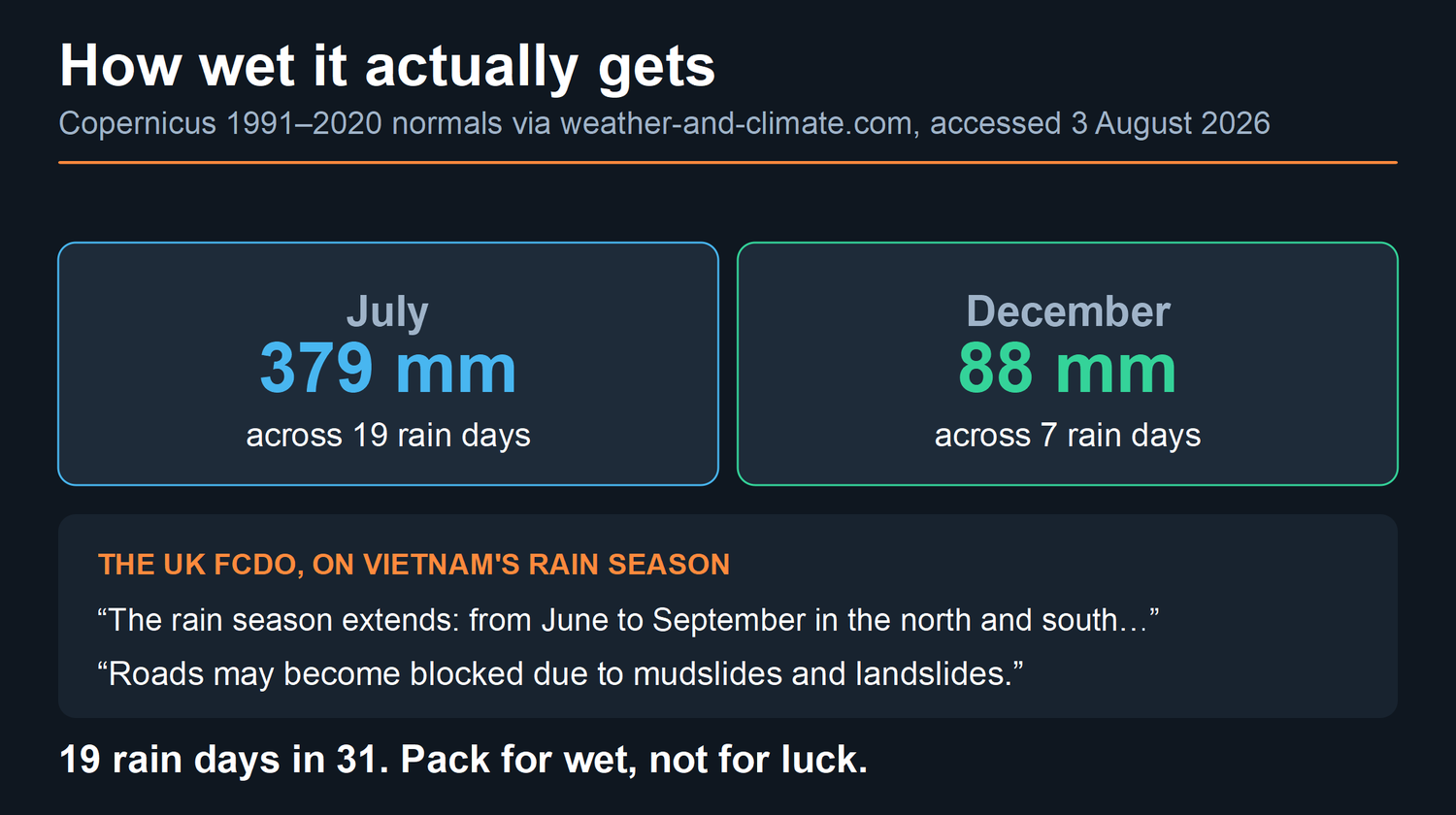
The Copernicus 1991–2020 climate normals put July at 379 mm of rain across 19 rain days, and December at 88 mm across 7. The FCDO gives one window for both halves of the country — “June to September in the north and south” — and adds that “Roads may become blocked due to mudslides and landslides.”
Nineteen rain days in thirty-one is not a risk you hedge with a plastic sheet. It is the weather. Riding between June and September, pack as though you will be wet on at least one day and possibly all of them. Accept too that a road can close in front of you. Which month to choose in the first place is a separate question.
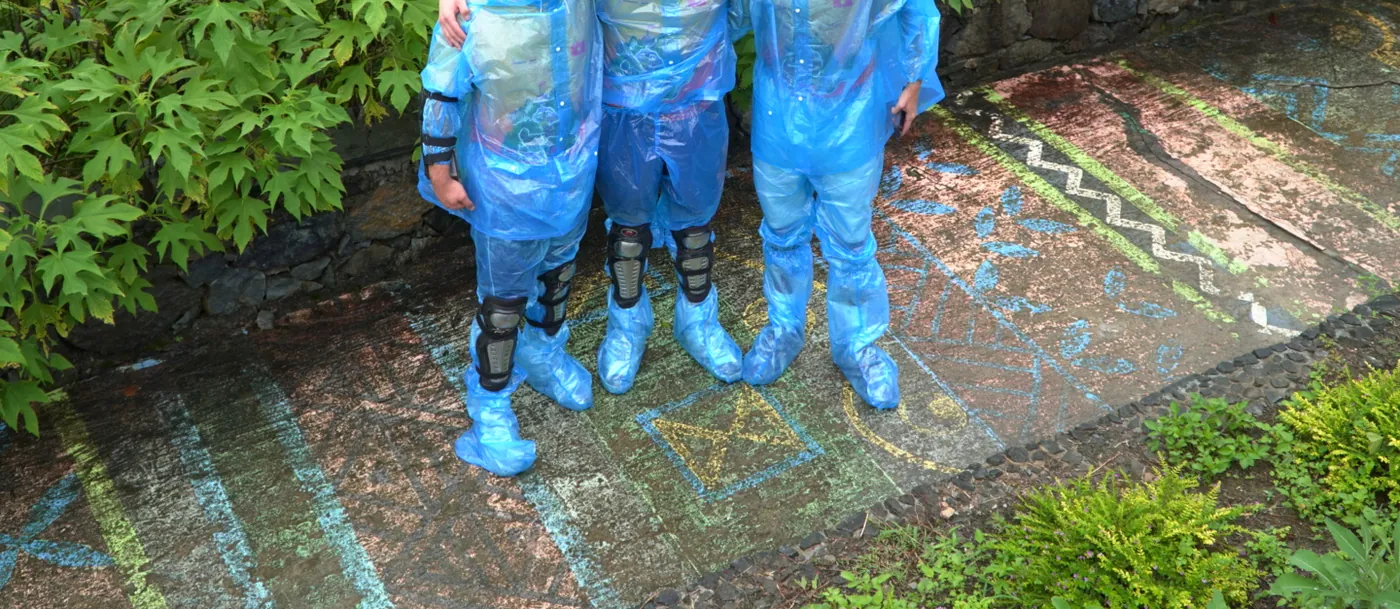
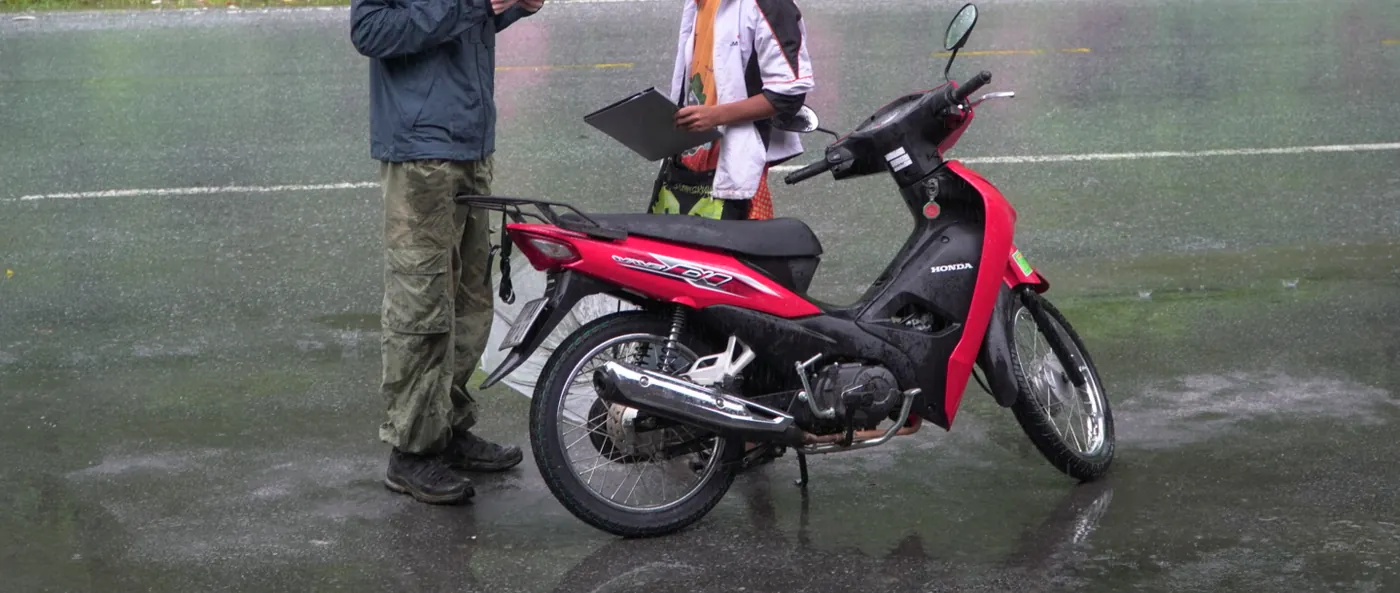
This is what the thin blue rain suit looks like in practice, and it is worth being fair to it: it is cheap, it is light, and for a shower it is fine. What it is not is windproof at road speed for three hours, and it tears on anything it catches. If you own a jacket that genuinely keeps water out, bring it and use the plastic as a spare layer over the top.
What you wear on the bike
The photographs on this page are honest about what people actually turn up in, which is shorts and open sandals.
The helmet is not a preference. The FCDO states that “it is illegal for drivers and passengers to ride without a helmet” in Vietnam, and one will come with the bike. The thing worth doing is putting it on before you agree to it and pushing it side to side. A helmet that rocks on your head is a helmet that will not be there when you need it.
Gloves are the item I would move to the top of every list that leaves them off. Hands go out first. They are also the cheapest insurance on this page, and nothing on my own package list includes them.
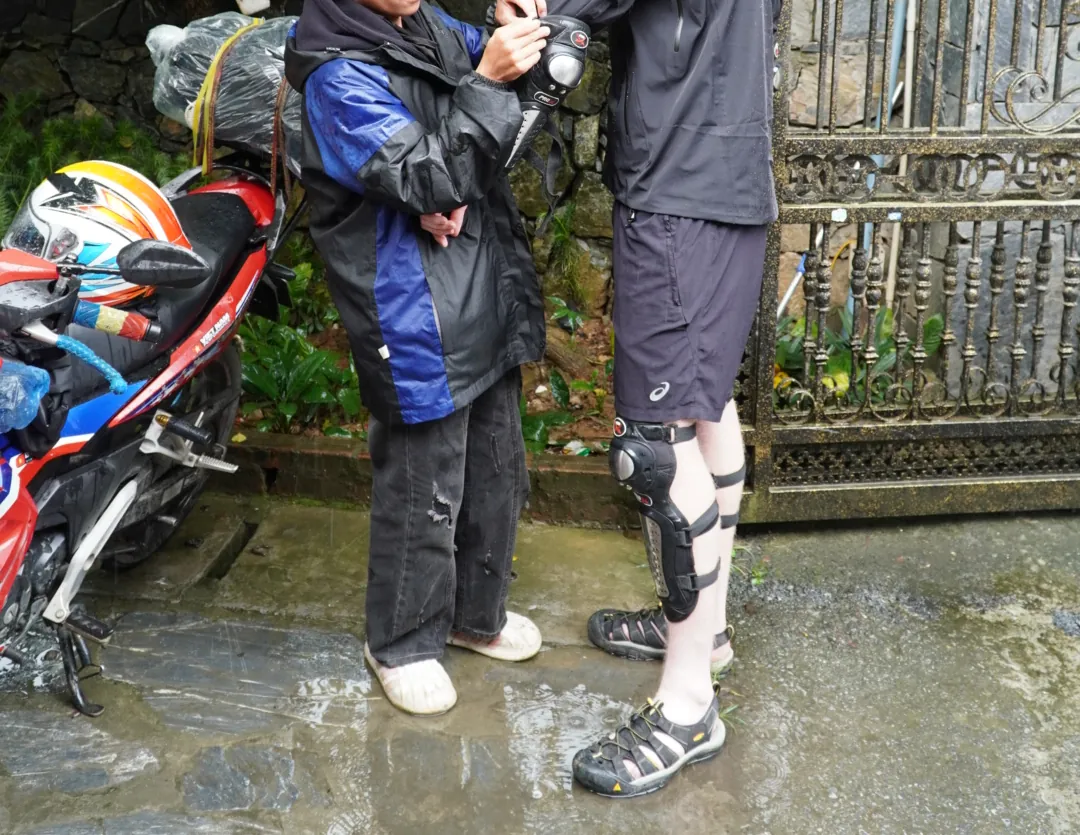
And the sandals. I am not going to pretend that everyone who rides this road in sandals gets hurt, because they do not. But a foot is the part of you closest to the ground, the exhaust sits at calf height, and the difference between the two outcomes is one loose gravel corner. If you own shoes that close, wear the shoes. The same logic covers the rest of you: sleeves and long trousers rather than a t-shirt and shorts, because the exhaust is at calf height and the open stretches between passes get more sun than the photographs suggest. The FCDO’s blunter version of the same point is worth repeating: “Do not hire a motorbike if you’re not an experienced rider.” The riding side of that argument, and what actually goes wrong up here, is its own article.
The two bags
Here is the structural thing almost every list gets wrong. You are not packing a bag. You are packing two, and they have opposite rules.
The first bag rides strapped to the rack behind you, or in the vehicle that follows the group. It holds clothes, toiletries, chargers and one dry set to change into at the homestay. It will be rained on, which is why you see bags wrapped in a plastic sheet on the rack up here. That is not somebody being precious — it is what I see people do, and a bin liner inside your bag does the same job for nothing.
The second bag is small, and it does not leave your body. Documents, cash, phone, water. If it has to stay dry, or has to be reachable without stopping and unstrapping, it goes here.
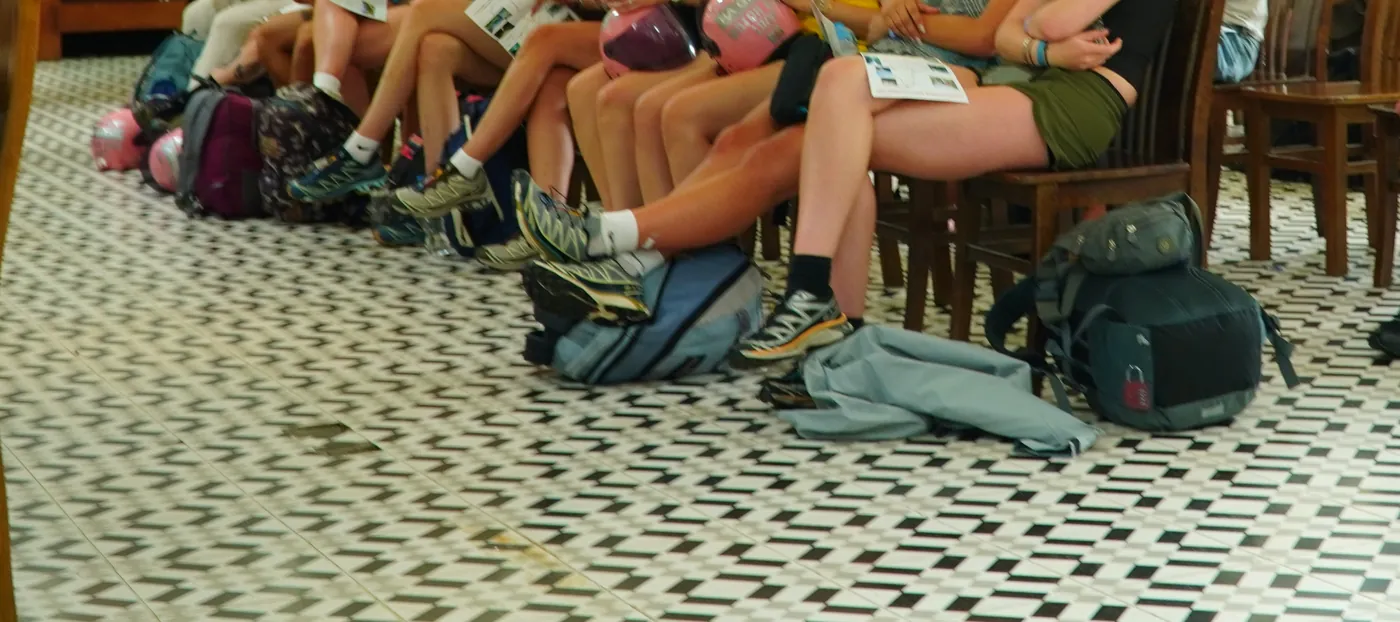
Look at what is on that floor: soft packs and one duffel. Nothing rigid. A hard-shell case does not strap to a rack, and from what I watch get loaded, it will not fit what is left in a support vehicle once eight other people have put theirs in.
Three small things almost every list leaves out. A strip of plasters, antiseptic and any medication you take daily — the pharmacies here are in the towns, not on the passes. An offline map on your phone, because the signal goes on the high sections. And a local SIM if you want data at all, bought before you leave the city.
If you are riding in December or January, add warm layers. The rainfall figures above is a packing input, not a temperature one, and the passes are cold enough in winter that the thin blue rain suit is no longer the whole answer.
How much cash, and in what notes?
More than you expect, in smaller notes than you have.
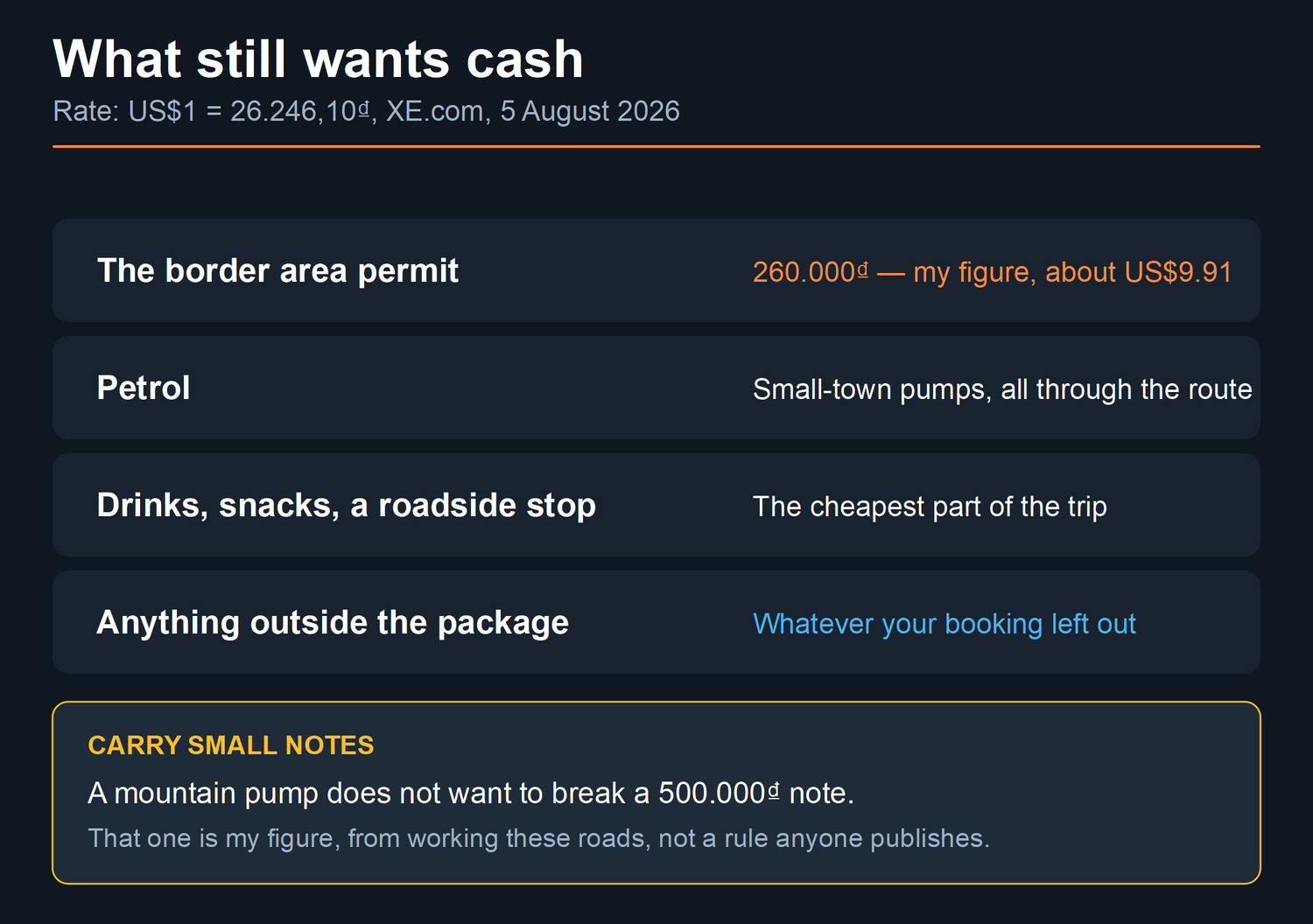
The permit is 260.000₫, about US$9.91 at the same 5 August 2026 rate — again, my figure. Petrol is cash at every small-town pump. Drinks and roadside stops are cash. And whatever your booking left out is cash.
The habit worth forming is small notes. A pump in a mountain town does not want to break a 500.000₫ note first thing in the morning, and that is my own observation from working here rather than a rule anyone publishes. Break your money in Hà Giang before you ride out. On the fuel itself there is one instruction that has not changed in all the years I have been doing this: fill the tank completely in every town that has a station. Not half. The passes drink more than flat road does.
What you can leave in Hanoi
Your hostel will hold a bag, and in my experience most of them do it for nothing.
Leave the hard-shell suitcase, two weeks of clothes for three days of riding, boots you have not walked in, the second camera body, and anything you would be upset to see soaked. The bag rides outside, in the weather, for most of the riding day. Assume everything in it gets wet, pack accordingly, and the whole problem becomes small. How you get yourself and that bag up here in the first place is covered separately.
Common questions
Do I need a dry bag, or will a bin liner do?
A bin liner inside your ordinary bag does most of the work for almost nothing. A proper dry bag is better and worth it if you already own one. What does not work is trusting the bag itself, whatever the label on it says.
Is the blue plastic rain suit enough?
For a shower, yes. For three hours at road speed in July, no — it is not windproof and it tears. Treat it as a layer, not as your rain plan.
Do I have to bring my own helmet?
No. One comes with the bike in my experience, and the FCDO notes that riding without one is illegal in Vietnam for driver and passenger alike. Do put it on and check it does not rock before you accept it.
What do I need to pack for the border permit?
Your passport, and cash. It is 260.000₫, about US$9.91 at 26.246,10₫ to the dollar on 5 August 2026 — my own figure, from selling these permits, and not written into the decrees. If you booked with a company they arrange it; independently, you buy it yourself.
Are you recommending the package you priced above?
No. The package priced above is my own company’s, which is exactly why I am not the person to ask for a verdict on it. I priced it because its inclusion list is published in full and I have quoted every item of it here, and because what that list leaves out is the point of this page. Ask your own operator for theirs in writing, and treat a vague answer as a no.
How much does the whole thing cost once the bag is packed?
That depends on what your package excluded, and it is a longer answer than this page can carry honestly.
Where these numbers come from. The two fine bands are Nghị định 168/2024/NĐ-CP, Điều 18, khoản 5 điểm b and khoản 7 điểm c, read 8 August 2026. The helmet, insurance, permit-and-licence and rain-season quotes are the UK FCDO’s own wording, read 5 August 2026. The rainfall figures are Copernicus 1991–2020 normals via weather-and-climate.com, read 3 August 2026 — thirty-year averages, not a forecast for your week. The package price and inclusion list come off my own company’s published page, read 3 August 2026. The insurance wording is Outbacker’s own FAQ, read 3 August 2026, and applies to their policy and no one else’s. US dollar figures use 26.246,10₫ to the dollar, XE.com, 5 August 2026.
The numbers that are mine rather than a source’s: the 260.000₫ permit fee, the roughly eight-hour riding day, and how long the blue plastic lasts. They are my own, from working these roads; the permit fee is not written into the decrees, though a different operator publishes the same figure on its own booking pages. So is the small-notes habit. They are approximations from experience, not measurements.
This page is not legal or insurance advice. It carries no first-hand price receipts for gear, because I hold none. Dated prices actually paid are what I am building toward; this is not yet that page.