You came here looking for a number. How many people die on the Ha Giang Loop, per year, out of how many riders.
I have to tell you up front that the number does not exist.
Not “I couldn’t find it”. It is not published. When Vietnamese police prosecuted the driver in the crash that killed a British teenager this March, the official report carried no figure for accidents or deaths on this route.
There is no central registry of tourist fatalities here. Every article you will read that implies a rate is implying something nobody actually counts.
So this page does something different. Instead of a statistic I cannot honestly give you, I’ll tell you where the risk on this road actually concentrates, what you can control, and what you cannot.
The short version
- There is no official death rate for the Ha Giang Loop. No agency publishes one. Treat any specific figure you see as unsourced.
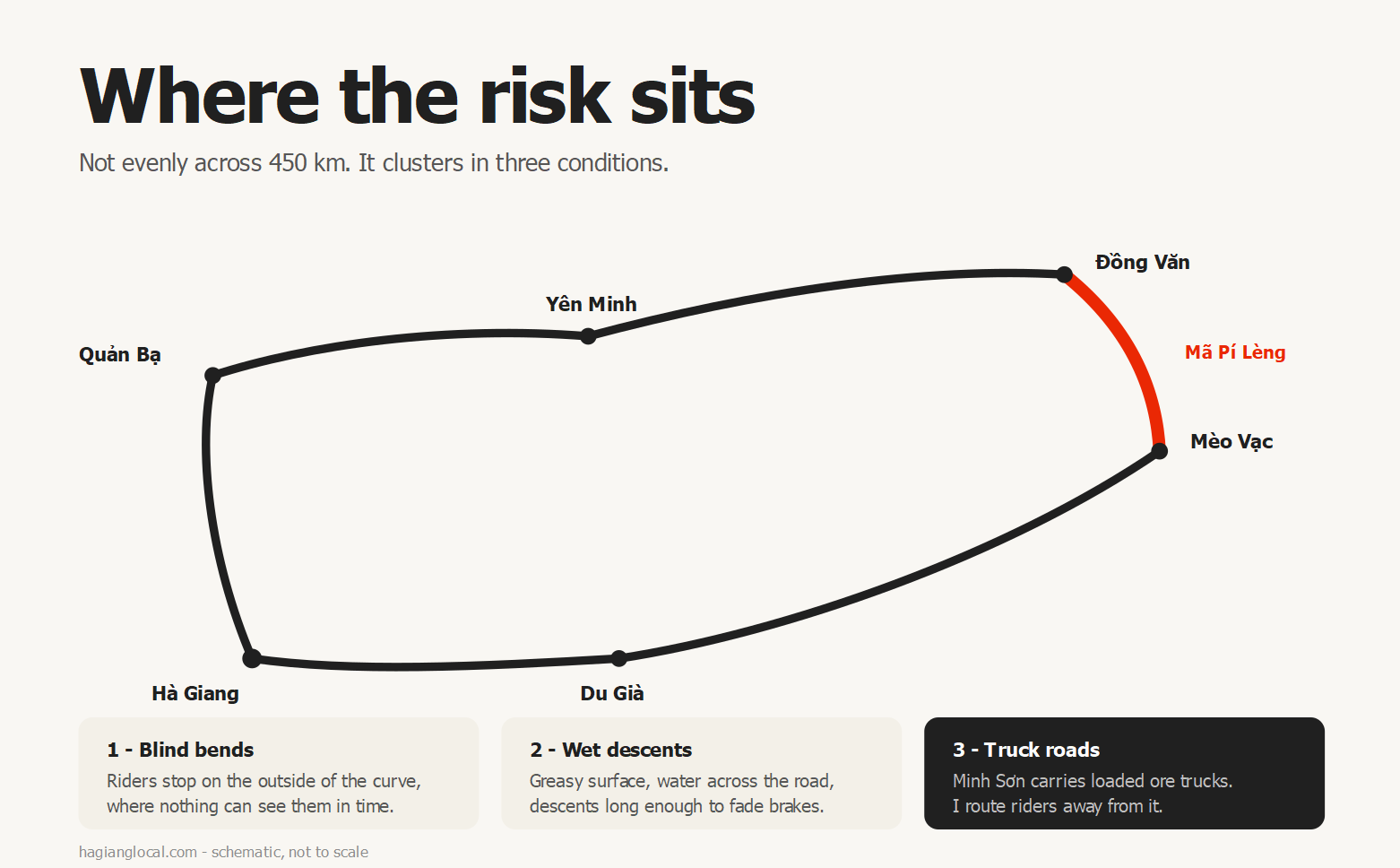
- Risk here is not evenly spread. It concentrates in a small number of conditions: blind bends, wet descents, and roads carrying heavy trucks.
- An easy rider is not a safety guarantee. The crash that put this route in the news in 2026 involved a passenger on the back of a bike, not a self-driver.
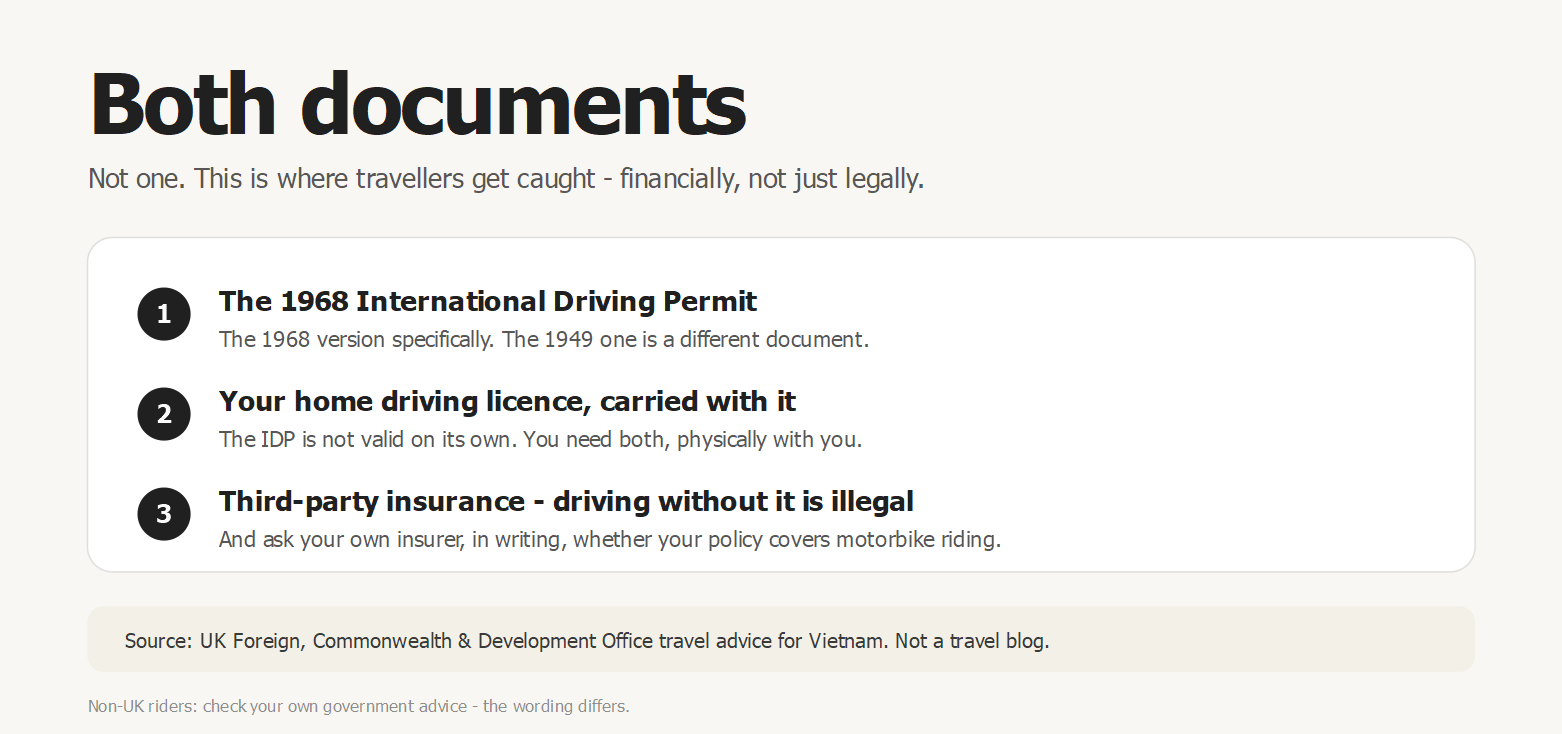
- The licence rule is stricter than most people think. The UK government says you need the 1968 international driving permit and your home licence — both.
- The most useful thing you can do is decide in advance what happens if something goes wrong. Almost nobody plans this part.
Why is there no Ha Giang Loop death rate?
Because nobody counts it in a way that could produce one.
A death rate needs two numbers: how many people died, and how many people rode. Neither is collected. Vietnam does not publish tourist-specific road fatality figures by route.
Nobody counts how many riders pass through Hà Giang in a year — riders arrive by night bus, rent from dozens of small shops, and leave. There is no gate, no permit, no register.
What exists instead is a scatter of individual cases, reported when the person who died was foreign enough to make the news at home. That is a reporting pattern, not a measurement.
I’m telling you this because the alternative — repeating a number I can’t stand behind — is how most of the pages on this subject are written.
What you can use instead. Britain’s Foreign Office puts it plainly, and this is a primary source rather than a travel blog: “Travelling by motorbike in Vietnam is much riskier than in the UK. Motorbike accidents are common and have killed and injured British nationals.” That is a real institutional judgement without a fake number attached to it.
It is the honest shape of what is known.
What actually happened in 2026?
In March 2026 a nineteen-year-old British traveller was riding as a passenger on the back of a motorbike on QL4C when the rider she was with struck the motorbike in front, then collided with an oncoming lorry.
She died of her injuries. Her family donated her organs.
I’m not going to use her name or her photograph on this page. She was a person, not a case study, and her family did not agree to have her death turned into a traffic source.
What is worth taking from it — and this is the part I think matters — is what the official account actually says.
According to the Investigation Police Agency of Tuyên Quang Provincial Police, who prosecuted the driver under Article 260 of the Penal Code, the driver “failed to pay sufficient attention to the road and did not maintain a safe distance from a motorbike travelling ahead in the same direction.”
Read that again. Not a landslide. Not a cliff. Not fog, not a hairpin, not the famous pass.
Following too close.
That is the most ordinary cause of a road accident there is, and it is one that happens on a straight, wide, sealed section of QL4C as easily as anywhere. The road did not kill her. The gap did.
Was she driving? No. And that matters.
She was on the back.
I want to be careful here, because this cuts against advice I give elsewhere on this site, including on my own route map: if you have never ridden a manual bike, take an easy rider. I still think that’s right for most people.
But “right for most people” is not the same as safe, and I’m not going to let you leave this page thinking it is.
Two of the eight things people search alongside this topic are specifically about whether easy riders are dangerous. People are asking because they sensed the gap in the usual advice.
Here is the honest version. Getting on the back of a bike moves the risk. It does not remove it.
You stop being responsible for the throttle and you start being entirely dependent on someone else’s judgement, someone else’s brakes, and someone else’s decision about how close to follow the vehicle in front.
You gain their experience of the road. You lose all your own control.
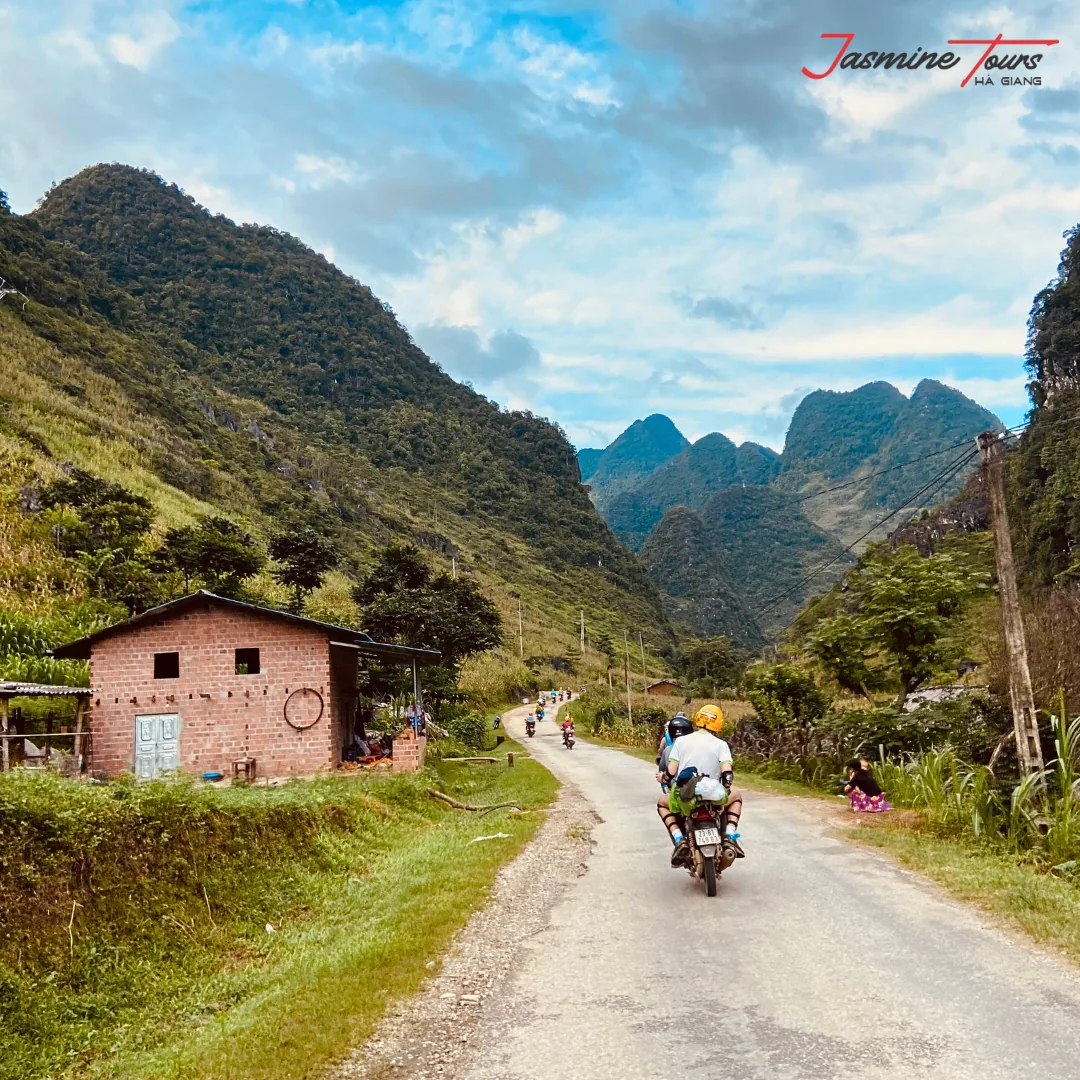
Whether that is a good trade depends almost entirely on who is riding — which is why the section further down on what to ask an operator is the most practical thing on this page.
And there is a limit to how far any of this reasoning goes. An accident is an accident. On a road, with other vehicles, nobody is ever at a hundred per cent — not the most careful rider, not the most experienced driver.
What you are choosing between is never safe versus unsafe. It is different distributions of a risk you cannot get to zero.
Where does the risk actually concentrate?
This is the part I can tell you that a news report cannot, because it comes from being on these roads rather than reading about them.
The danger on this loop is not spread evenly across 450 kilometres. It clusters.
Blind bends, and where people stop
The single most common dangerous thing I see riders do is stop in the wrong place.
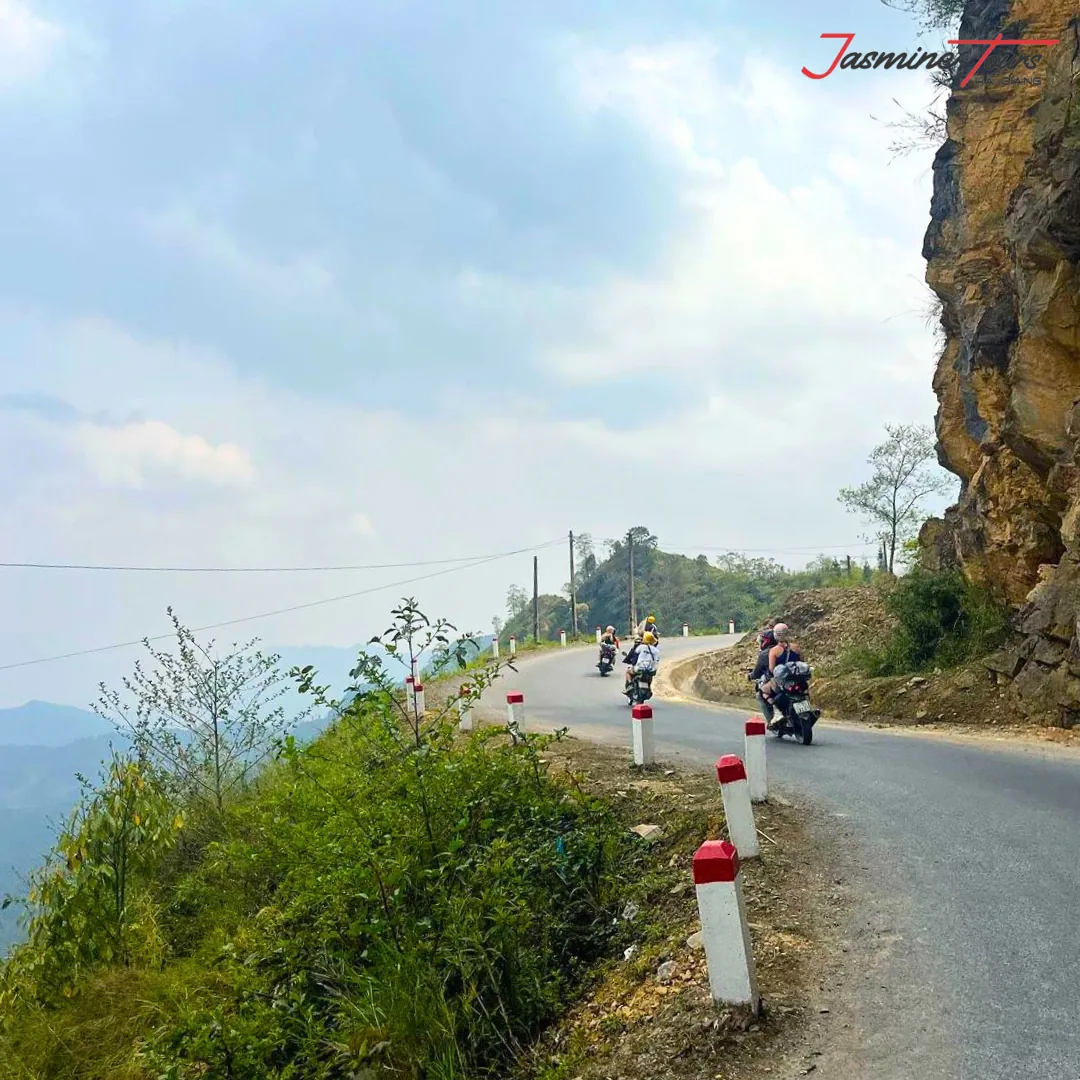
On Mã Pí Lèng, and on a dozen smaller passes, the best view is almost always on the outside of a bend — the side with the drop. So that is where people pull over.
Half on the tarmac, on the outside of a curve, at the exact point where nothing coming the other way can see them until it’s too late to do anything.
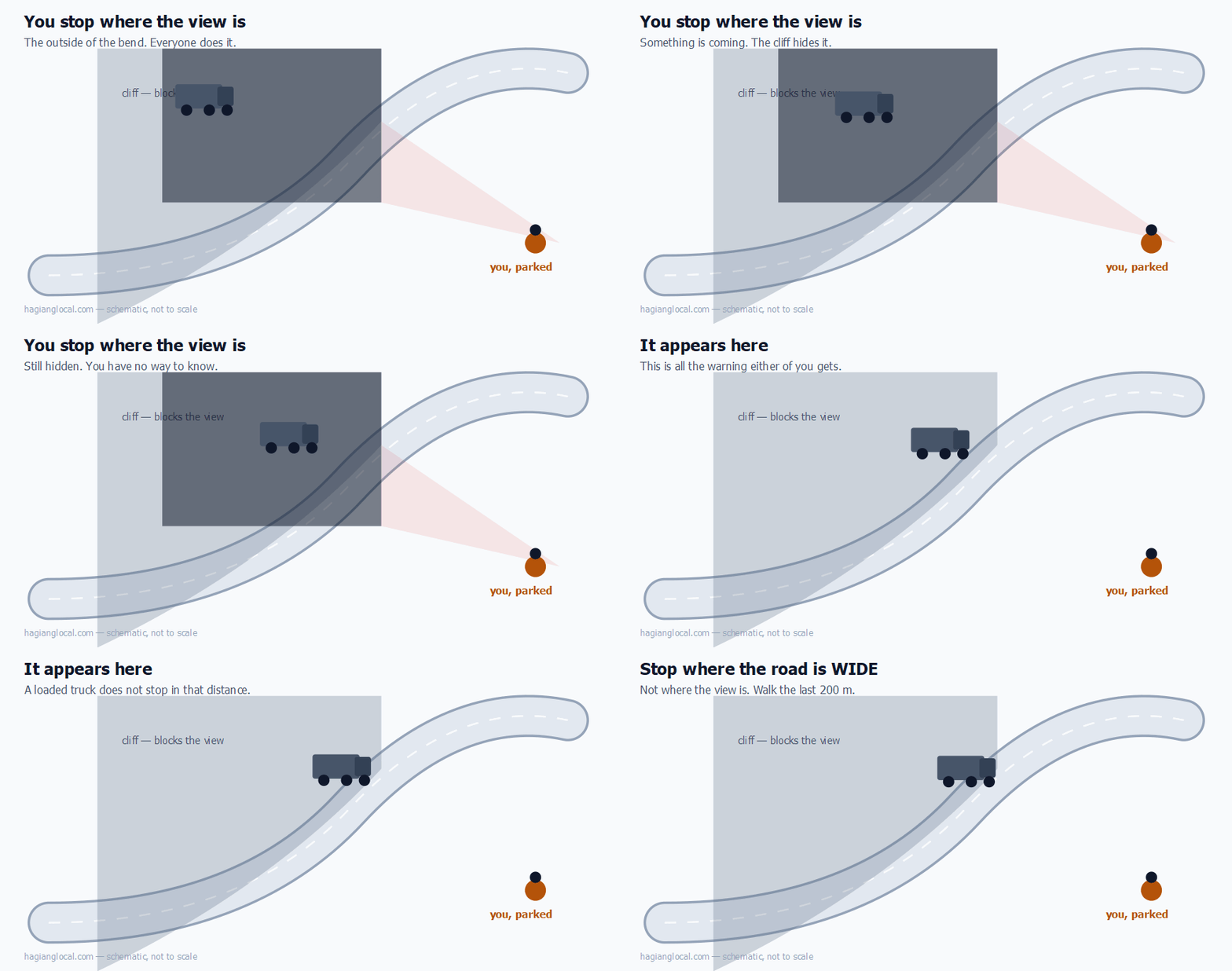
The rule that costs you nothing: stop where the road is wide, not where the view is best. Get both wheels off the tarmac. Then walk back the two hundred metres to the view. You will lose four minutes and a slightly worse angle.
Wet descents
Rain changes this road more than it changes most roads. The surface goes greasy, the drainage runs across the tarmac rather than beside it, and the descents are long enough that brakes fade.
Most riders’ instinct on a wet descent is to brake harder. That is the wrong instinct.
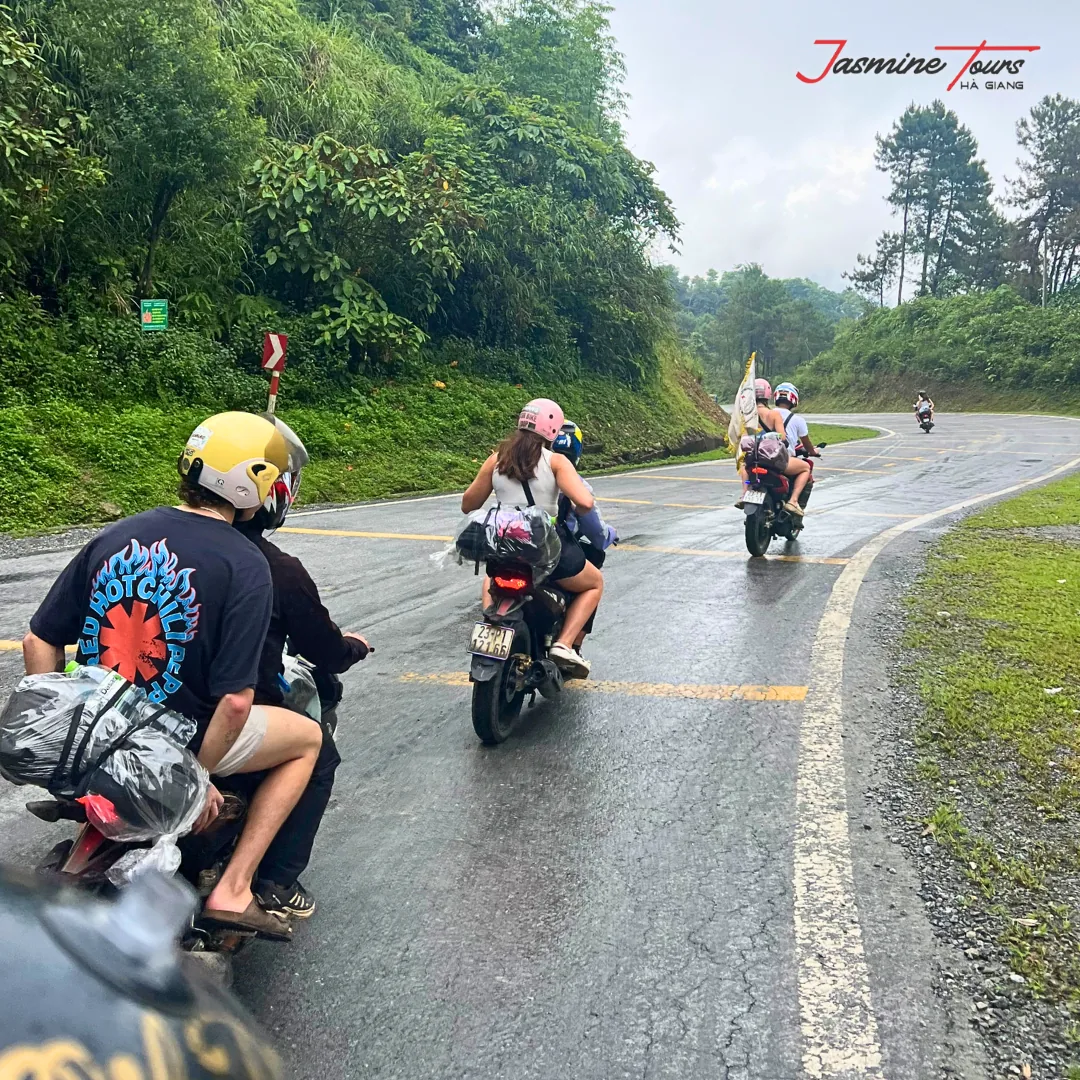
If it starts raining hard on a pass, the answer is usually to stop and wait it out under a roof. Rain here rarely lasts all day.
Roads with heavy trucks
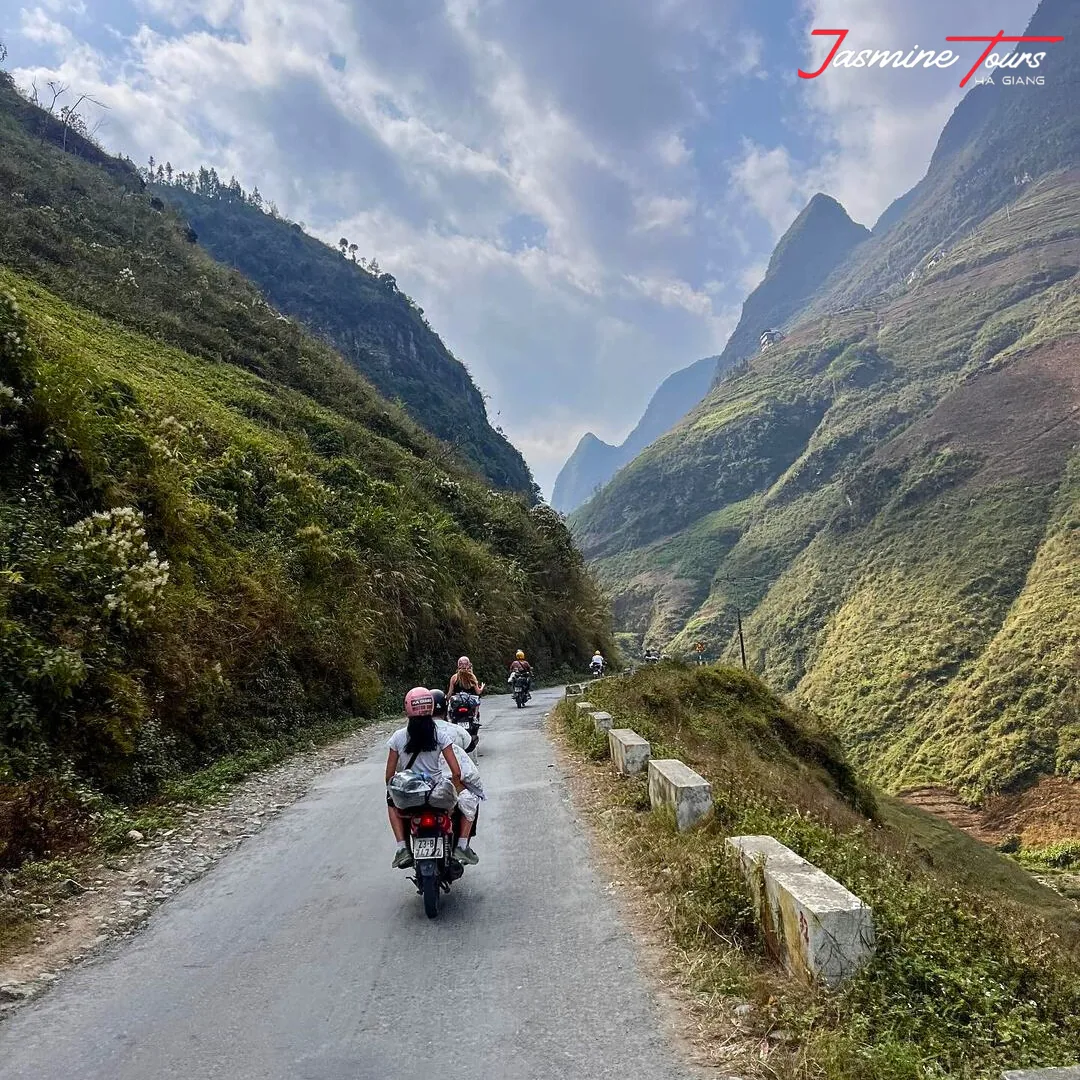
Not all roads on this loop carry the same traffic. The Minh Sơn road, which some riders take as a short way home from Du Già, carries heavy iron-ore trucks.
I have watched those trucks run that road hard, and it is the reason I do not send riders down it when there is another option.
I have no accident figures for it and I’m not going to invent any — but a loaded ore truck on a narrow repaired road is a different proposition from a scooter.
The hours
Late afternoon is worse than morning. The light goes flat, the temperature drops, people are tired, and on a four-day itinerary the last leg is usually the longest.
If you are running late, the correct response is to stop somewhere and finish tomorrow — not to ride faster.
What can you control, and what can’t you?
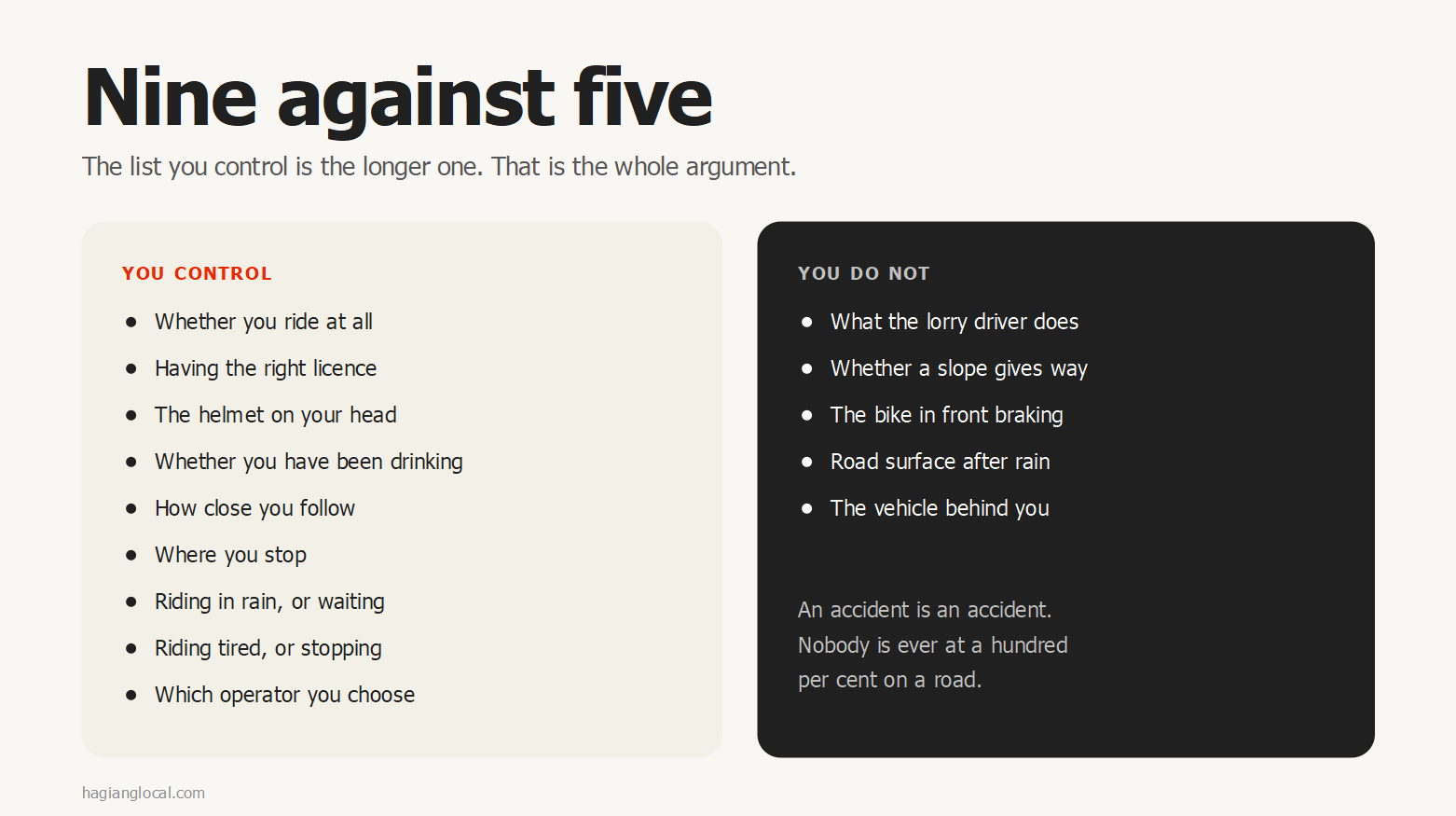
You control: whether you ride at all · whether you have the right licence · what helmet is on your head · whether you have been drinking · how close you follow · where you stop · whether you ride in the rain · whether you ride tired · which operator you hand your safety to.
You do not control: what the lorry driver does · whether a slope gives way · whether the bike in front brakes suddenly · road surface after rain · what the vehicle behind you is doing.
The list on the left is longer than most people expect. That is genuinely good news.
It is also the whole argument of this page: you can’t make this risk zero, and you can make it much smaller, and the difference between the two is mostly decisions you make before you start the engine.
Do you need a licence to ride it?
This is where I see travellers get caught, and it is not a safety point so much as a financial one.
The UK Foreign Office is explicit: “You’ll need to have both the 1968 version of the international driving permit and your UK driving licence with you whilst driving a car or motorbike in Vietnam.” Both documents. Not one.
The same page states that “it is illegal to drive without third-party insurance” and advises travellers to “make sure your travel insurance covers your planned activity.”
Read that last line carefully, because it is doing quiet work. A lot of travel policies exclude motorbike riding, or exclude it above a certain engine size, or exclude it if you do not hold the correct licence for the vehicle at home.
That is a question for your insurer before you leave, in writing, not a question for a rental shop in Hà Giang. Nobody at the shop will ask to see your licence. Your insurer will ask afterwards.
If you are not from the UK, check your own government’s travel advice — the licence rules are broadly similar across countries, but the wording matters and yours will be specific.
What should you ask before booking an easy rider?
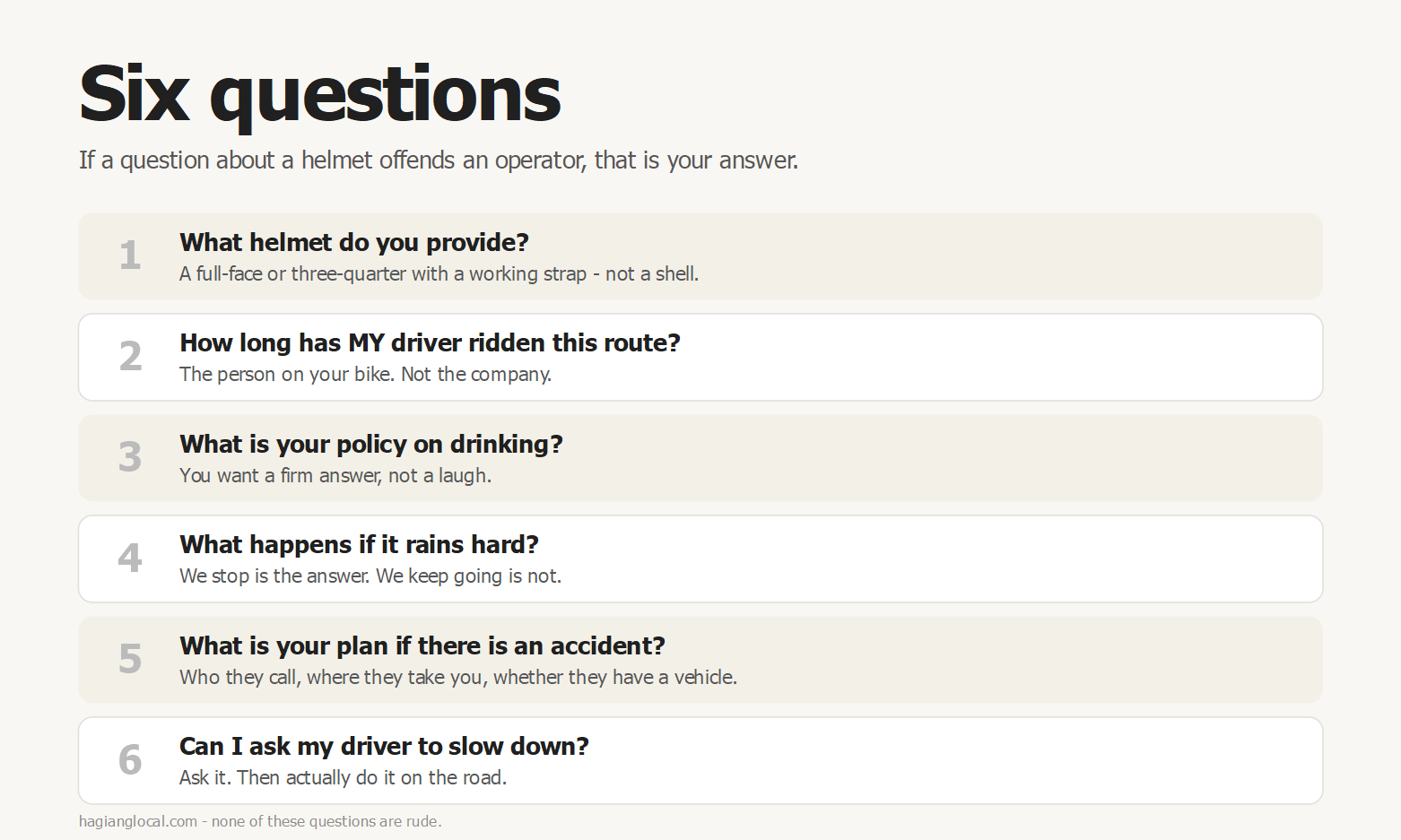
If you are handing your safety to a driver, these are the questions worth asking. Any operator worth riding with will answer them without getting defensive.
- What helmet do you provide? A proper full-face or a three-quarter with a working strap, not a plastic shell. If they can’t describe it, assume it is a shell.
- How long has my specific driver been riding this route? Not the company. The person on your bike.
- What is your policy on drinking? Evenings at homestays on this loop involve a lot of rice wine. You want a firm answer, not a laugh.
- What happens if it rains hard? The answer you want is “we stop” or “we adjust the day”. The answer you don’t want is “we keep going”.
- What is your plan if there is an accident? Who do they call, where do they take you, do they have a vehicle. Vagueness here tells you something.
- Can I ask my driver to slow down? Obvious, but ask it — and then actually do it on the road if you need to. You are allowed. It is your ride.
None of these questions are rude. If a question about a helmet offends an operator, that’s your answer.
What do you do if something happens?
Almost nothing written about this route covers this part, which I’ve never understood, because it is the part you will need under pressure.
Decide before you go. Write down, on paper, in your bag: your insurer’s 24-hour emergency line, your policy number, and your blood type if you know it. Your phone may be broken or lost in exactly the situation where you need those.
Your homestay and your driver are your first line. They know which vehicle to get, which road is open and who to call locally.
This is not a route where you should expect to manage an emergency in English on your own. It is also, honestly, the strongest argument for going with local people rather than alone.
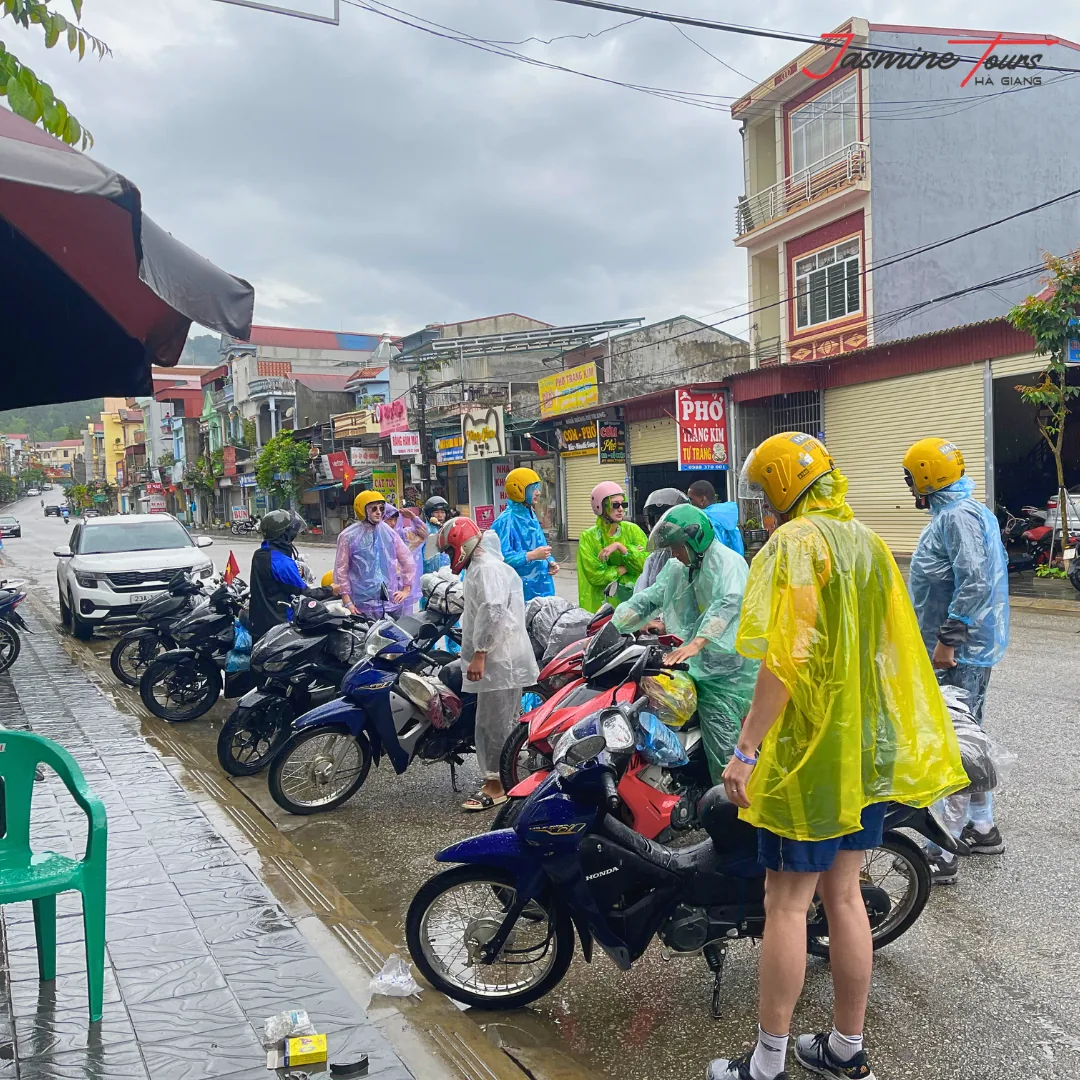
Serious injuries go to Hà Giang city, and from there to Hanoi. That is a long way.
It is the main reason I route riders home from Du Già along Đường Thượng rather than the short Minh Sơn road: if a bike breaks or someone comes off, help can reach you on that road. Some of the shortcuts, you’re on your own for a long time.
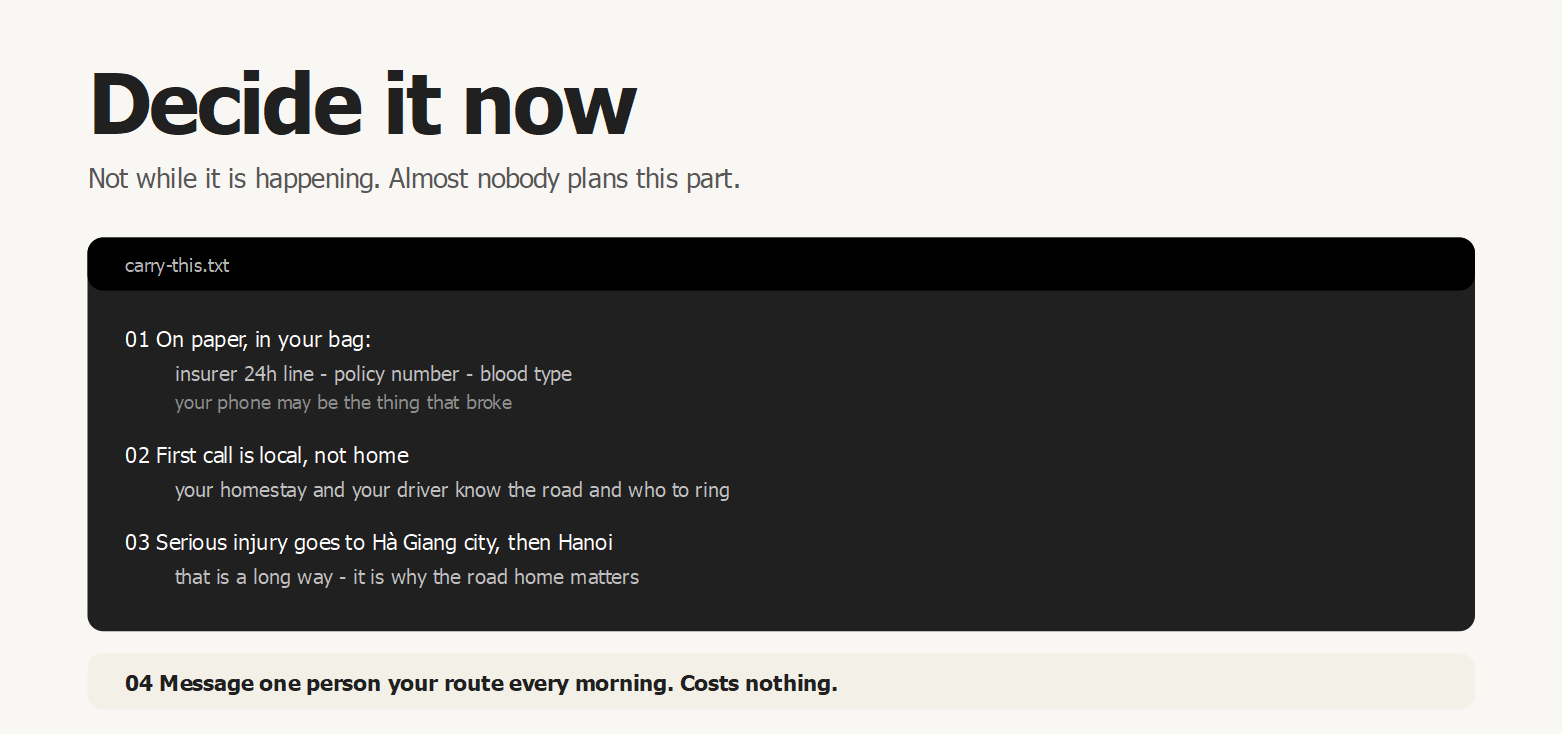
Tell someone your route each morning. One message to one person: where you are going, which way, when you expect to arrive. Costs nothing, and it’s the difference between somebody knowing where to look and nobody knowing.
So — should you ride it?
Is it dangerous? Yes — more than the roads you learned on, and less than the internet suggests. It is a narrow two-lane mountain road with long descents, weather that changes the surface, and no ambulance within an hour of most of it. What it is not is a road that catches people at random. The risk on it is concentrated, and almost all of the concentrated part is a decision somebody made before they set off.
I’m not going to tell you yes or no. I place stops on this route for a living and I’m not able to make that decision for a stranger.
What I can give you is the question that actually sorts people, which is not “is it dangerous” but this:
If something goes wrong on this road, is there a plan?
If you have the right licence, insurance that genuinely covers you, a helmet that is a helmet, an operator who answered those six questions properly, and someone who knows your route today — you’ve made this about as small as it gets, and it’s a ride worth doing.
If three of those are missing, the honest answer is not “be careful”. It is that you are relying on nothing going wrong, on a road where things sometimes do.
Common questions
How many people die on the Ha Giang Loop each year?
Nobody publishes that figure. There is no central registry of tourist fatalities on this route, and the official report on the most widely covered recent case contained no accident or death statistics for it. Any specific number you see is unsourced.
Is the Ha Giang Loop dangerous with an easy rider?
It moves the risk rather than removing it. You gain a driver who knows the road; you lose your own control over speed and following distance.
The most widely reported recent fatality involved a passenger, not a self-driver. Who is riding matters more than whether you are on the back.
Is the Ha Giang Loop dangerous?
Yes, more than the roads most riders learned on — a narrow two-lane mountain road, long descents, weather that changes the surface, and no ambulance within an hour of most of it. It is not dangerous at random, though. The risk concentrates in a small number of places and decisions, and this page is about which ones.
How risky is the Ha Giang Loop?
Nobody can answer that with a rate, because no rate is published — there is no central registry of tourist casualties here, and the section at the top of this page explains what that means for every figure you will see quoted. What can be answered is where the risk sits and how much of it is inside your control, which is most of it.
Is the Ha Giang Loop safe for beginners?
Riding it yourself as a first experience of a manual or semi-automatic bike is the single decision that turns a manageable road into an unmanageable one. Sitting behind a local driver removes that decision entirely, and it is the reason the pillion product exists.
What is the most dangerous part of the Ha Giang Loop?
Not one place. Risk concentrates in conditions: blind bends where people stop badly, wet descents, and roads with heavy truck traffic. The reported cause in the 2026 case was following too close — which can happen anywhere on the route.
Do I need a licence to ride the Ha Giang Loop?
The UK government states you need both the 1968 international driving permit and your home driving licence, and that driving without third-party insurance is illegal.
Check your own country’s advice, and check with your insurer in writing that your policy covers motorbike riding.
Should I still go?
That is yours to decide. The question worth answering first is whether there is a plan if something goes wrong — licence, insurance, helmet, a competent operator, and someone who knows your route.
A note on this page. I haven’t put a booking link on it, and I’m not going to. I place stops on this route and I have commercial relationships in this industry, and a page about people dying is not a place to use either of those.
Where a figure here comes from somewhere official, it is linked. Where something is my own judgement from working these roads, I have said so.
The photographs were taken on our own trips — our logo is visible on each one — and each caption carries its own date.