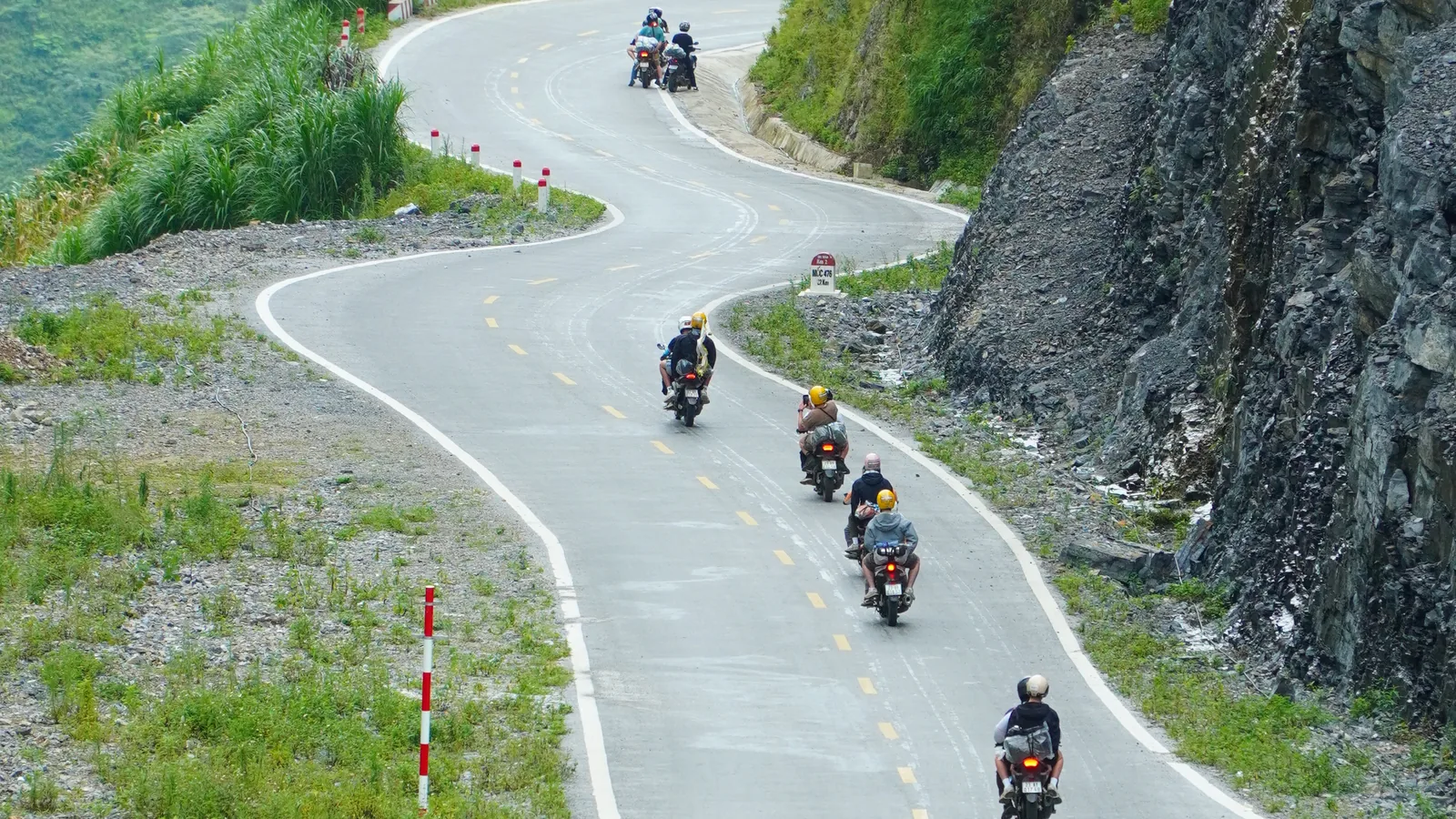
Bikes strung out on new tarmac. What I watch a shop around Hà Giang hand a self-driving customer is usually a semi-automatic — gears, no clutch lever — and one operator’s list puts it at 110cc, the small side of the 125 cm³ line the penalty schedule turns on.
For most of the riders I watch, the shop examined a home licence and stopped there — not what the legislation requires, and that gap is this page.
The law is specific about what it punishes, and the commonest failure is priced to the đồng: 2.000.000₫ to 4.000.000₫ on a machine that size. Nothing you meet on the road will tell you so.
The short version
- Two documents, not one. An International Driving Permit is worth nothing without your national licence beside it; the offence is defined by the missing one.
- Get the 1968 permit — the one Vietnamese law names. Vietnam acceded on 20 August 2014 per the UN depositary record. This page does not resolve whether the 1949 one still binds.
- Your licence has to cover motorbikes. An IDP translates what you hold; it cannot add a category you never earned.
- On that 110cc machine the fine is 2.000.000₫ to 4.000.000₫ (about US$76 to US$152 at 26.287,25₫ to the dollar on 3 August 2026) — the clause for a two-wheeler of 125 cm³ or less. The 8–10 million figure you see quoted is the car clause.
- The rulebook was amended on 15 August 2026 and these lines weren’t in it. I read the amending decree article by article before it landed.
- This is not the border permit. Different document, different law, different page — and people arrive having confused them.
Do you need an International Driving Permit in Vietnam?

If you are riding yourself: carry both, in the same pocket — that is what the FCDO tells its nationals and what the Vietnamese decree prices the failure of, although no instrument I located states the obligation in so many words.
The British Foreign, Commonwealth & Development Office states it for its own nationals in one sentence:
“You’ll need to have both the 1968 version of the international driving permit and your UK driving licence with you whilst driving a car or motorbike in Vietnam.”
Read 3 August 2026. If you aren’t British that sentence isn’t addressed to you, but the Vietnamese legislation underneath it is, and it delivers the same requirement harder — describing not the obligation but the punishment.
Nothing here grants a visitor the right to ride: every clause I quote from the penalty decree assumes the entitlement and punishes the documentary gap. I searched for the enabling instrument and found none I’d cite — that finding is mine, not a source’s.
The clause, from Nghị định 168/2024/NĐ-CP, Điều 18 khoản 5 — its opening sentence, then điểm b, read 4 August 2026:
“5. Phạt tiền từ 2.000.000 đồng đến 4.000.000 đồng đối với người điều khiển xe mô tô hai bánh có dung tích xi-lanh đến 125 cm3 hoặc có công suất động cơ điện đến 11 kW và các loại xe tương tự xe mô tô thực hiện một trong các hành vi vi phạm sau đây: … b) Có giấy phép lái xe quốc tế do các nước tham gia Công ước của Liên hợp quốc về Giao thông đường bộ năm 1968 cấp (trừ giấy phép lái xe quốc tế do Việt Nam cấp) nhưng không mang theo giấy phép lái xe quốc gia phù hợp với loại xe được phép điều khiển;”
The ellipsis stands for điểm a alone. điểm c follows điểm b and is not quoted; nothing is elided inside điểm b.
In English, my translation rather than an official one: 2.000.000₫ to 4.000.000₫ for the rider of a two-wheeler up to 125 cm³ or 11 kW holding a 1968-convention international permit — other than a Vietnamese-issued one — but not carrying the national licence matching the class you may drive.
It has to be the 1968 one, and the year is the whole point
Two conventions are in circulation, producing two booklets: Geneva 1949 and Vienna 1968. Every Vietnamese clause here names the same one — Công ước của Liên hợp quốc về Giao thông đường bộ năm 1968 — and the FCDO names the year for that reason.
Vietnam’s position is on the record. The UN depositary status list records the 1968 Convention at 20 August 2014 as an accession, with a reservation declining Article 52 and VN as its vehicle sign. Read 4 August 2026.
One thing I am deliberately not going to resolve for you. The depositary’s list for the 1949 convention also carries a Vietnam row, dated 2 November 1953, and that page’s own footnote attributes the accession to “The Republic of Viet-Nam” — a state that no longer exists. Whether that binds today’s Socialist Republic is state succession, and I found no source I would stand behind either way. Get the 1968 one. Vietnamese law names it and the question never arises. Both links open the depositary’s status page, not the conventions.
What is an IDP actually, and what is it not?
An IDP — International Driving Permit — is a translation. That distinction saves travellers money.
It restates the categories already on your licence in a standard multilingual booklet; it doesn’t examine you, add a category, or work on its own.
Look again: “phù hợp với loại xe được phép điều khiển” — matching the category you may drive. The question is not whether you hold a licence but whether it covers this.
A second, smaller trap, catching Vietnamese riders. Thông tư 12/2025/TT-BCA, in force since 1 March 2025, says at Điều 29:
“1. IDP do Việt Nam cấp theo Công ước về giao thông đường bộ năm 1968 không có giá trị sử dụng trong lãnh thổ Việt Nam. 2. IDP được công nhận theo điều ước quốc tế mà nước Cộng hòa xã hội chủ nghĩa Việt Nam là thành viên sẽ được thực hiện theo điều ước quốc tế đó.”
An IDP issued by Vietnam has no force inside Vietnam; one recognised under a treaty Vietnam has joined is governed by that treaty. Which matters beyond trivia: the circular never spells your obligation out. It hands you back to the convention, and the decree does the rest.
What does it cost you to get this wrong?
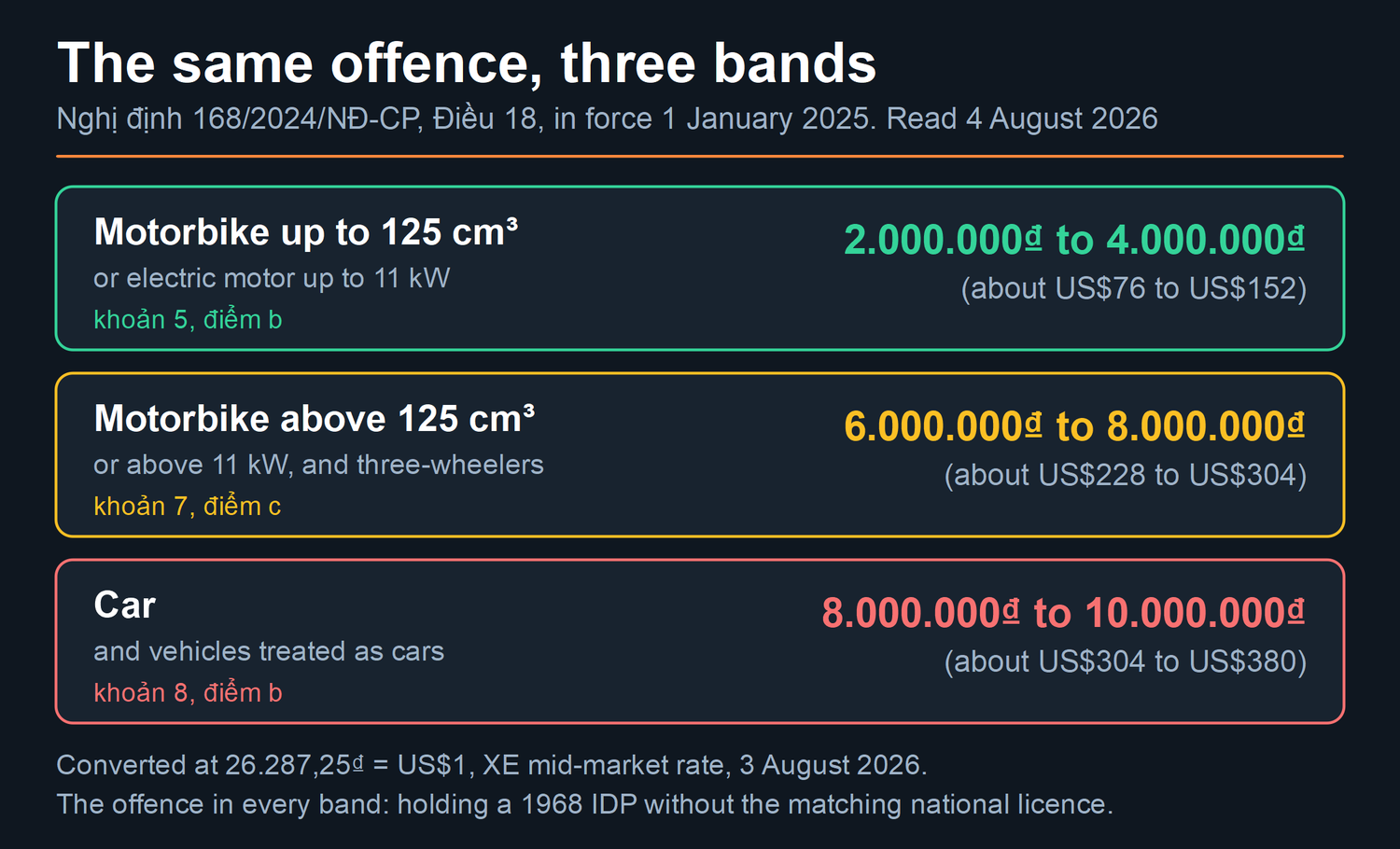
Nghị định 168/2024/NĐ-CP was signed 26 December 2024 and in force for these clauses on 1 January 2025 — a handful of others were deferred, some to 2026 and one later still, none of them here. Its Điều 18 puts this offence in three bands:
- 2.000.000₫ to 4.000.000₫ (about US$76 to US$152) — motorbike of 125 cm³ or less, or 11 kW electric or less. Điều 18, khoản 5, điểm b.
- 6.000.000₫ to 8.000.000₫ (about US$228 to US$304) — motorbike above 125 cm³ or above 11 kW, and three-wheelers. Điều 18, khoản 7, điểm c.
- 8.000.000₫ to 10.000.000₫ (about US$304 to US$380) — a car. Điều 18, khoản 8, điểm b.
Be careful with the car figure: Điều 18 gives a car driver two bands ten million apart. Khoản 8 is the one above — permit held, licence left behind. Khoản 9 is 18.000.000₫ to 20.000.000₫ (about US$685 to US$761) for no licence whatever or one not matching the car — so an 18–20 million figure quoted against this offence is the wrong khoản.
Converted at 26.287,25₫ to the dollar, XE, 3 August 2026.
Why does the fine depend on the size of your bike?
Because the penalty schedule splits two-wheelers at 125 cm³, and that line decides which of the two motorbike bands you are in. The sizes below come off another operator’s list, and
An easy rider is a local driver you ride behind, as the pillion; the clauses below are not addressed to you. One operator’s list, read 4 August 2026, offers a “110cc semi-automatic motorbike with fuel included” for self-driving and an “Easy Rider on a 150cc manual motorbike” for the driven option — opposite sides of the 125 cm³ line.
Observation rather than a survey. What a shop asks a self-driver for is almost always the home licence, and none has ever quoted me the decree — but a shop declining to ask is not the document not being required. What that check is for belongs to the easy rider page.
The rules changed on 15 August 2026 — these lines did not
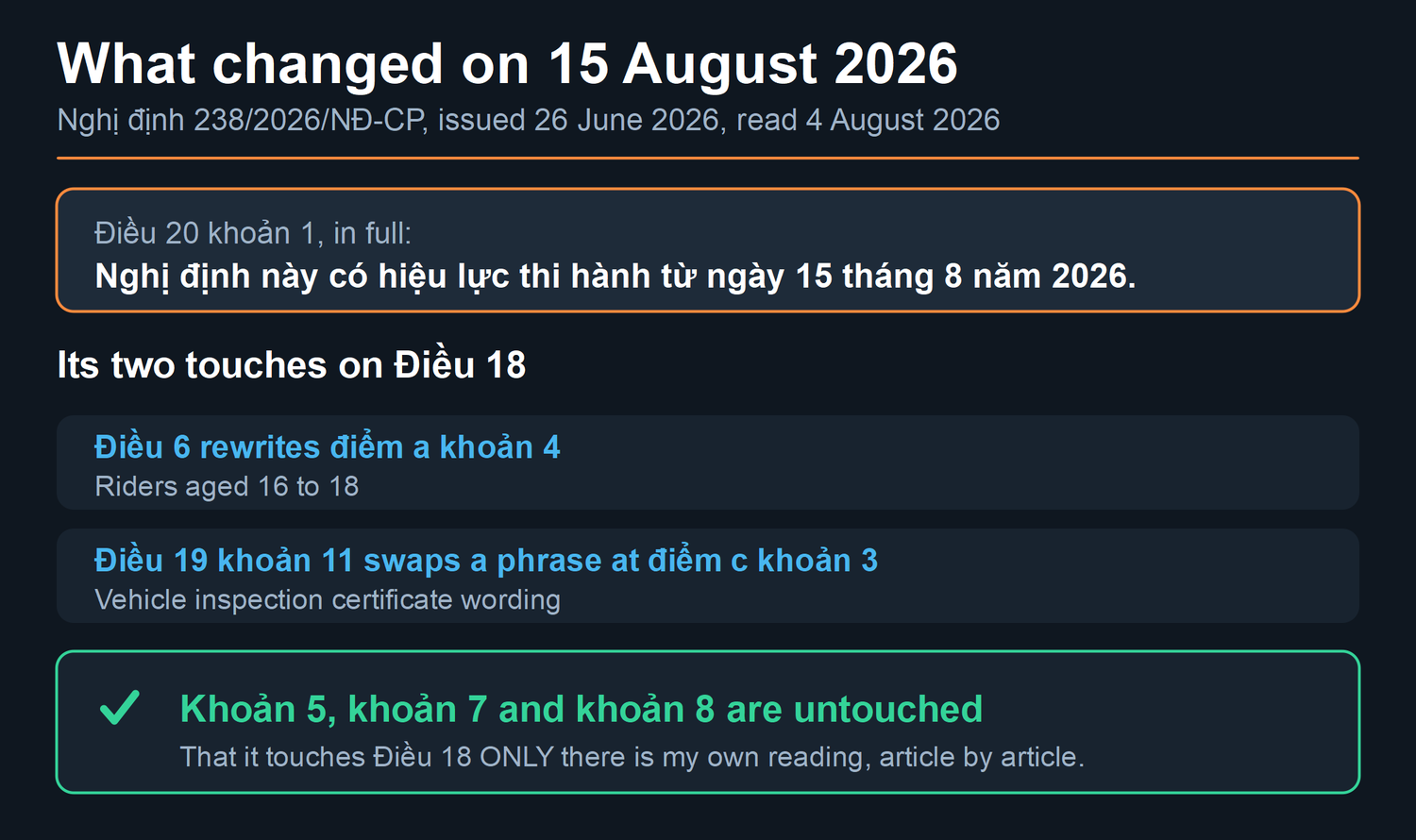
One live change to know about. Nghị định 238/2026/NĐ-CP, issued 26 June 2026, amends 168/2024. The portal serves a signed PDF rather than page text, and that PDF is what I read. Its Điều 20 khoản 1 is one sentence:
“Nghị định này có hiệu lực thi hành từ ngày 15 tháng 8 năm 2026.”
In force since 15 August 2026, so anything written about Vietnamese traffic penalties before that date describes a rulebook that has since been amended.
It touches Điều 18 twice, at điểm a khoản 4 and điểm c khoản 3, both on the card. Khoản 5, 7 and 8 are untouched, so the three bands survive. That those are the only two is my reading, article by article, on 4 August 2026 — and the decree’s own text bears it out: its Điều 6 is headed Sửa đổi bổ sung điểm a khoản 4 Điều 18, its Điều 19 khoản 11 swaps a phrase at điểm c khoản 3 Điều 18, and across its twenty articles there is no third mention of Điều 18. Full text, read 15 August 2026.
What should you do before you fly?

Four things. Three deserve a sentence more; the fourth, the travel policy, has the next section.
Your licence must cover motorcycles — read the category letters on it. A licence states categories, never a displacement, and the permit only restates what is there. If motorcycles are missing, nothing after landing fixes it.
Ask for the 1968 permit by name, before you fly. In the UK it is £5.50 over a PayPoint counter, read 8 August 2026; elsewhere ask your own motoring authority, because I have not read that procedure and will not invent it. Nor will I tell you how long the booklet lasts: pages in this niche say one year, three years and twenty, and when I read the UK government’s own IDP page on 8 August 2026 it published no term at all.
Carry both, physically. The clause says mang theo — carrying — so a phone photograph is not the licence.
If any of that lands badly — car-only licence, permit too late, never ridden a manual — don’t fudge it. The FCDO is blunt and I’d say the same: “Do not hire a motorbike if you’re not an experienced rider.” You can still see all of it from the back of somebody else’s bike.
Does any of this touch your insurance?

Yes, and this is where the numbers stop being denominated in hundreds.
The FCDO page, read 3 August 2026, says that after a crash “you could face criminal charges and may need to pay compensation to injured people, even if the injuries are minor”, with “the possibility of a travel ban while the investigation is carried out”.
Then your own policy. Outbacker Insurance publishes a page on riding this loop, and for driving yourself it requires that “You are licensed in the UK to drive the motorbike, moped, scooter, or assisted bicycle.” Read 3 August 2026.
That’s one insurer’s wording and yours will differ: Outbacker makes UK licensing a condition of cover, and whether yours does is a question for your policy document rather than for this page.
Then read the rest of that list. The same page says: “There is no cover for Personal Liability.” Read 7 August 2026. Personal liability pays the other person — the exposure the FCDO sentence describes. A policy can leave you insured for your own hospital bill and uninsured for the compensation. Cover from the pillion seat is a different argument.
Common questions
Is the IDP the same as the Hà Giang border permit?
No — unrelated documents under unrelated laws. The IDP is about driving; the border permit is about being in the zone at all, and where that zone begins on this route is further south than people expect — my own operational knowledge, not a boundary the decree publishes. It has its own page.
Do I need one to ride as a passenger?
No — the clauses address người điều khiển, the person driving. Your travel policy may still ask about the driver.
I am staying longer than a trip — do I need a Vietnamese licence?
Eventually, and the threshold is a residence document, not a length of stay. Thông tư 12/2025/TT-BCA Điều 24 lets a foreigner “cư trú, làm việc, học tập tại Việt Nam” holding a valid national licence exchange it for the matching Vietnamese class — on a diplomatic or official-duty ID, or a thẻ tạm trú or thẻ thường trú “với thời gian từ 03 tháng trở lên”. Read 8 August 2026. A tourist visa reaches none of the three, which is why this page is about the permit.
Can I get an IDP after I arrive in Vietnam?
Not one that’ll help you. Điều 29 of Thông tư 12/2025/TT-BCA says a Vietnam-issued IDP has no validity inside Vietnam. The permit you need is issued where your licence is, before you travel.
What if I have no licence at all, rather than the wrong combination?
Điều 18 khoản 5 điểm a, and no cheaper: same khoản, same 2.000.000₫ to 4.000.000₫ band. It covers no licence, one whose points are gone, an expired one, one not from a competent authority, one tampered with, or one not matching the vehicle — “giấy phép lái xe không phù hợp với loại xe đang điều khiển”. Read 8 August 2026. Above 125 cm³ it moves to khoản 7.
Did the 15 August 2026 amendment raise these fines?
Not these ones — see above. That it touches Điều 18 in only those two places is my own reading, article by article, on 4 August 2026, not something the decree says about itself. A decree can be amended again.
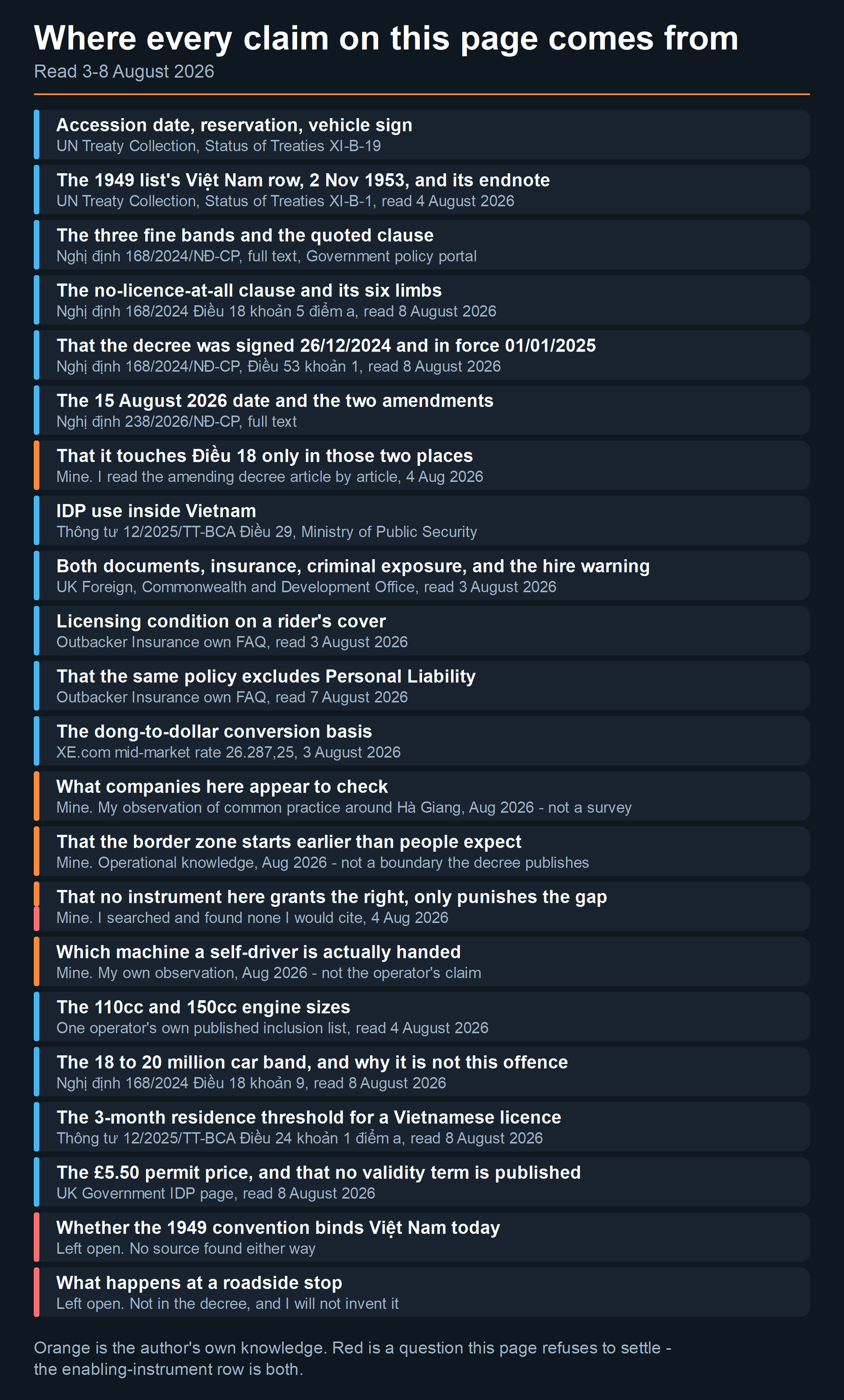
One closing note on what this page can and can’t show you. Every clause I quote is in Vietnamese; khoản 7, 8 and 9 are referenced and priced, not quoted. The circular and 168/2024 link to their full texts, read 4 and 8 August 2026; 238/2026 opens a signed PDF, the conventions depositary records.
Five claims here are mine, and each is marked where it appears. What I watch companies check. Where the border zone begins. My reading that the August amendment leaves these clauses alone. Which machine a self-driver is actually handed. My finding that no instrument I could cite grants the right to ride. Three questions stay open on purpose: whether the 1949 convention binds Vietnam today, what happens at a roadside stop, and whether the enabling instrument exists at all. I am not a lawyer.
Still deciding whether to ride? The risk page is more useful, and the route page describes what the road actually does.