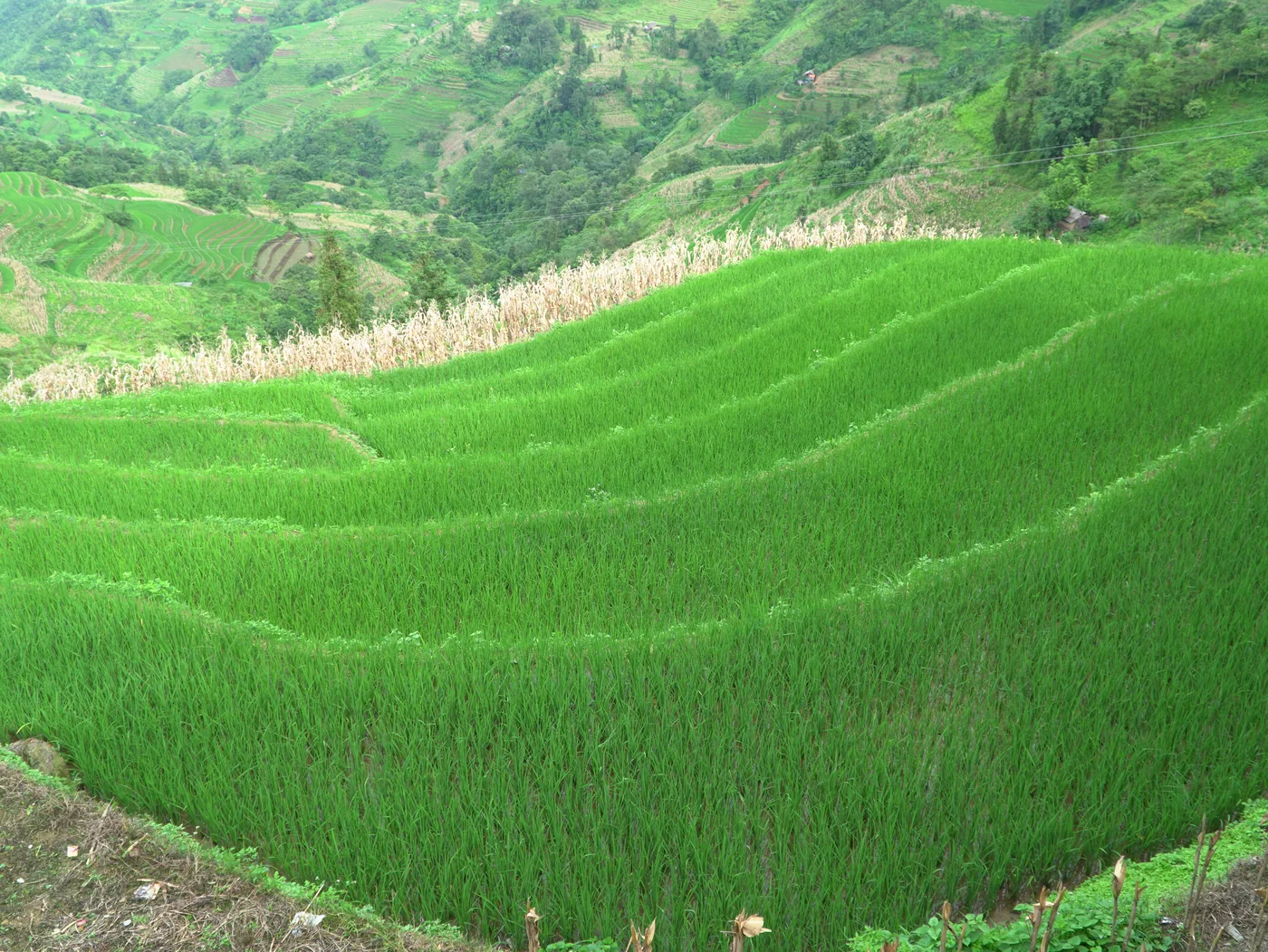
Almost nobody comes to Hà Giang for Hà Giang.
They come for what is a couple of hours further north, and the town is where they sleep the night before it starts. That is not a criticism. It is a job, and the town does it — a place to land, sort the paperwork, get a bike, and go.
What almost every page about it still gets wrong is the name. As of 1 July 2025 there is no administrative unit called Hà Giang city. There are two wards, and they are called something else.
The short version
- The town is a staging post, not a destination. Vietnam’s own national tourism site calls it “the gateway to the province”, and that is the honest description.
- There is no airport, and none is in the national plan. The Civil Aviation Authority of Vietnam publishes the airport master plan — 15 international and 17 domestic airports for 2021–2030. Neither Hà Giang nor Tuyên Quang is among them.
- “Hà Giang city” is no longer an administrative unit. Under Nghị quyết 1684/NQ-UBTVQH15, signed 16 June 2025, the old city’s wards became phường Hà Giang 1 and phường Hà Giang 2. The new units began operating 1 July 2025.
- Tuyên Quang now has 124 commune-level units — 117 xã and 7 phường. Two of those seven wards are the town you are standing in.
- The town is outside the border-permit zone. My own figure, from working these roads: that zone starts about 21 km out on QL4C, around Minh Tân. So this is the last place to sort the permit before you need it.
- This page will not name you a hotel, an ATM or a rental shop. I explain why near the bottom, and I would rather tell you that plainly than invent a list.
- How to get here belongs to the Hanoi page; the province and the merger to the page on what Hà Giang is.
What is Hà Giang city for?
Arriving, sleeping, and leaving properly equipped.
Vietnam’s national tourism site puts it in one clause: “The small city of Ha Giang is the gateway to the province.” The same page notes that “Public transport around Ha Giang Province is limited” and that “Experienced drivers can rent a motorcycle in town.”
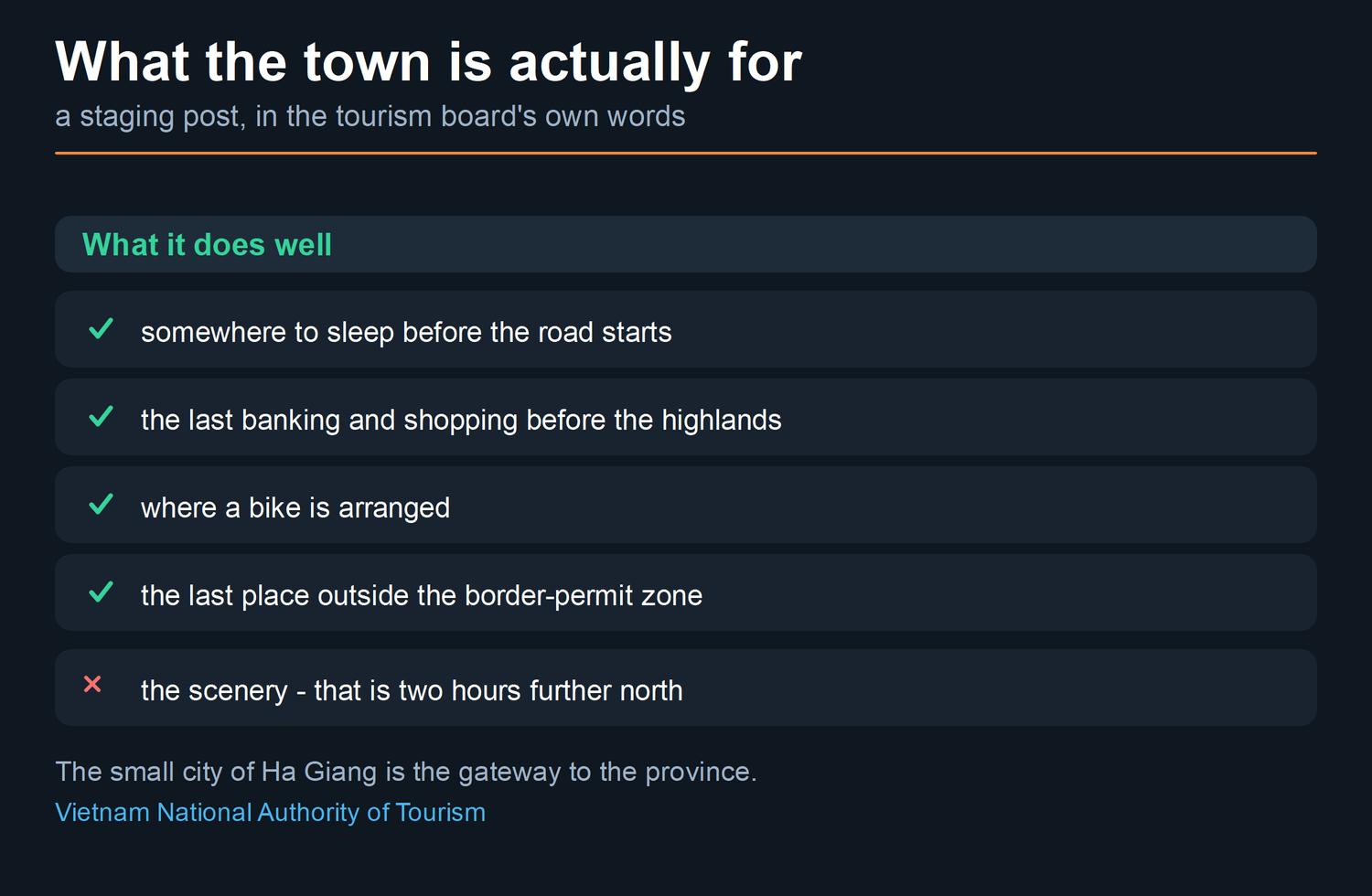
Read that in order and the shape of a trip appears. You get here, you fix everything that has to be fixed while there are still shops and a bank, and then the road takes over. Treating the town as a sight is how people lose a morning.
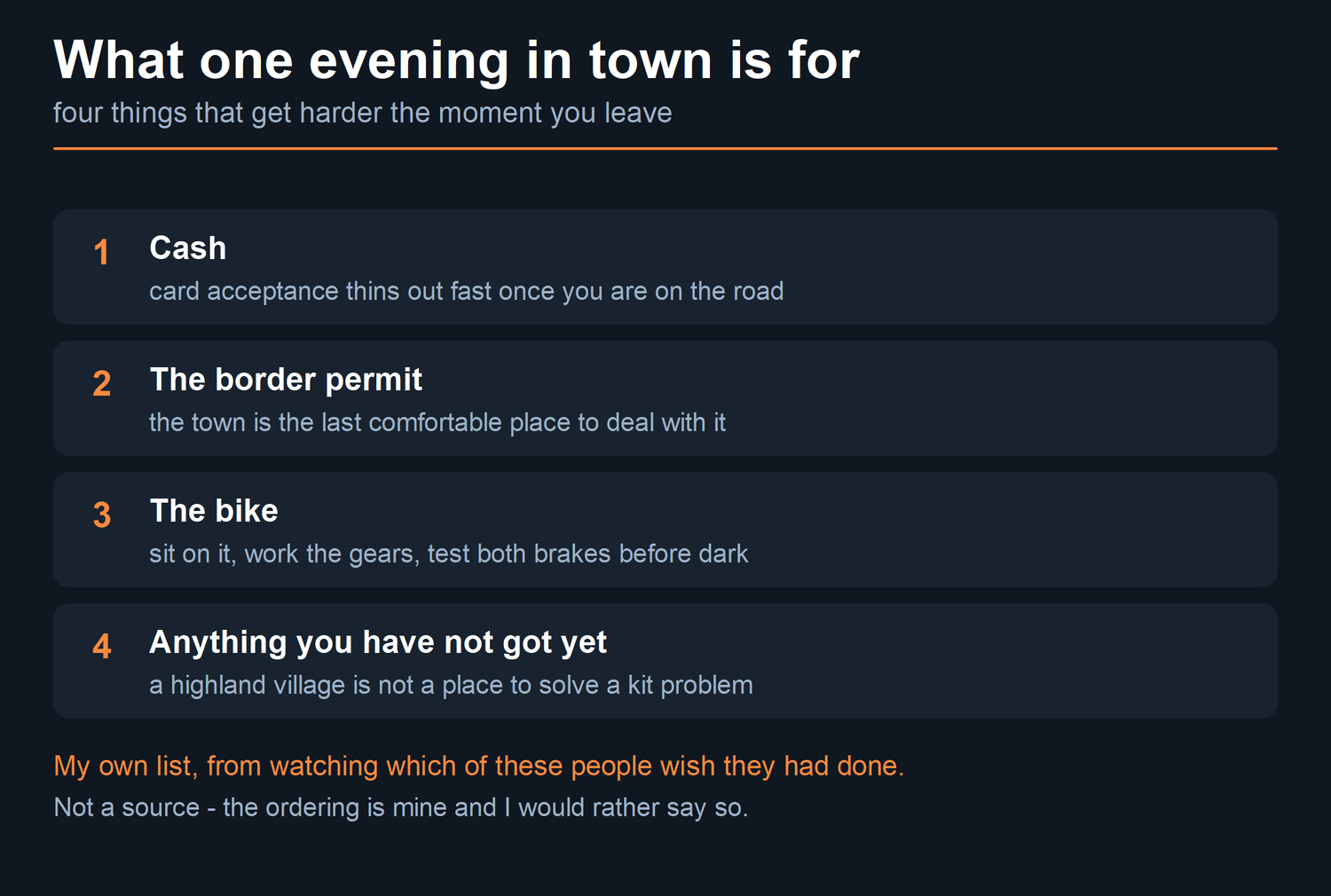
That list is mine rather than anyone’s published advice, and the ordering matters more than the items. Cash first, because card acceptance thins out quickly once the road starts climbing. The permit next, for the reason set out further down. Then the bike, in daylight, while whoever handed it over is still standing in front of you.
Sit on the bike before you accept it. Work the gears, pull both brakes, and look at the tyres. Doing that in a town with shops in it is a very different experience from doing it on a pass.
Is there an airport at Hà Giang?
No, and there is no plan for one either. This is a real question — people search it every month — and the answer is usually given as a bare assertion, so here is the document.
Vietnam’s national airport system is planned by decision. The Civil Aviation Authority of Vietnam publishes the current version: Quyết định 648/QĐ-TTg of 7 June 2023, adjusted by Quyết định 1102/QĐ-BXD of 20 July 2025 and Quyết định 1714/QĐ-BXD of 7 October 2025.
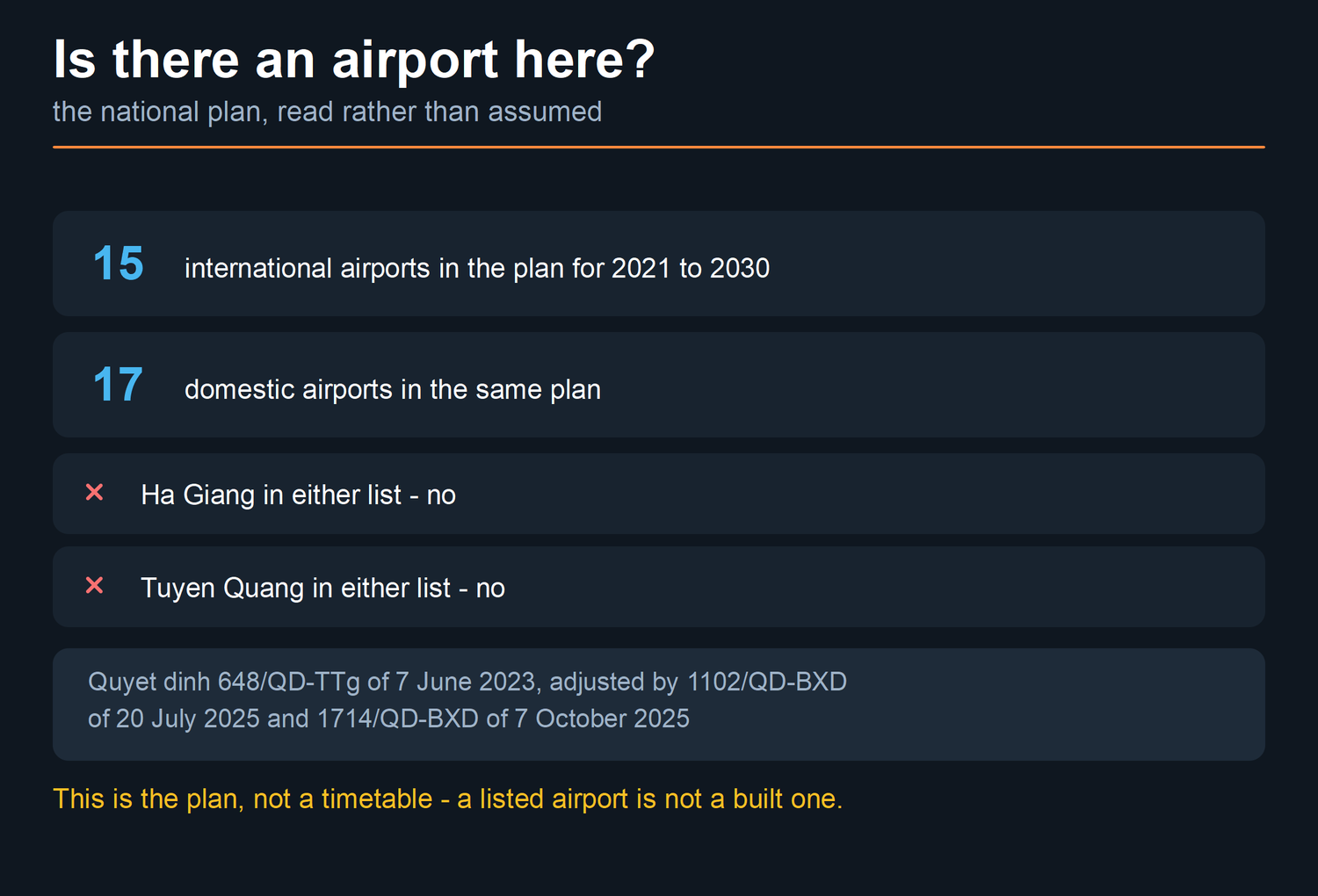
The plan for 2021–2030 covers 15 international airports and 17 domestic ones. Read the two lists and neither Hà Giang nor Tuyên Quang appears in either. The 2050 vision on the same page adds three further domestic airports and does not name this province among the ones it lists.
Two things that document does not tell you, so I will not pretend otherwise. It is a plan rather than a construction schedule — being on the list is not the same as being built. And it names one of the three 2050 additions without naming the others, so I can tell you Hà Giang is absent from what is published, not that it is excluded for ever.
The practical consequence is simple and it shapes everything else: every way in here is a road. The page on what Hà Giang is covers what that does to a trip, and the Hanoi page covers the journey itself. I am not going to duplicate either.
Is it still called Hà Giang city?
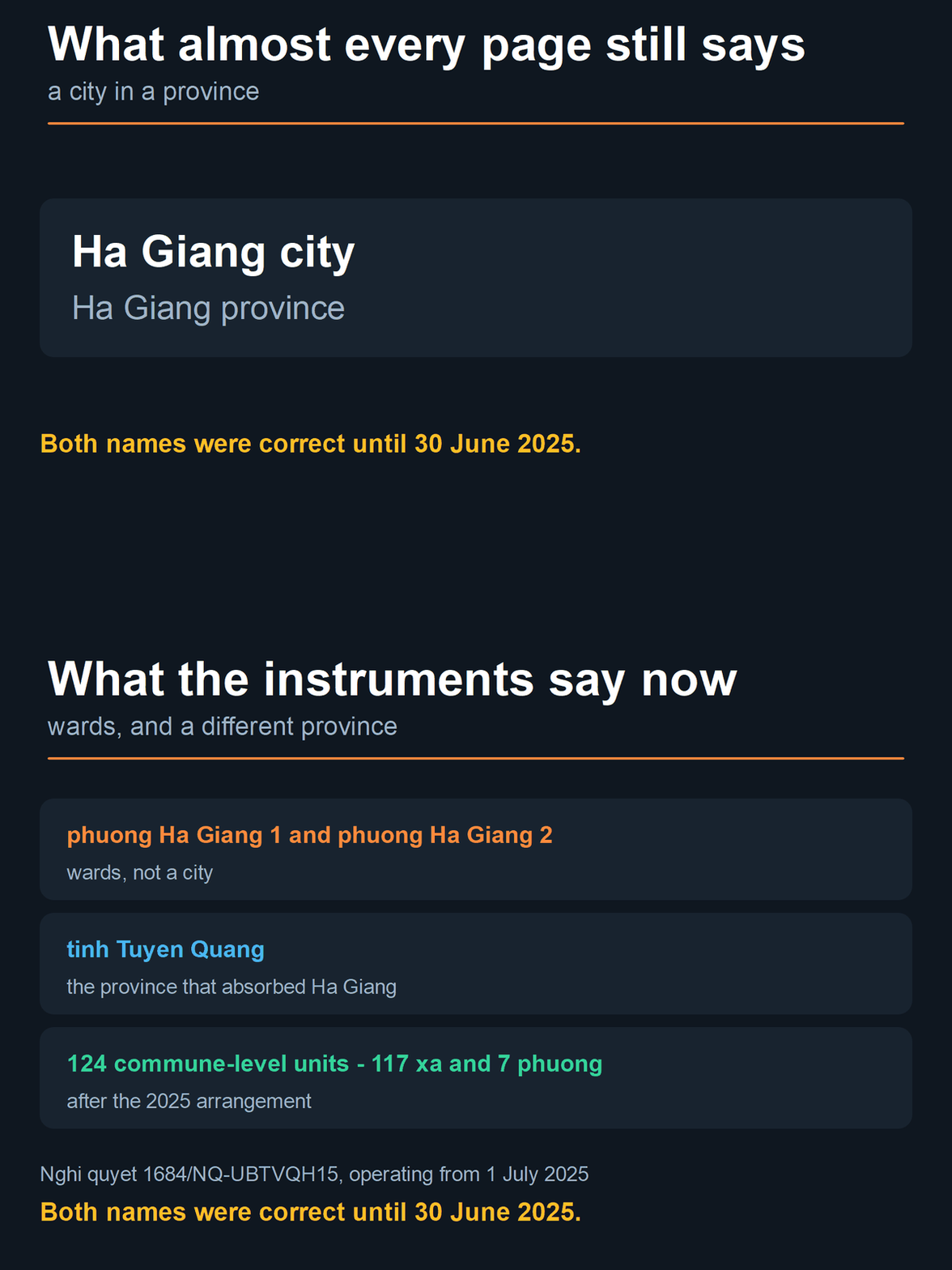
Not as an administrative unit. It stopped being one on 1 July 2025, and almost every page you will read still uses the old name.
The instrument is Nghị quyết 1684/NQ-UBTVQH15, on the arrangement of commune-level administrative units of Tuyên Quang province in 2025. It was signed on 16 June 2025 by the Chairman of the National Assembly, Trần Thanh Mẫn, took effect on adoption, and the new units began operating on 1 July 2025.
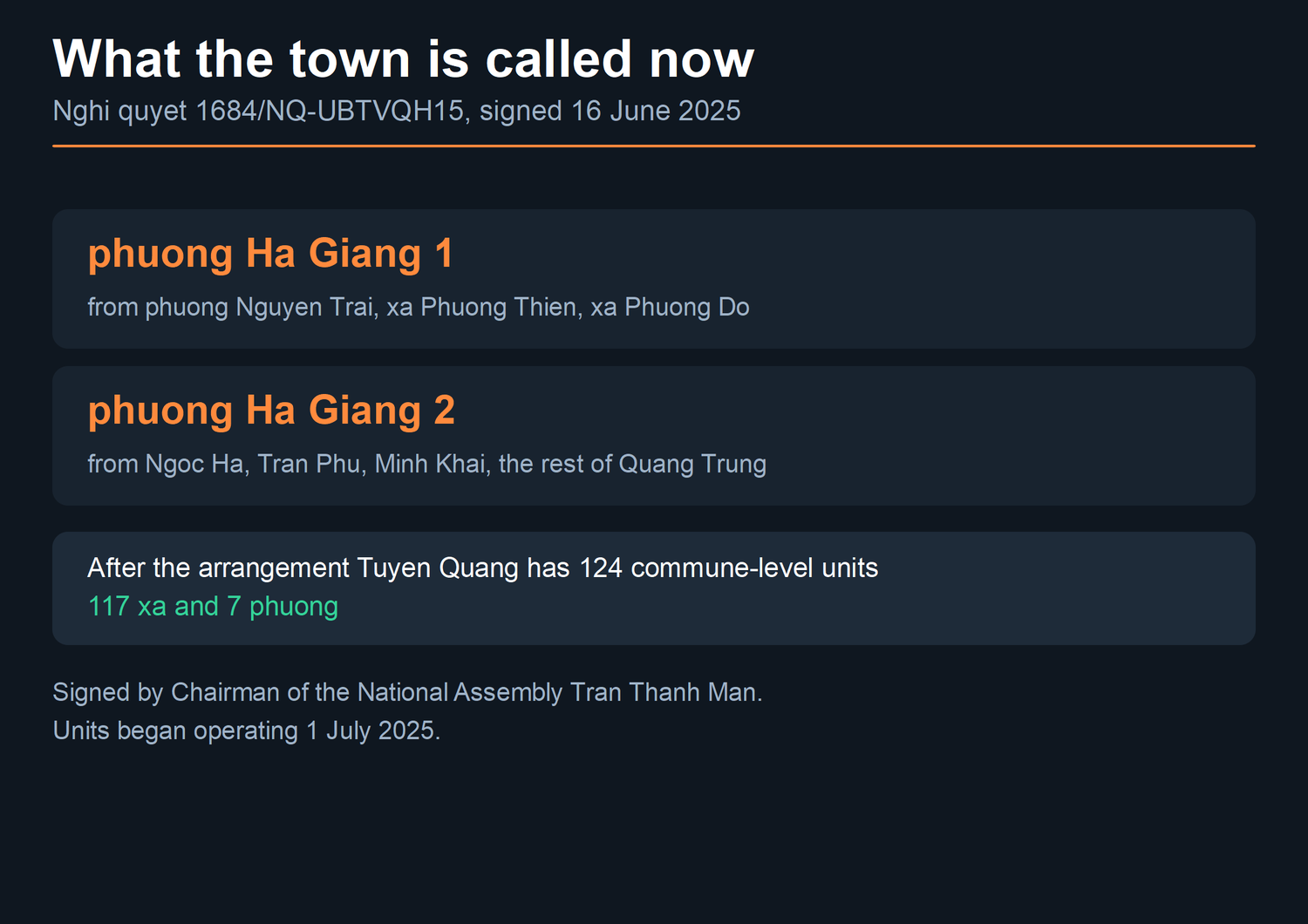
What it did here was merge the old town’s wards with two neighbouring communes into two new wards. Phường Hà Giang 1 was formed from phường Nguyễn Trãi, xã Phương Thiện, xã Phương Độ and part of phường Quang Trung. Phường Hà Giang 2 was formed from the wards of Ngọc Hà, Trần Phú and Minh Khai, the remainder of Quang Trung, and xã Phong Quang.
After the whole exercise, Tuyên Quang has 124 commune-level units — 117 xã and 7 phường. Two of those seven wards are the town you will be standing in.
I am reporting those two clauses rather than quoting them. The text I retrieved carried whitespace corruption in the surrounding sentences, and this site’s rule is that a legal instrument is quoted exactly or not at all. The names, the instrument, the signatory and the dates are all as published; the Vietnamese wording is not reproduced here because I could not verify it character for character.
The province-level half of this — how Hà Giang stopped being a province at all, and which instrument did it — is set out on its own page. That was a different act by a different body, and conflating the two is the mistake I am trying to help you avoid.
What does the new name actually change for you?
Less than you fear on the ground, more than you expect on paper.
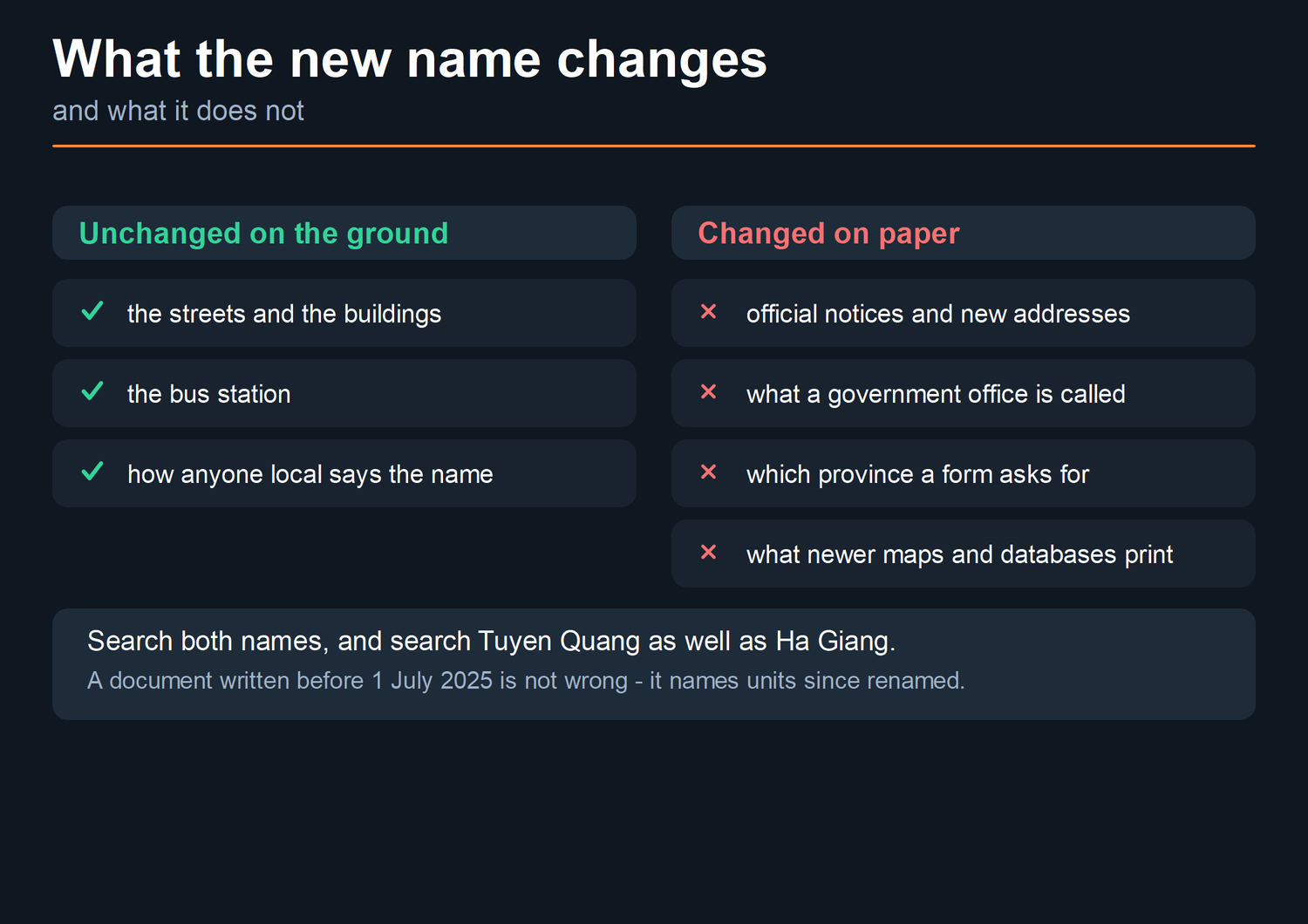
Nothing physical moved. The streets, the bus station and the buildings are where they were, and people still say Hà Giang, because that is what it is called.
Where it bites is paperwork. An official notice, a newly written address, a form that asks for a province, a government office’s own name — all of those follow the new units. So do newer maps and databases, which is why some of them now show Tuyên Quang for a place every travel blog still files under Hà Giang.
When you are searching for anything official — a police office, a road closure, a notice — search Tuyên Quang as well as Hà Giang, and search the ward name as well as the town name. A document written before 1 July 2025 is not wrong; it is describing units that have since been renamed.
Where does the border zone start?
Not here — and closer than people assume.
Much of the route north sits inside Vietnam’s land border area, and a foreign national entering that area needs a permit from the provincial police. The town itself is outside it, which is exactly why it matters that you are standing here.
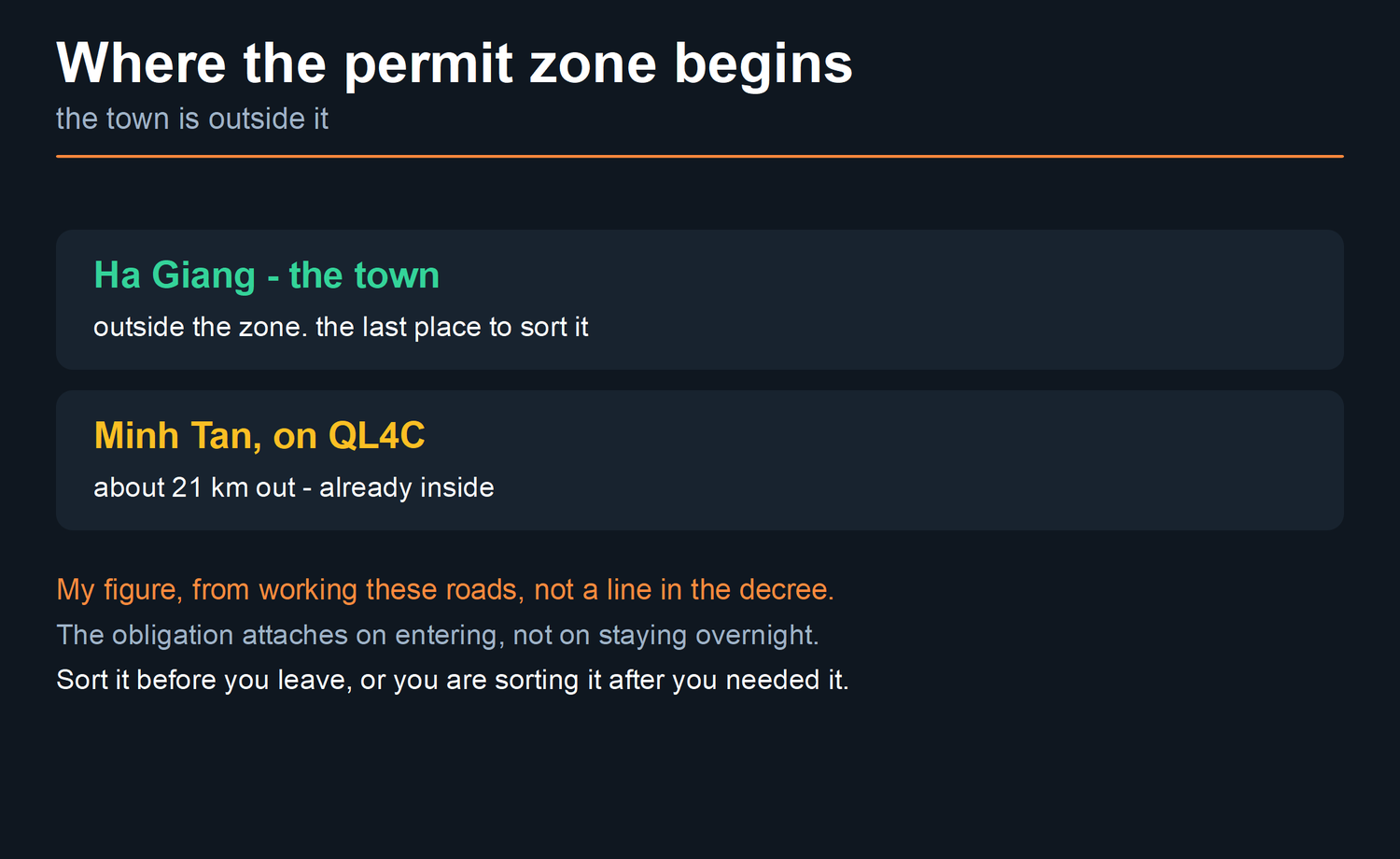
Here is my own figure, from working these roads rather than from any document: the zone starts around Minh Tân, roughly 21 km out on QL4C. Not at Đồng Văn, not at the top of the map — a short ride from where you slept. It is operational knowledge, not a line in the decree, and I would rather you knew which of those it was.
What that means practically is that the town is the last comfortable place to deal with it. The requirement itself, the fee, who arranges it and the legal chain behind it are all on the permit page, and I am not repeating them here.
Can you get a motorbike here?
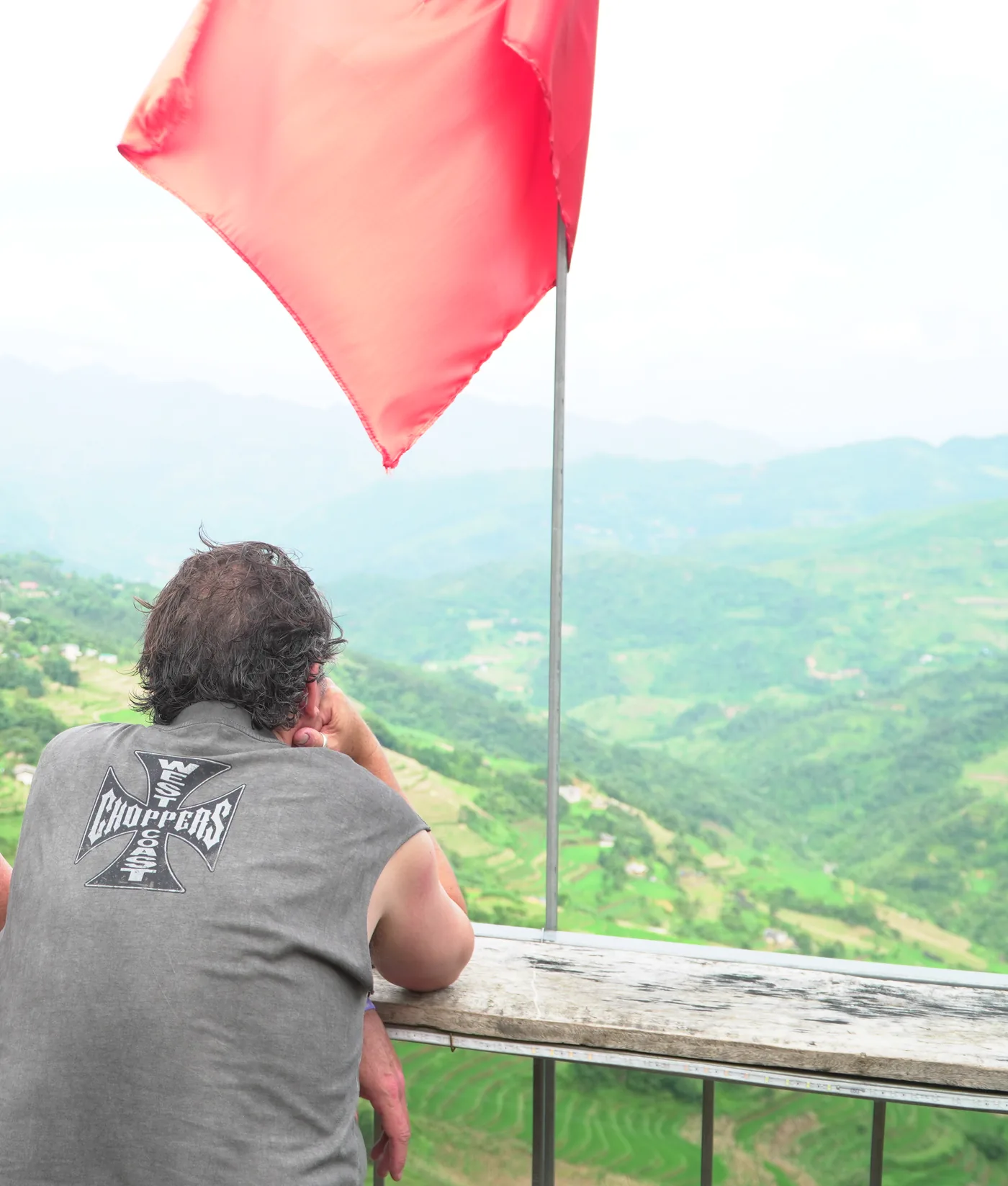
Yes, and Vietnam’s national tourism site says so in the same breath as a warning worth reading twice: “Experienced drivers can rent a motorcycle in town.”
Note which word is doing the work. The UK Foreign, Commonwealth & Development Office is blunter in its Vietnam travel advice: “Do not hire a motorbike if you’re not an experienced rider.” Neither organisation rents bikes or sells tours, and both say the same thing in different registers.
I am not naming a rental shop on this page, and the next section explains why.
What this page will not tell you
Which hotel. Which ATM. Which rental shop. Which restaurant.
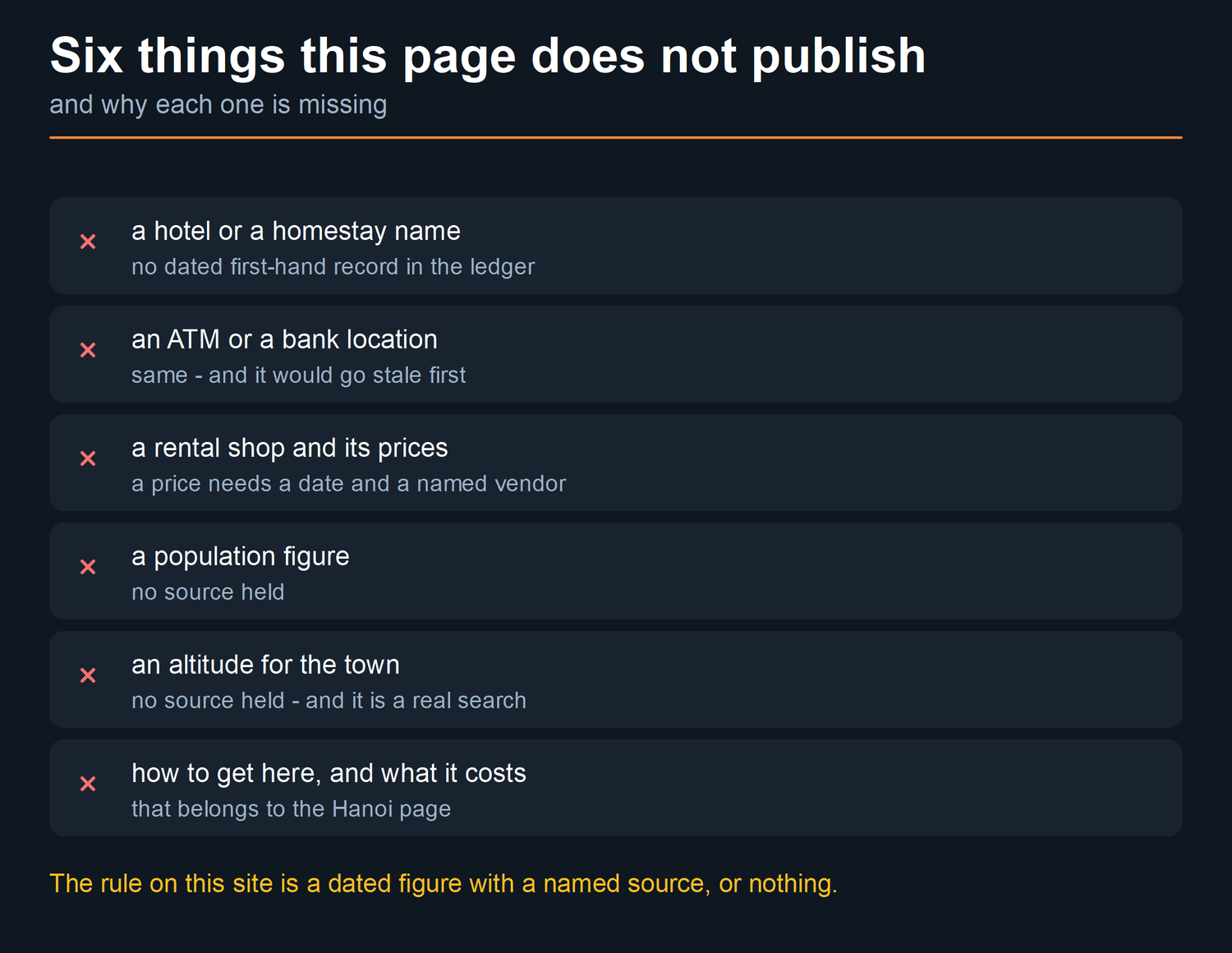
The rule on this site is that a price carries a date and a named vendor, or it does not get published. I do not hold a dated record for a single hotel, cash machine or rental counter in this town, and a list assembled from other people’s blogs would be exactly the article this site exists to beat.
Two of those gaps are things people actively search for. There is a steady trickle of searches for the town’s altitude, and I have no source for one. This site already refuses to repeat the unsourced altitude range that circulates for the plateau to the north, and I am applying the same rule one level down. When a survey figure turns up, it goes here with its citation attached.
Common questions
Is there an airport in Hà Giang?
No. The Civil Aviation Authority of Vietnam publishes the national airport master plan — Quyết định 648/QĐ-TTg of 7 June 2023, adjusted in July and October 2025 — which lists 15 international and 17 domestic airports for 2021–2030. Neither Hà Giang nor Tuyên Quang appears. Every route in is by road.
Is Hà Giang city still a city?
Not as an administrative unit. Nghị quyết 1684/NQ-UBTVQH15, signed 16 June 2025, reorganised the old city’s wards into phường Hà Giang 1 and phường Hà Giang 2, and the new units began operating on 1 July 2025. Everyone still calls the place Hà Giang, and that is fine — it is forms and official notices where the distinction matters.
Which province is Hà Giang in now?
Tuyên Quang. The province-level change is a different instrument from the ward-level one described here, and it is explained properly on its own page.
Do I need the border permit in Hà Giang city itself?
The town is outside the zone. My own figure, from working these roads: the zone begins about 21 km out on QL4C, around Minh Tân — that is my operational knowledge, not something in the decree. The requirement, the fee and who arranges it are all on the permit page.
Is Hà Giang city worth a day?
Rarely, if the loop is why you came. Vietnam’s national tourism site calls it “the gateway to the province”, and a gateway is a thing you pass through. Use the evening for cash, paperwork and checking the bike.
How high is Hà Giang city?
This page does not publish an altitude, and that is deliberate rather than an oversight. I have not found a figure attached to a survey or a mapping authority, and this site has a standing rule against repeating the unsourced altitude range that circulates for the plateau further north. When I have a source, the number goes here with it.
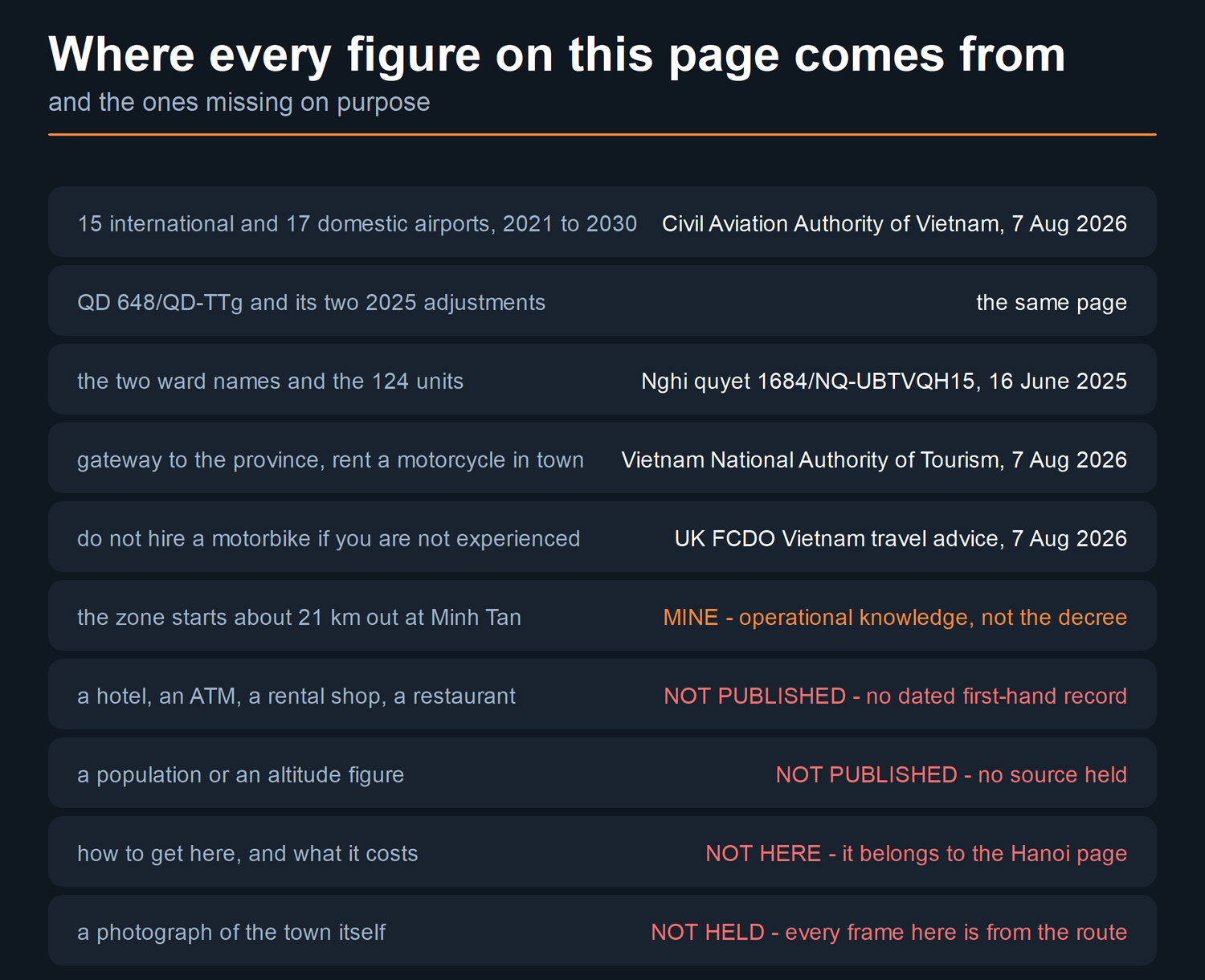
Where the figures come from. The airport counts and the three decision numbers are published by the Civil Aviation Authority of Vietnam, read on 7 August 2026 and linked above. The ward names, the two source lists, the 124 commune-level units and the signing date come from Nghị quyết 1684/NQ-UBTVQH15 of 16 June 2025. The two quoted descriptions of the town are the Vietnam National Authority of Tourism’s own wording, and the rider-experience line is the UK FCDO’s, both read the same day.
What is mine. One thing: that the border zone begins around Minh Tân, roughly 21 km out on QL4C, and that the town itself sits outside it. That is operational knowledge from selling these permits, it is an approximation rather than a measurement, and it is marked as mine everywhere it appears on this page — in the summary at the top and in the questions above as well as in the body, because those two blocks get read on their own.
What is deliberately absent. No hotel, ATM, rental shop or restaurant, because no dated first-hand record exists for any of them. No population and no altitude, because no source does. No journey time, fare or operator — that is the Hanoi page’s subject. No explanation of the province merger — that is post 169’s, and it is a different instrument. And no photograph of Hà Giang city: every frame on this page was taken out on the route, and each caption says so rather than pretending otherwise.
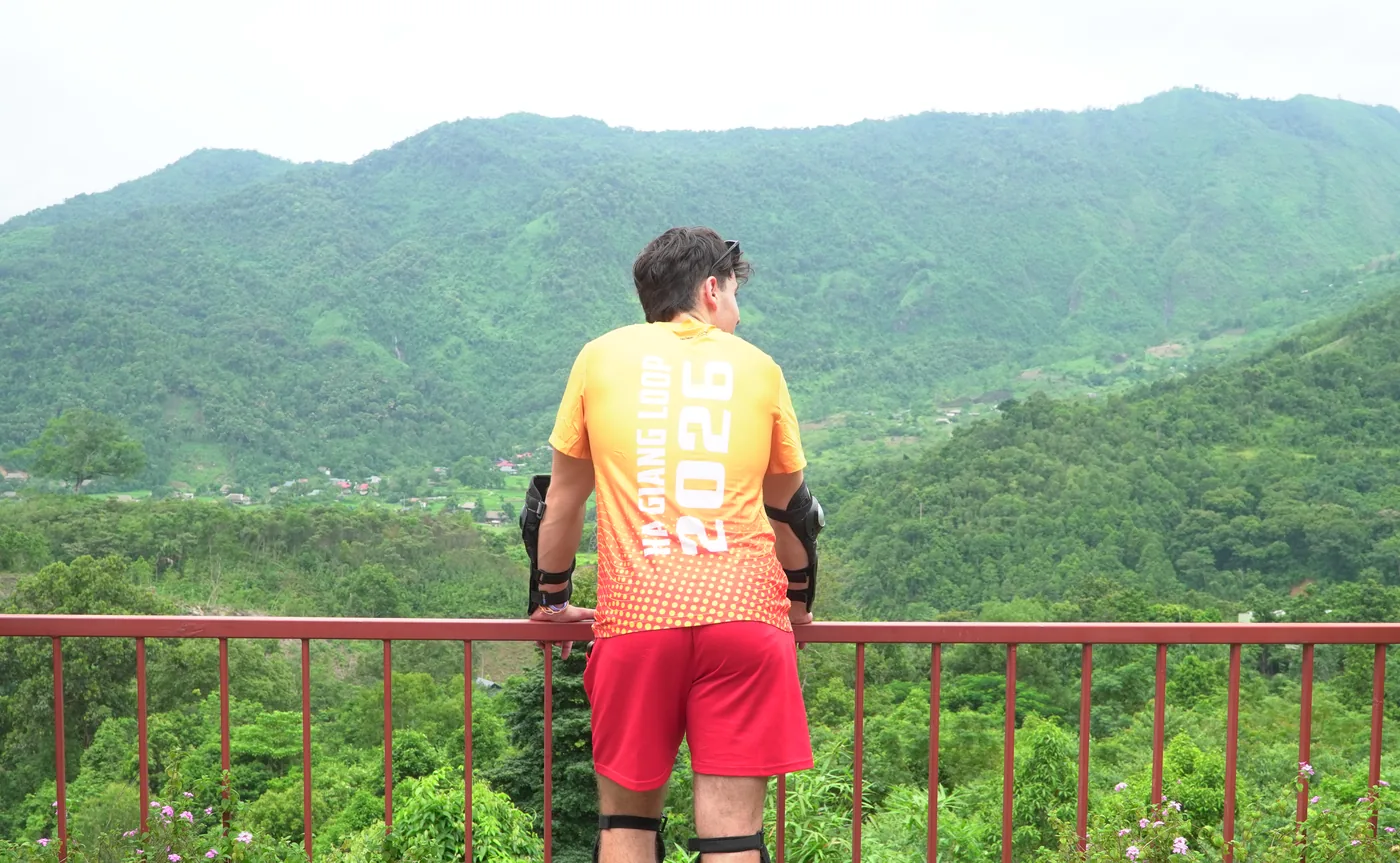
Photographs taken on our own trips, 2 August 2026. None of them shows Hà Giang city. Diagrams and cards are ours.