Walk into Đồng Văn’s old quarter early enough and the first thing you notice is what it is made of. Not timber. Not concrete. Stone — cut blocks, squared off, carrying three rows of buildings around an open square.
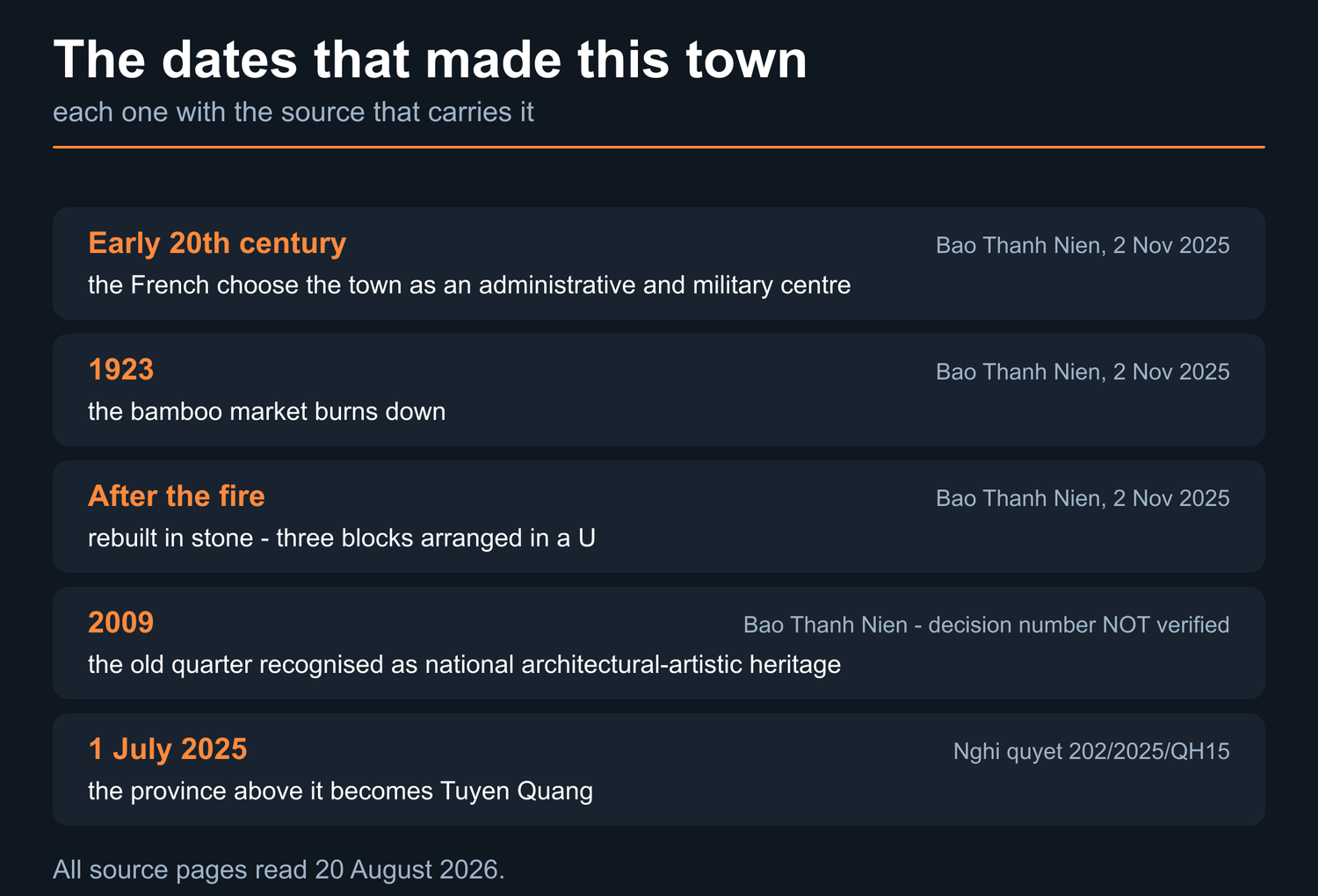
There’s a reason for that, and it carries a date: 1923.
That year the market burned down. It had been built of bamboo. What went up in its place is the thing people photograph today, and almost no English page about Đồng Văn tells you why it looks like this.
The short version
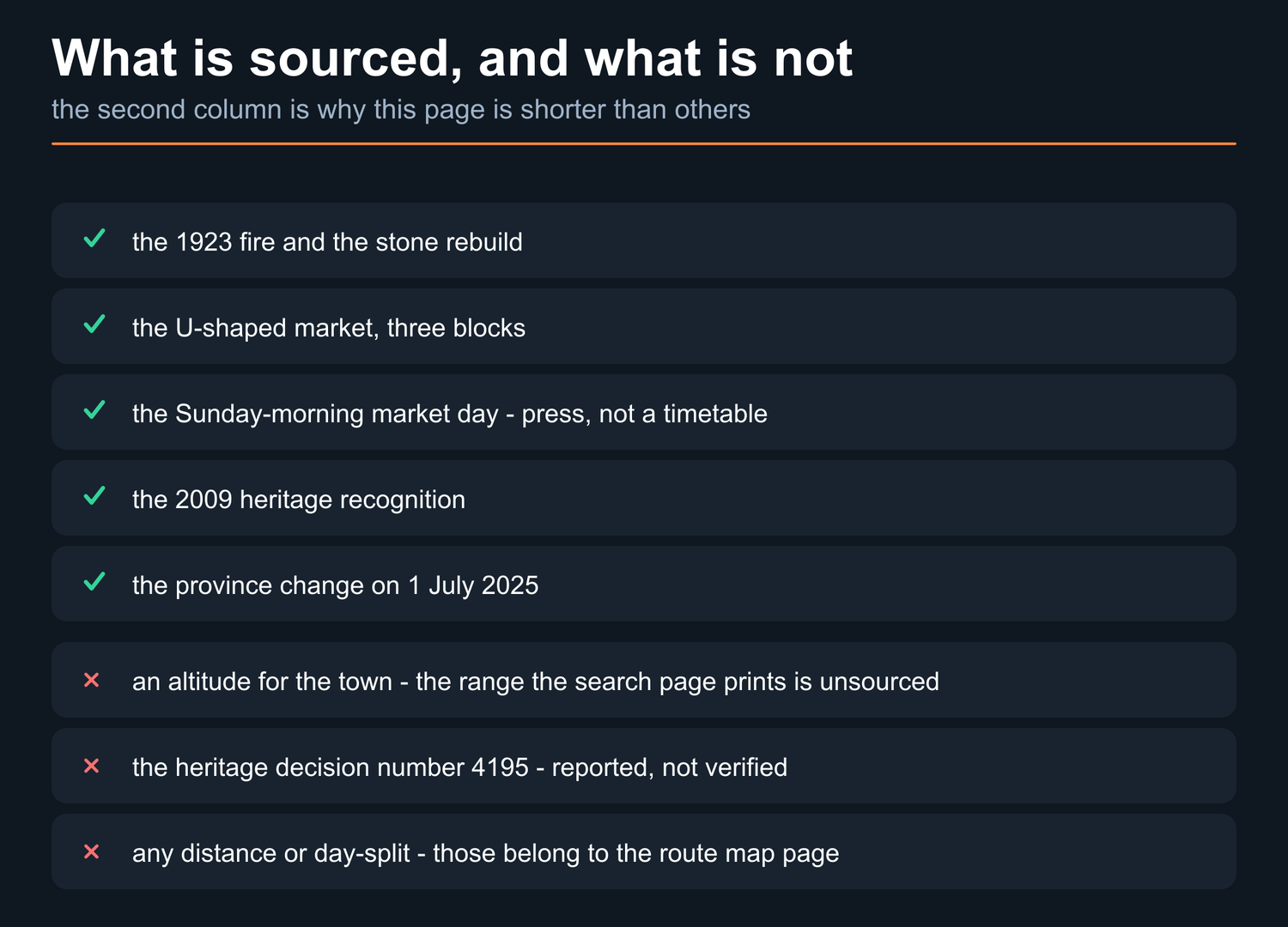
- The market burned in 1923 and was rebuilt in stone. Báo Thanh Niên, 2 November 2025, read 20 August 2026: “Năm 1923, chợ (bằng tre nứa) bị cháy” — the bamboo market burned — and the French hired builders to put up a sturdier stone market of three blocks arranged in a U.
- The quarter has a planned shape, not an organic one. The French made Đồng Văn an administrative and military centre in the early 20th century, and rows of shophouses formed in an L around the market. Same source, same read date.
- The market runs on Sunday mornings. VietnamNet, 30 October 2023, read 20 August 2026: “mỗi tuần họp một lần vào sáng chủ nhật”. That’s a press report, not an official timetable — confirm locally before you build a day around it.
- The old quarter has been a national architectural-artistic heritage site since 2009. The decision number usually quoted alongside it, I could not verify. I say below exactly which host failed.
- Đồng Văn is in Tuyên Quang province now, not Hà Giang province. The new units began operating on 1 July 2025.
- I’m not going to tell you how high it is. There is a section on why, and it is the most useful thing on this page.
Which Đồng Văn do you actually mean?
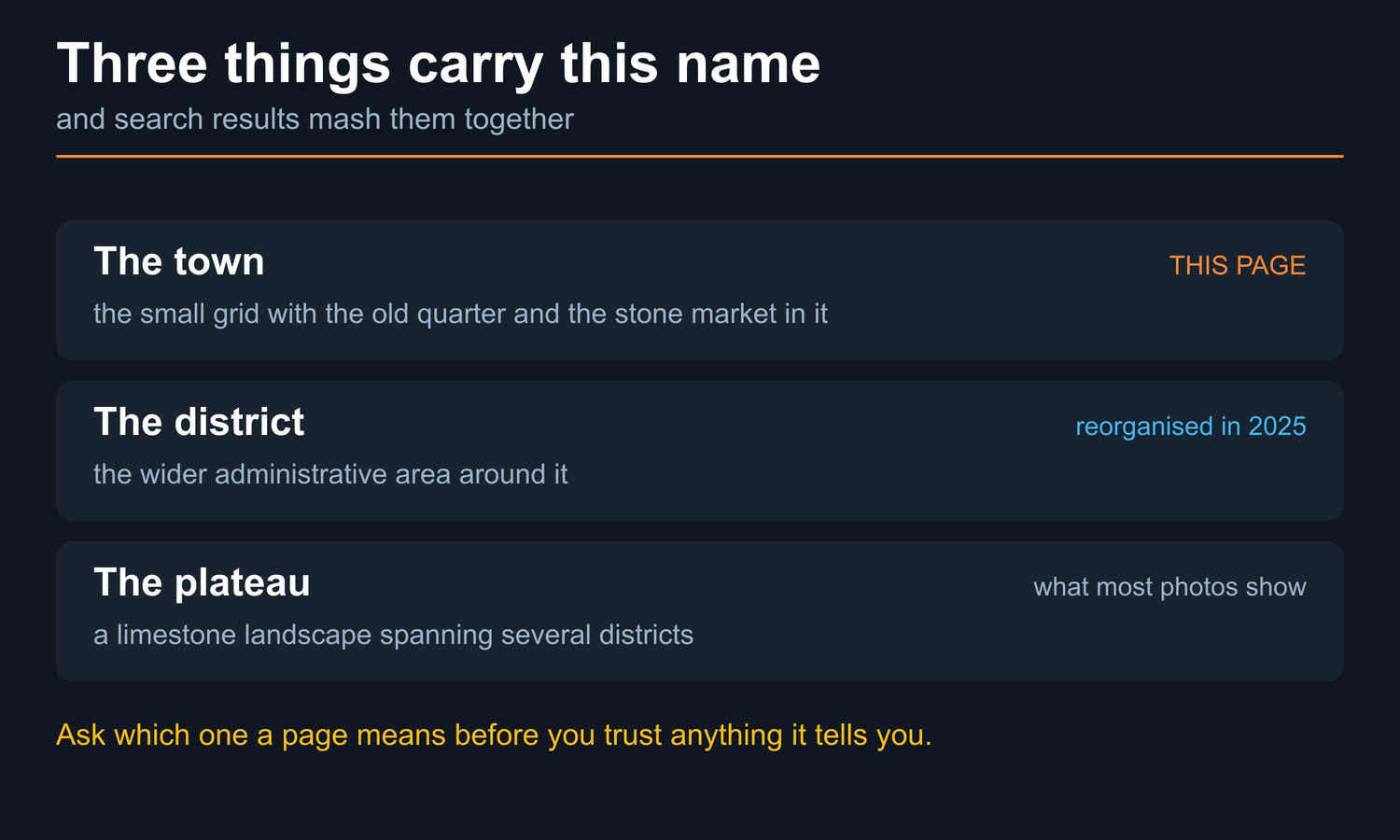
Three different things carry this name, and search engines mash them together.
There is the town — the small grid with the old quarter and the stone market in it. There is the wider district around it. And there is the limestone plateau, which is a landscape spanning several districts and is the thing most photographs are actually of.
This page is about the town. Specifically about two things in it that the English-language internet mentions and then never explains: the old quarter, and the market at the centre of it.
If you want the plateau and its geopark status, that belongs on the Hà Giang overview. If you want where Đồng Văn sits on the road and how the days break up, that is the route map page, and I have kept every kilometre off this one deliberately.
For scale only: the 2019 census counted roughly 81,880 people across Đồng Văn district as it was drawn then, over about 447 km². That’s a tertiary figure. It comes from the Google knowledge panel and Wikipedia, not from a statistics office I read directly. The district tier was also reorganised in 2025. Treat it as an order of magnitude and nothing finer.
The market burned down in 1923, and that is why it is stone
Here is the sentence the English pages are missing. Báo Thanh Niên, in a piece by Lam Yên published 2 November 2025, puts it plainly:
“Năm 1923, chợ (bằng tre nứa) bị cháy. Thực dân Pháp thuê thợ xây dựng lại khu chợ mới bằng đá kiên cố hơn gồm 3 dãy nhà xếp hình chữ U”
In 1923 the market — made of bamboo — burned. The French colonial administration hired builders to put up a new market in stone, sturdier, in three blocks arranged in a U.
Read that again, because it changes what you’re looking at. The stone isn’t ancient. It isn’t a deep local building tradition expressing itself in the only material to hand. It’s a replacement, chosen after a fire, by an administration that did not want to pay for the same market twice.
That’s a much better story than “atmospheric old stone market”, and it is verifiable. I read it at the source on 20 August 2026 and the page was live.
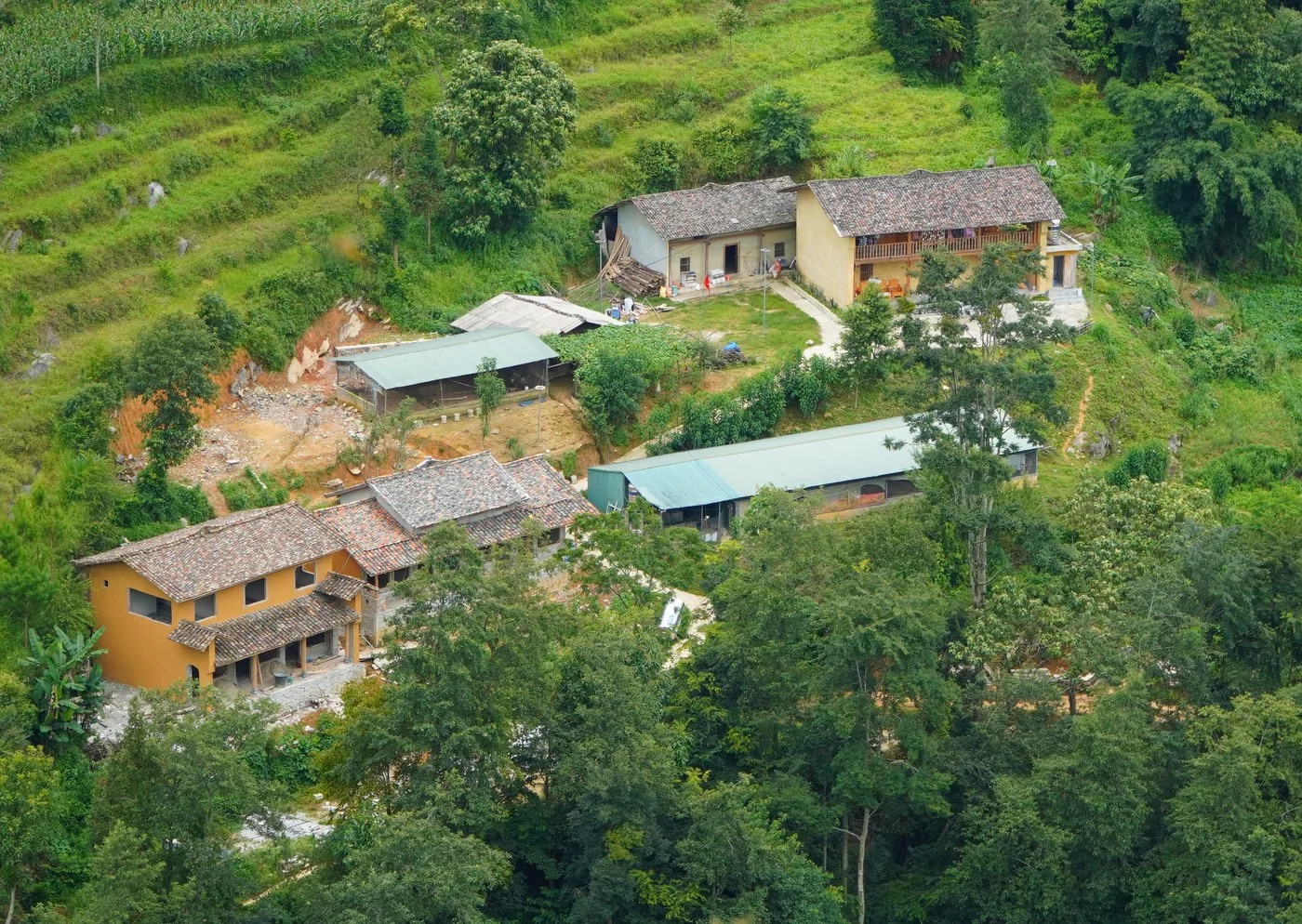
The local building traditions are there too, and they are different things. The Thanh Niên piece describes trình tường — rammed-earth walling, the Hmong technique. It also describes roofs laid with ngói âm dương, the interlocking convex-and-concave tiles. The gaps between the yin and yang tiles let air escape, which cuts condensation on the timber ceiling. Those are local answers to local problems. The stone market is a colonial answer to a fire.
Both are in the same few hundred metres. Telling them apart is most of what makes the walk interesting.
Why does a mountain town have a French street plan?
Because someone drew it.
The same source: “Đầu thế kỷ 20, thực dân Pháp chọn Đồng Văn là trung tâm hành chính và quân sự” — in the early 20th century the French chose Đồng Văn as an administrative and military centre. The quarter then formed as “dãy nhà phố hình chữ L vây quanh khu chợ”: rows of shophouses in an L, wrapped around the market.
Around the market. Not along a river, not up a ridge, not spreading out from a temple. The market square came first as the organising fact, and the buildings were arranged in relation to it.
That’s planning, and it’s unusual up here. Most settlements on this plateau grew where the land allowed, in the shape the land allowed. Đồng Văn’s centre has corners because an administration wanted corners.
What it means for you, practically: the square is the thing to orient by. Stand in it and the old quarter is legible in about ten minutes. Try to explore the town as a network of streets and it will feel smaller and more confusing than it is.
When is the market, and what happens there?
Sunday morning. There’s a caveat, and I want it in front of the answer rather than behind it.
VietnamNet, on 30 October 2023, writes that the market “mỗi tuần họp một lần vào sáng chủ nhật” — it meets once a week, on Sunday morning. I read that page on 20 August 2026. Vietnamese travel coverage agrees with it consistently.
What I couldn’t find is an official schedule. Not a district announcement, not a management-board notice, nothing with a stamp on it. So what I am giving you is a well-corroborated press report, and I am labelling it as one.
That distinction matters more than it sounds. A market day is exactly the kind of thing that quietly moves for a holiday, a festival, or a reorganisation, and the blogs repeating “Sunday” are mostly repeating each other rather than checking. If your trip depends on being there on market day, ask your accommodation the week you travel. It costs you one message.
What happens is a trading morning, not a performance. People come in from the surrounding villages early — traders are setting up well before the tourist hour — bringing produce, livestock and household goods, and it thins out through the middle of the day. Several ethnic groups trade here, which is why the clothing in every photograph is so varied.
One request, and I mean it: the people in that square are shopping, not modelling. Ask before you photograph faces.
Why won’t I tell you how high it is?
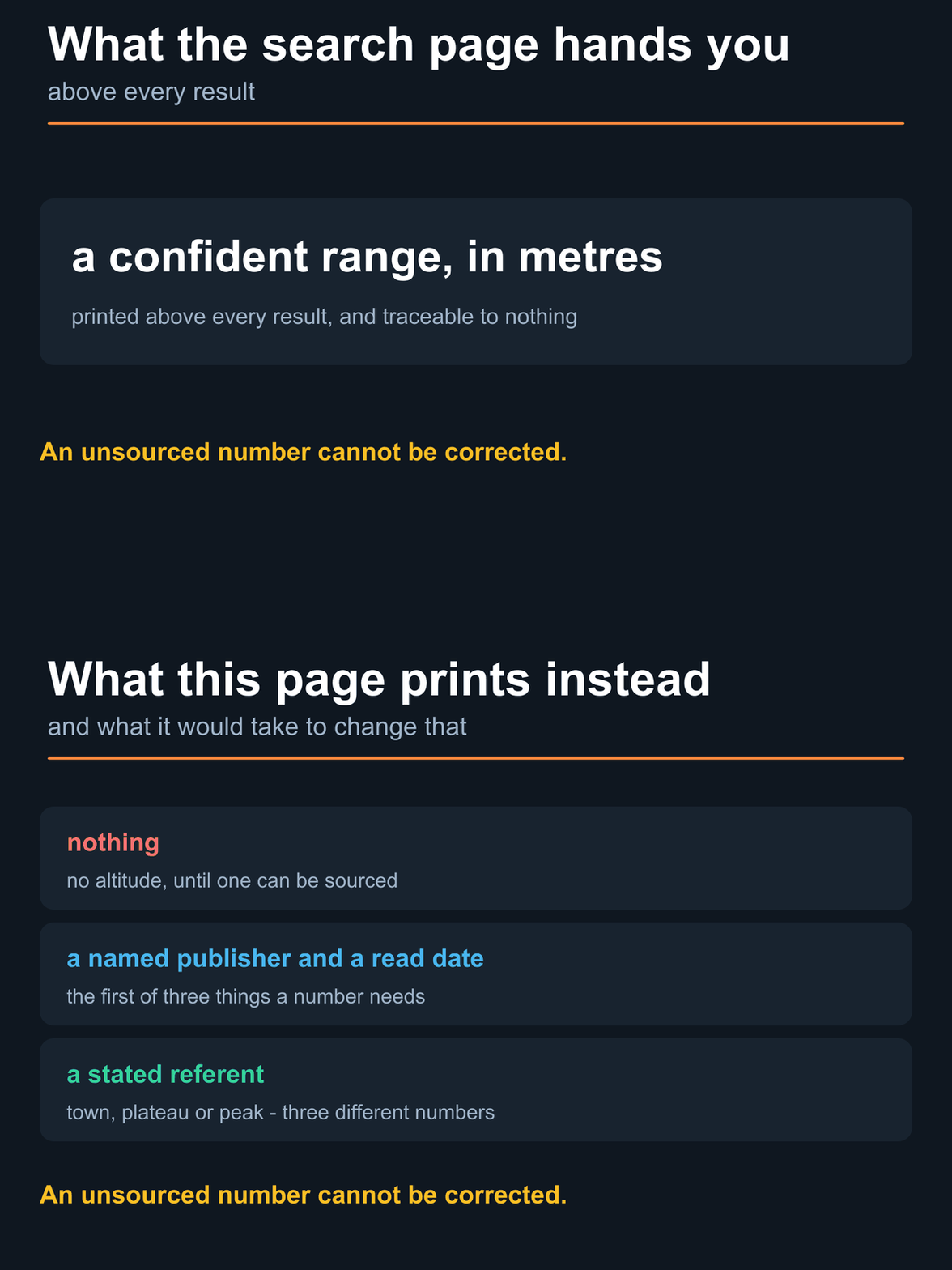
Because I can’t source it, and this site doesn’t print numbers it can’t source.
Search “dong van vietnam” and Google’s own AI summary will hand you an elevation of 1,000 to 1,600 metres above sea level. It’s on the first thing you see, above every result. It’s also the single figure this site’s source ledger specifically red-lists, because it cannot be traced to the UNESCO Global Geopark listing it gets attributed to.
So the number isn’t obviously wrong. It’s unsourced, which is a different problem and a worse one. An unsourced number can’t be corrected, because there’s nothing to check it against.
There is a second problem underneath it, and it is the one that actually catches people. An elevation range for a plateau is not the altitude of a town, and neither is the height of a peak. Those are three different referents that get printed interchangeably. A figure without a stated referent tells you nothing you can use, even when it happens to be accurate.
What I would publish: a figure with a named publisher, a date I read it, and a clear statement of what it measures. When I have one for Đồng Văn town, it goes on this page with all three attached.
Until then you get this paragraph instead, which I think is more honest than a confident number I would be quietly borrowing from a competitor who borrowed it from someone else.
Which province is Đồng Văn in now?
Tuyên Quang. This trips people up constantly, and most of the travel internet has not caught up.
Vietnam reorganised its provinces in 2025. The National Assembly passed Nghị quyết 202/2025/QH15 on 12 June 2025, and the new units began operating on 1 July 2025. Hà Giang province is not one of them. Its territory, Đồng Văn included, now sits within Tuyên Quang province.
You can watch the change land in the search results: Google’s knowledge panel for Đồng Văn already prints Tuyen Quang, while page after ranking page underneath it still says Ha Giang province.
The place names themselves are untouched. Đồng Văn is still Đồng Văn, Mèo Vạc is still Mèo Vạc, and nobody locally has started calling the road anything new. What changed is the province label above them, which matters when you are filling in a form, reading an official notice, or trying to work out whether a document that says “Hà Giang” is current.
Permit rules for the border area are a separate question and they have their own page — the border permit guide covers what applies and where.
Is the 2009 heritage listing verified?
The old quarter’s heritage status is solid. Báo Thanh Niên: “Năm 2009, phố cổ Đồng Văn được công nhận là di tích kiến trúc nghệ thuật cấp quốc gia” — in 2009 the Đồng Văn old quarter was recognised as a national architectural-artistic heritage site.
The decision number is where I have to stop short. Vietnamese search results attach Quyết định số 4195/QĐ-BVHTTDL, dated 16 November 2009, to that recognition. I haven’t been able to confirm it against a primary source.
The provincial host that ought to carry it, tuyengiao.hagiang.gov.vn, returns a single line — “Website đã hết hạn sử dụng”, the website’s registration has expired. I checked again on 20 August 2026 and that’s still all it returns.
So: the 2009 recognition is sourced. The number 4195 is reported, not verified, and I am naming the host that failed rather than implying I checked something I didn’t. If you find it in a ministry database, I would genuinely like to know.
Common questions
Why is Đồng Văn market made of stone?
Because the previous bamboo market burned down in 1923, and the French colonial administration had it rebuilt in stone — three blocks in a U shape. Báo Thanh Niên, 2 November 2025, read 20 August 2026.
What day is Đồng Văn market?
Sunday morning, according to VietnamNet, 30 October 2023, read 20 August 2026. That is a press report and not an official timetable; no official schedule was found. Confirm locally the week you travel.
Is Đồng Văn old quarter worth visiting?
If you like knowing why a place looks the way it does, yes — it is a rare planned quarter up here, with a documented reason for its shape and its material. If you are looking for a large old town, no. It’s small, and it reads in an hour.
What province is Đồng Văn in?
Tuyên Quang province, since the 2025 reorganisation. Nghị quyết 202/2025/QH15 passed on 12 June 2025 and the new units began operating on 1 July 2025. Sources still saying “Hà Giang province” predate that or have not updated.
How high is Đồng Văn?
I don’t publish a figure for this, and the section above explains why. The 1,000–1,600 m range that Google’s AI summary prints cannot be traced to the listing it is attributed to, and it describes a plateau rather than the town.
What is nhà trình tường?
Rammed-earth walling — the local Hmong building technique. The Thanh Niên piece describes it alongside ngói âm dương roof tiles. Those are the interlocking convex and concave tiles, and the gaps between them vent air and cut condensation on the ceiling below.
When was Đồng Văn old quarter recognised as heritage?
2009, as a national architectural-artistic heritage site. The decision number commonly quoted is 4195/QĐ-BVHTTDL, of 16 November 2009. It’s reported in Vietnamese search results, but I couldn’t verify it. The provincial host that should carry it returns “Website đã hết hạn sử dụng”.
Sources
- Báo Thanh Niên, Lam Yên, 2 November 2025 — Phố cổ Đồng Văn: chợ đá và nhà trình tường. Read 20 August 2026. Source for the 1923 fire, the stone rebuild, the L-shaped rows, the 2009 recognition, trình tường and ngói âm dương.
- VietnamNet, 30 October 2023 — Rực rỡ sắc màu chợ phiên Đồng Văn ngày cuối tuần. Read 20 August 2026. Source for the Sunday morning market.
- Nghị quyết 202/2025/QH15, passed 12 June 2025; new units operating from 1 July 2025. Source for the province change.
tuyengiao.hagiang.gov.vn— checked 20 August 2026, returns “Website đã hết hạn sử dụng”. The failed host for decision 4195/QĐ-BVHTTDL.
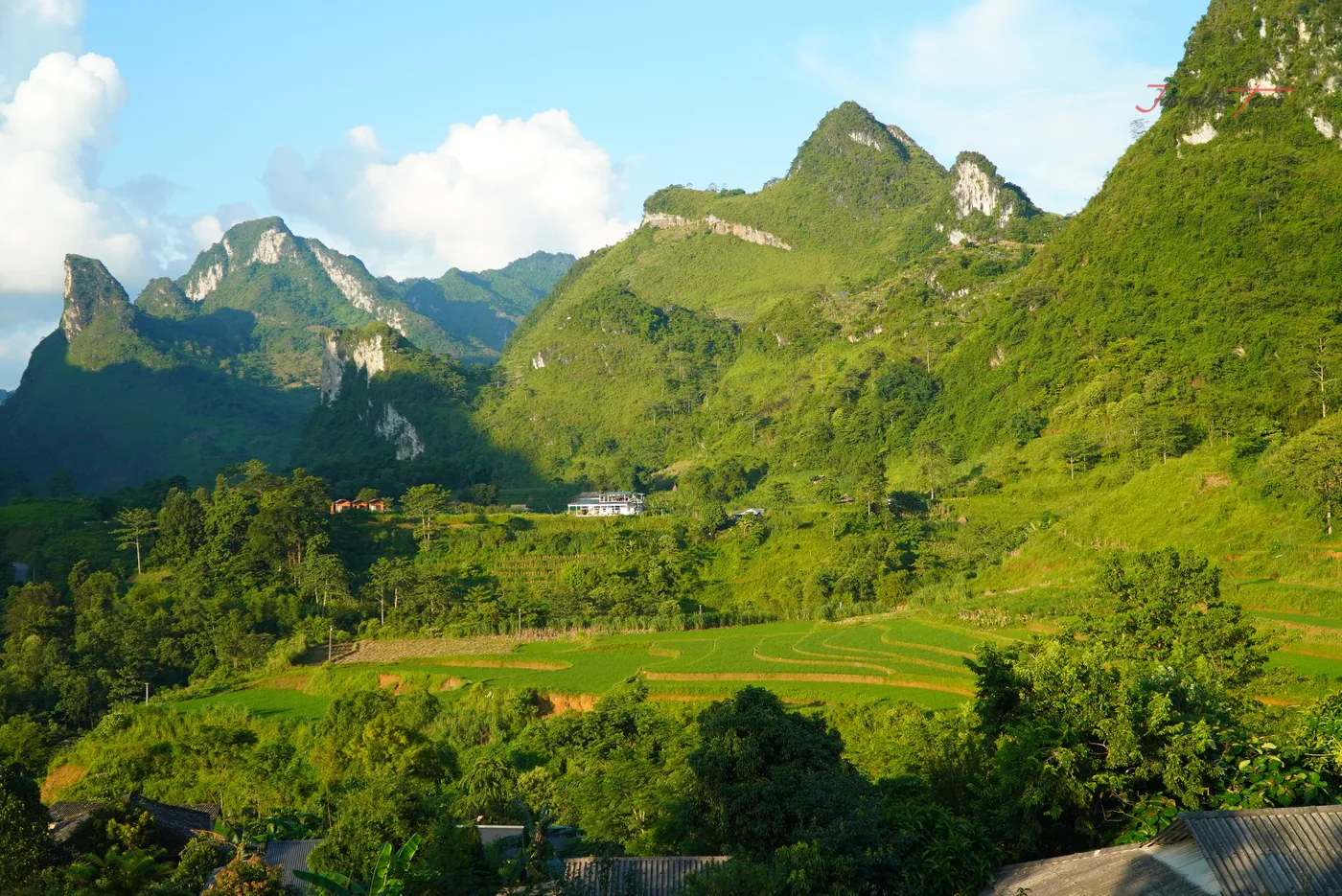
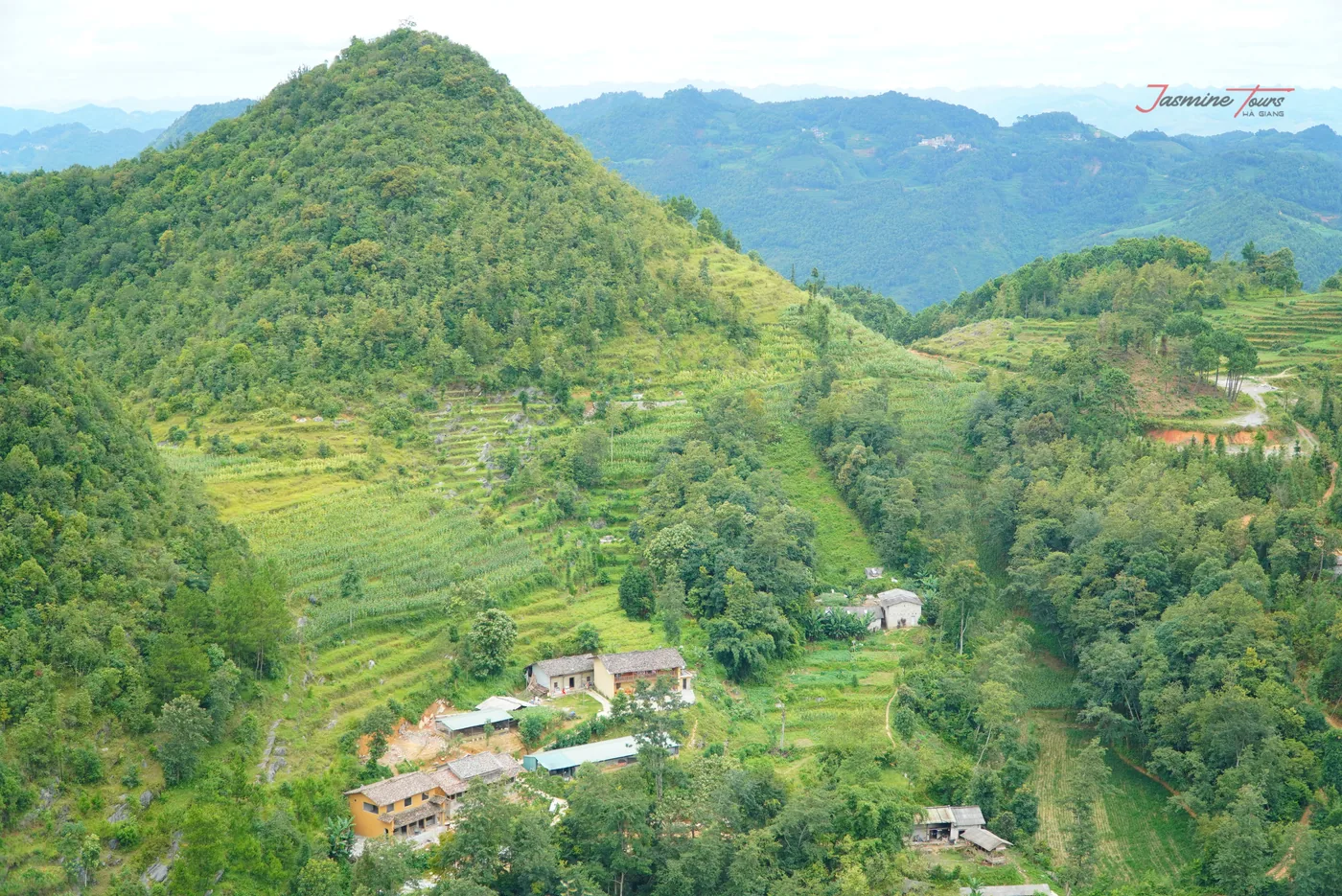
Photographs taken on our own trips, 30 and 31 July 2026. None of them shows Đồng Văn — not the town, not the old quarter, not the market. The pool holds no frame of any of them, so every caption above says where the picture actually is instead of pretending otherwise. Diagrams and cards are ours.