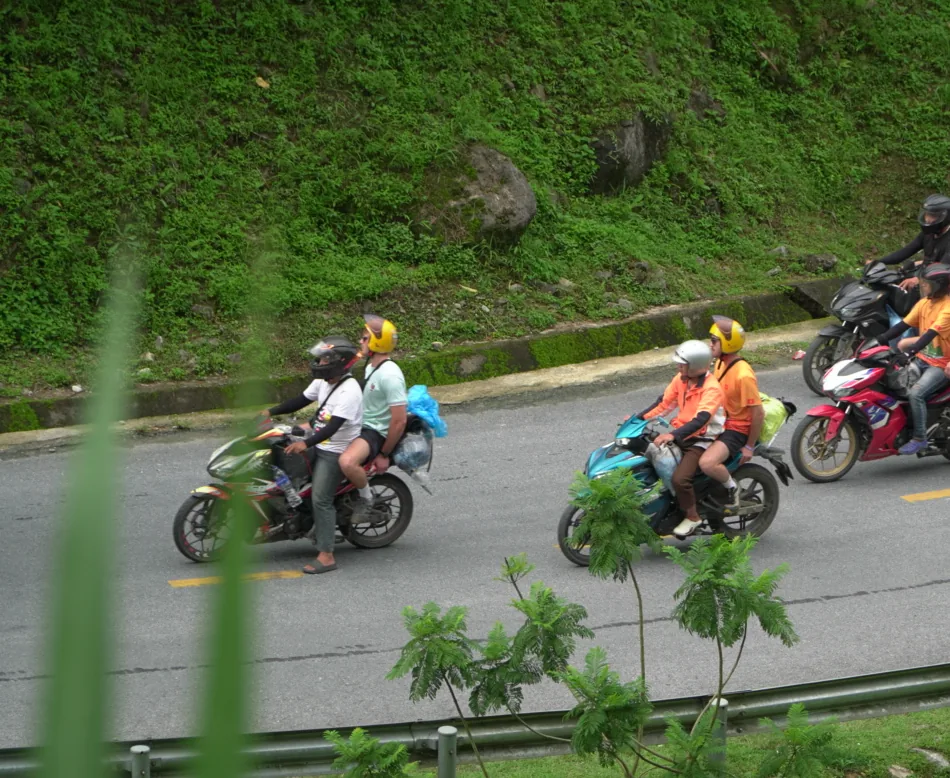
The loop finishes in Hà Giang, usually mid-afternoon — my own timing from working here, not a published one — and usually with everybody slightly deaf from three days of wind.
The bus west to Sa Pa leaves from an office at 60 Minh Khai Street, and the listing for it gives the journey at six and a half hours. Five run daily on the marketplace listing, the first at 07:30, the last at 19:30.
Which means the thing most people get wrong here isn’t the ticket. It’s the day they book it for.
The short version
- About six and a half hours by bus, five departures daily, office to office. Vexere’s listing for the Quang Nghị coach, read 4 August 2026. Vexere is the marketplace selling the seat, not the carrier.
- Two sources publish 235 km; the marketplace lists 310 km. BestPrice Travel and Full Moon Travel Asia both give roughly 235 km, both read 4 August 2026 — Full Moon publishes it for the reverse direction, and distance is symmetric — and BestPrice says the buses use that road. I cannot explain the extra 75 kilometres, so book against the published time.
- Published bus fares run 332.500₫ (Vexere) to about 578.320₫ (Full Moon Travel Asia) (US$12.65 to US$22 — the top figure is a struck-through original, not a fare anyone currently charges), both read 4 August 2026, converted at 26.287,25₫ to the dollar on 3 August 2026. BestPrice Travel publishes a private car at about 3.943.088₫ to 5.257.450₫ (US$150 to US$200), read 4 August 2026.
- The real decision is the order — loop first or Sa Pa first — and the rule I’d hold either way: don’t book this bus for the evening your loop ends.
- Both ends were rearranged administratively in 2025. You travel from Tuyên Quang province to Lào Cai province, and the former Hà Giang city and Sa Pa town are now phường, or wards, instead.
- I don’t know whether your border permit covers the Lào Cai side. I’m not guessing about something carrying a fine. Ask.
- This is not my road. The Hà Giang end is mine. Every figure below is somebody else’s published work, dated.
How long does Hà Giang to Sa Pa take?
Six and a half hours, on the timetable published in the listing for the coach.
| Leaves | Arrives | Bus |
|---|---|---|
| 07:30 | 14:00 | Limousine, 14-seat VIP |
| 11:30 | 18:00 | Limousine sleeper, 34 seats |
| 16:00 | 22:30 | Limousine, 19 seats |
| 18:00 | 00:30 | Limousine cabin sleeper, 24 |
| 19:30 | 02:00 | Limousine sleeper, 34 seats |
Quang Nghị, Hà Giang to Sa Pa, from the Vexere listing read 4 August 2026. Every one of them is listed at 6h30m. A timetable is what the company intends, not what the road allows.
Those departures are Vexere’s listing for Quang Nghị, read 4 August 2026, unchanged on 9 August. Full Moon publishes a different four for the same carrier — 07:30, 10:00, 16:00 and 20:00, read 4 August 2026 — which is a second reason not to treat any single timetable as settled. The vehicles are limousine and sleeper — vehicle classes here, not stretch cars. A limousine is a minibus refitted with a dozen wide reclining seats; a sleeper is a coach of flat berths.
Not everybody agrees with six and a half. BestPrice Travel’s guide publishes “8-9 hours” for buses; Full Moon Travel Asia gives “6 hours” for this direction, and “6-7 hours” only for the return — both read 4 August 2026. Plan against the longer figure: mountain variance runs one direction.
One departure disagrees with itself. Vexere lists the 07:30 arriving 14:00; Full Moon sells the identical 07:30 and publishes 13:30, read 4 August 2026. Half an hour is a fair measure of how precise these timings are.
The 07:30 is also the only departure delivering you into Sa Pa with an afternoon remaining. Everything from 16:00 arrives after dark, and the final two in the middle of the night.
Why don’t the published distances agree?
I don’t know. What I can tell you is that the sources are unevenly divided: two publish 235 km, one publishes 310 km.
| Published by | Distance | Time | Read |
|---|---|---|---|
| Vexere — the marketplace selling the seat | 310 km | 6h30m | 4 August 2026 |
| BestPrice Travel | 235 km | at least 5–6 hours direct | 4 August 2026 |
| Full Moon Travel Asia | 235 km, by bus | — | 4 August 2026 |
Two of the three publish the same figure. The marketplace’s is 75 km higher, and it reads like a routing figure rather than a road sign. I do not know why, and I am not going to invent a reason — so book against the published time, not against anybody’s kilometres.
Vexere lists 310 km. BestPrice Travel publishes 235 km and describes that road, in its own words, as “the direct route which is 235 km long-staying, mostly on the main road and also the same route with most of the bus”. Full Moon, selling a seat on the coach, independently gives “about 235 km”. BestPrice also gives “at least 5 – 6 hours” to cover that distance directly, read 4 August 2026 — a driving figure, not a bus one.
So both sources publishing 235 km attach it to the bus road, and I have no explanation for the marketplace’s extra 75 kilometres. Inventing one would be worse than admitting it.
What I’m deliberately not doing is telling you which roads those are. BestPrice describes two — a main road, and a border route “passing through Si Ma Cai and… Bac Ha” — but publishes no highway number for either, and I haven’t ridden this leg. A route description I invented would strand somebody at dusk.
What are your actual options?
| Option | How often | Published price |
|---|---|---|
| Sleeper or limousine bus | Five a day, about 6h30m | 332.500₫ minimum, 356.250₫ average |
| Private car, door to door, 4 seats | On demand | US$150–200 — about 3.943.088₫ to 5.257.450₫ |
| Ride it yourself | Your own bike, your own day | No published figure |
Vexere and BestPrice Travel’s own published figures, read 4 August 2026. There is no train and no flight: Sa Pa’s nearest station is in Lào Cai and Hà Giang has no railway — my own knowledge from working here, not a published figure.
There’s no train and no flight. Hà Giang has no railway whatsoever, and Sa Pa’s nearest station sits down in Lào Cai — that observation is mine, from working here, rather than a published figure. Carrying on by rail from Sa Pa therefore means a further leg down to Lào Cai; this page does not price or time it.
The bus is what almost everybody takes: five departures, an office at each end, a fare in tens of dollars rather than hundreds.
A private car buys the door and the departure hour. BestPrice Travel publishes “around 150-200 USD” for a four-seat vehicle, read 4 August 2026 — about 3.943.088₫ to 5.257.450₫. Four average bus tickets total 1.425.000₫ (US$54.21), so the car costs between about 2.8 and 3.7 times what those passengers pay for coach seats. Worth it for the convenience, but nowhere near parity.
Riding it yourself is the option nobody prices, because it isn’t a transfer. It’s a day of the trip. Coming off the loop on a rented motorbike, you’d also have to arrange what happens to that machine — a conversation to have before departure, not afterwards.
Should you do the loop first, or Sa Pa first?
This is the part I can genuinely help with, because it isn’t about the road. It’s about what a person is fit for.
| Loop first | Sa Pa first |
|---|---|
| Sa Pa is where you land, not where you start | You reach Hà Giang already on the road |
| The loop sets your dates; Sa Pa absorbs a delay | Sa Pa becomes the flexible end of the trip |
| You arrive tired for walking, not for riding | You start the loop on a travel day, which is a real cost |
| A blocked road costs you Sa Pa, not the loop | A blocked road here eats into your loop days |
Either way, do not book the bus for the evening the loop ends. That comparison is my own knowledge from working in Hà Giang, August 2026 — not a published figure.
Loop first. The loop sets your dates, being the component with fixed days and a booked machine. Sa Pa becomes the flexible end — walking, eating, sitting down — absorbing delay without costing anything already paid for.
Sa Pa first. You reach Hà Giang already travelling, already acclimatised to Vietnamese coaches. The cost: a blocked road now consumes loop days, and you begin the loop on a travel day.
The one thing I’d hold either way: do not book this bus for the evening the loop ends.
The final day of a three-day loop is the long one — the disadvantage of three days against four, and it’s on the route page. Riders arrive later than expected, filthy, and unfit for six more hours sitting down. Give it a night. My own view, not a published rule.
What does it cost?
Before the numbers: Weigh it accordingly.
| What | Price | Published by, read 4 August 2026 |
|---|---|---|
| Bus, from-price | 332.500₫ — about US$12.65 | Vexere |
| Bus, average listed fare | 356.250₫ — about US$13.55 | Vexere |
| Bus, a second published fare | US$19, discounted from US$22 — about 499.458₫ | Full Moon Travel Asia |
| Private car, 4 seats | US$150 to US$200 — about 3.943.088₫ to 5.257.450₫ | BestPrice Travel |
Converted at 26.287,25₫ = US$1, XE mid-market rate, 3 August 2026. None of these is a receipt. They are published prices, read on the dates given.
Vexere lists the route from 332.500₫ (about US$12.65), averaging 356.250₫ (about US$13.55). Full Moon Travel Asia publishes US$19 per passenger (about 499.458₫), struck through from an original US$22 (about 578.320₫). The genuine published spread is therefore 332.500₫ to about 578.320₫ (US$12.65 to US$22), not a single price. A private car costs about 3.943.088₫ to 5.257.450₫ (US$150 to US$200). All read 4 August 2026, converted at 26.287,25₫ to the dollar on 3 August 2026.
The coach leaves from the carrier’s own office at 60 Minh Khai Street, and at least one agency resells seats on it — Full Moon says it works with bus companies to hold seats, read 4 August 2026.
That spread runs from a marketplace’s from-price to one agency’s discounted booking — not evidence anybody is overcharging. And none of these is a receipt: a published price is what somebody says they charge.
Against the remainder of the trip this is small money. The loop itself costs an order of magnitude more. Reaching Hà Giang originally has its own page.
Both ends of this trip were rearranged in 2025
Nghị quyết 202/2025/QH15, National Assembly, passed 12 June 2025. The Hà Giang end:
Sắp xếp toàn bộ diện tích tự nhiên, quy mô dân số của tỉnh Hà Giang và tỉnh Tuyên Quang thành tỉnh mới có tên gọi là tỉnh Tuyên Quang.
Hà Giang and Tuyên Quang become one province, named Tuyên Quang. And the Sa Pa end:
Sắp xếp toàn bộ diện tích tự nhiên, quy mô dân số của tỉnh Yên Bái và tỉnh Lào Cai thành tỉnh mới có tên gọi là tỉnh Lào Cai.
Yên Bái and Lào Cai become one province, still named Lào Cai. Local governments began operating on 1 July 2025, and the resolution gives 34 province-level units — 28 tỉnh and 6 thành phố. Separate resolutions rearranged the wards at each end: Hà Giang city became phường Hà Giang 1 and 2, and Sa Pa town became phường Sa Pa.
This catches people out on forms and on newer maps, and it’s the identical reform at both ends.
Nghị quyết 202/2025/QH15, passed by the National Assembly on 12 June 2025, merged Hà Giang and Tuyên Quang into one new province, which took the name Tuyên Quang:
“Sắp xếp toàn bộ diện tích tự nhiên, quy mô dân số của tỉnh Hà Giang và tỉnh Tuyên Quang thành tỉnh mới có tên gọi là tỉnh Tuyên Quang […]”
And in the same instrument, at the other end:
“Sắp xếp toàn bộ diện tích tự nhiên, quy mô dân số của tỉnh Yên Bái và tỉnh Lào Cai thành tỉnh mới có tên gọi là tỉnh Lào Cai […]”
Each is the operative sentence of its clause; the bracketed ellipsis marks the area and population figures that follow. The new arrangement began operating 1 July 2025, and the resolution gives the national total as 34 province-level units, 28 tỉnh and 6 thành phố.
Separately, the wards at each end were rearranged too — the part usually reported incorrectly. Nghị quyết 1684/NQ-UBTVQH15 converted the former city of Hà Giang into phường Hà Giang 1 and phường Hà Giang 2. Nghị quyết 1673/NQ-UBTVQH15 combined the six wards of Sa Pa town into a single phường Sa Pa, within a Lào Cai counted at “99 đơn vị hành chính cấp xã, gồm 89 xã và 10 phường”. Both are Standing Committee instruments at commune level, read 9 August 2026 — a different body and tier from the province merger.
You’ll still hear Hà Giang and Sa Pa in speech and see them on signage, and writing them as places remains correct. Writing “Hà Giang city” or “Sa Pa town” as administrative units is not: neither exists. What the name change did and didn’t do has its own page.
Does your border permit carry over?
I don’t know, and this is a situation where I’d rather say so than round it off.
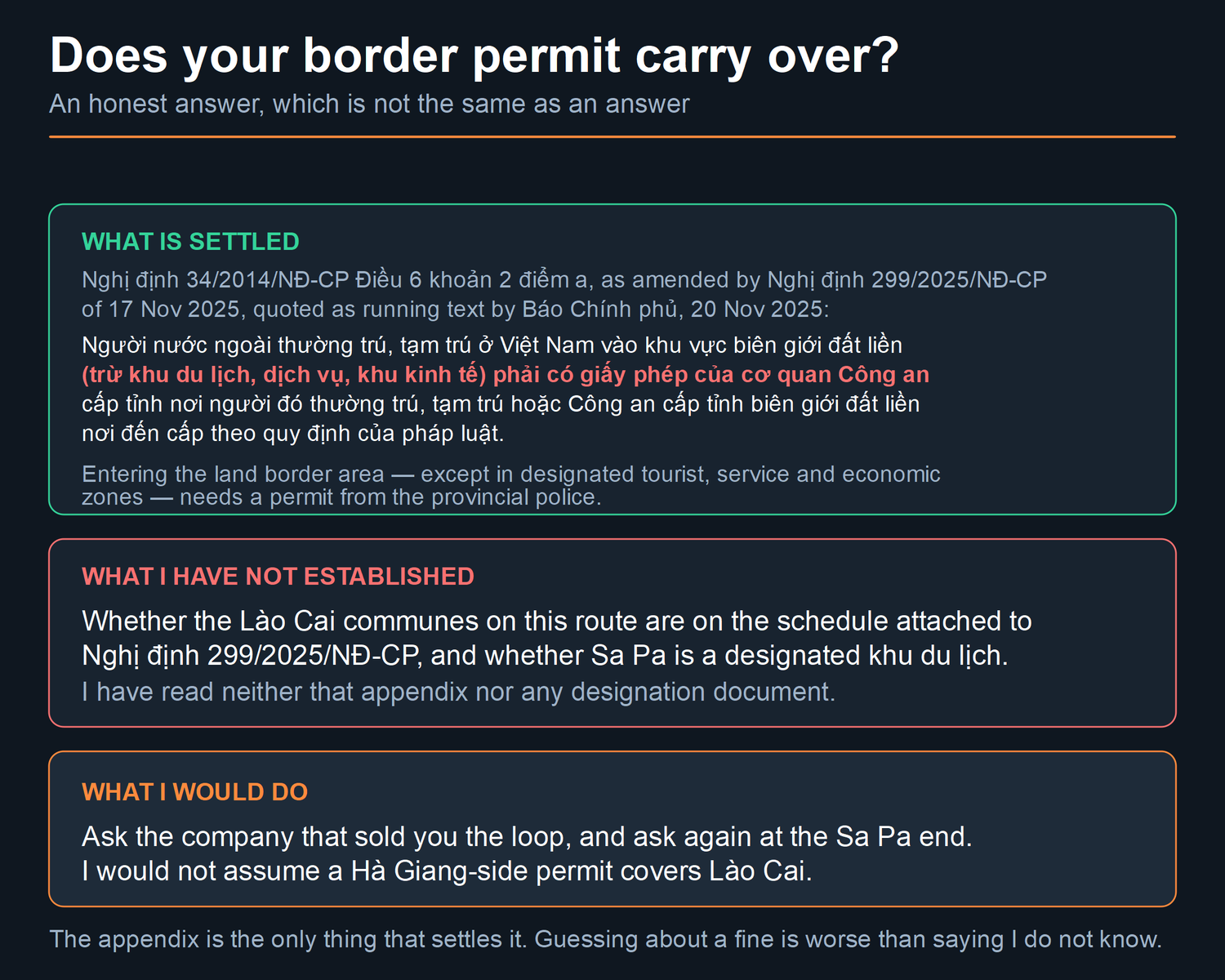
Here is what is settled, with the bracket inside it left in because that bracket is the operative part. This is Nghị định 34/2014/NĐ-CP Điều 6 khoản 2 điểm a as amended by Nghị định 299/2025/NĐ-CP of 17 November 2025. Read both links knowing what each one gives you: the first serves the original 2014 text, which does not carry the bracket, and the second is a record page serving a signed PDF rather than page text. For the amended clause as running text, the Government’s own newspaper quoted it on 20 November 2025, bracket included — read 10 August 2026.
“Người nước ngoài thường trú, tạm trú ở Việt Nam vào khu vực biên giới đất liền (trừ khu du lịch, dịch vụ, khu kinh tế) phải có giấy phép của cơ quan Công an cấp tỉnh nơi người đó thường trú, tạm trú hoặc Công an cấp tỉnh biên giới đất liền nơi đến cấp theo quy định của pháp luật.”
A foreign national living in Vietnam on permanent or temporary residence, entering the land border area — except within designated tourist, service and economic zones — must hold a permit from the provincial police. A separate point of the same khoản covers Vietnamese organisations bringing foreign nationals in — which is what a loop company does, and is why the question below is one for them. The decree’s verb is vào, to enter: entering triggers it, and overnight accommodation is a separate rule. The permit has its own page.
Here’s what I haven’t established, and it’s two things. Whether the Lào Cai communes on this route appear on the schedule attached to Nghị định 299/2025/NĐ-CP — that appendix settles it and I haven’t read it. And whether Sa Pa is a designated khu du lịch within that bracket, which would remove the requirement entirely. A khu du lịch is a formally designated zone, not simply anywhere tourists gather, and I’ve found no designation document.
What I’d do: ask the company that sold your loop, before departing Hà Giang, whether your permit covers where you’re heading. Then ask again at the far end. A permit is small money; a fine and an argument in a language you don’t speak isn’t.
When is this road worth avoiding?
| Season | When |
|---|---|
| Tropical cyclone season | May to November |
| Rain season, north and south | June to September |
UK Foreign, Commonwealth & Development Office, read 3 August 2026, in their own wording: “Roads may become blocked due to mudslides and landslides.” A blocked road here is not just a wet day. It is a missed connection at the far end, and this leg has five departures, not fifty.
The UK Foreign, Commonwealth & Development Office puts the tropical cyclone season at May to November and the rain season at “from June to September in the north and south”, stating plainly: “Roads may become blocked due to mudslides and landslides.” Read 3 August 2026, rechecked 9 August.
That isn’t a reason to stay away — people travel here throughout. It’s a reason to hold a day in reserve on a leg offering five departures, not fifty. What the seasons actually do up here is on the weather page.
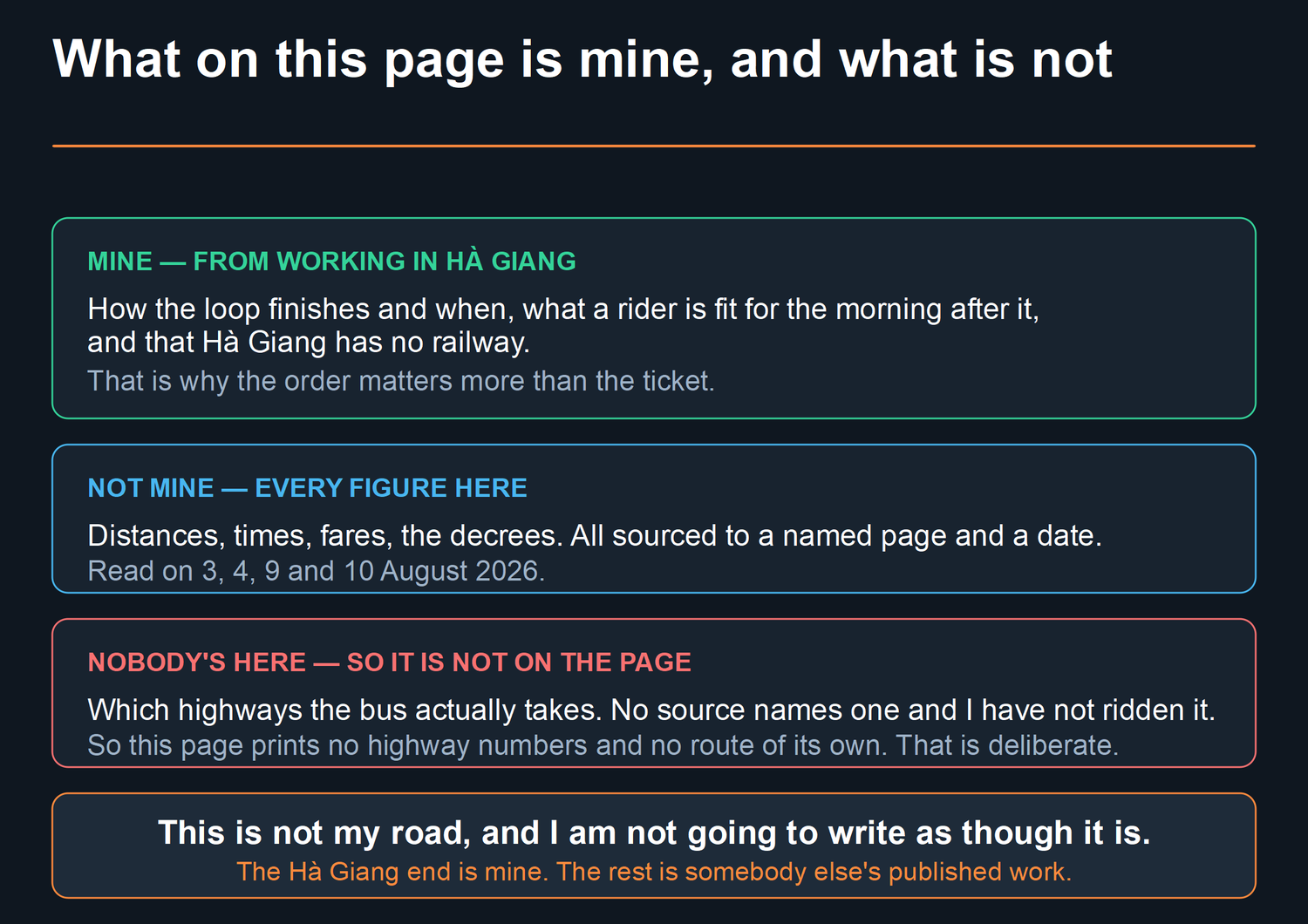
And now the thing I said I’d come back to. This is not my road.
I’ve spent years working the loop — placing the stops, splitting the days, learning which pass you don’t want at four in the afternoon. West of the city I’m reading identical published pages to yours, and I’ve named which ones and when.
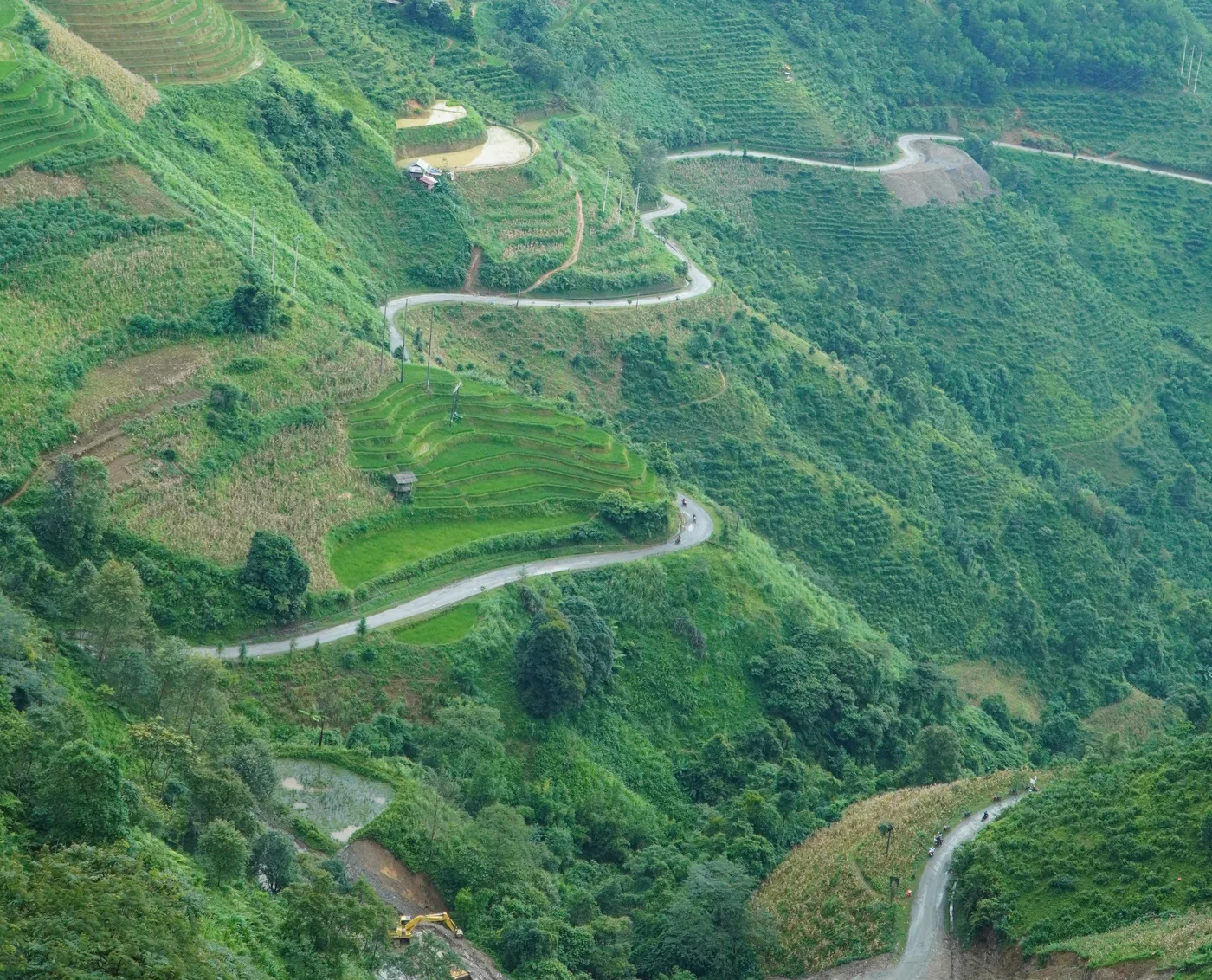
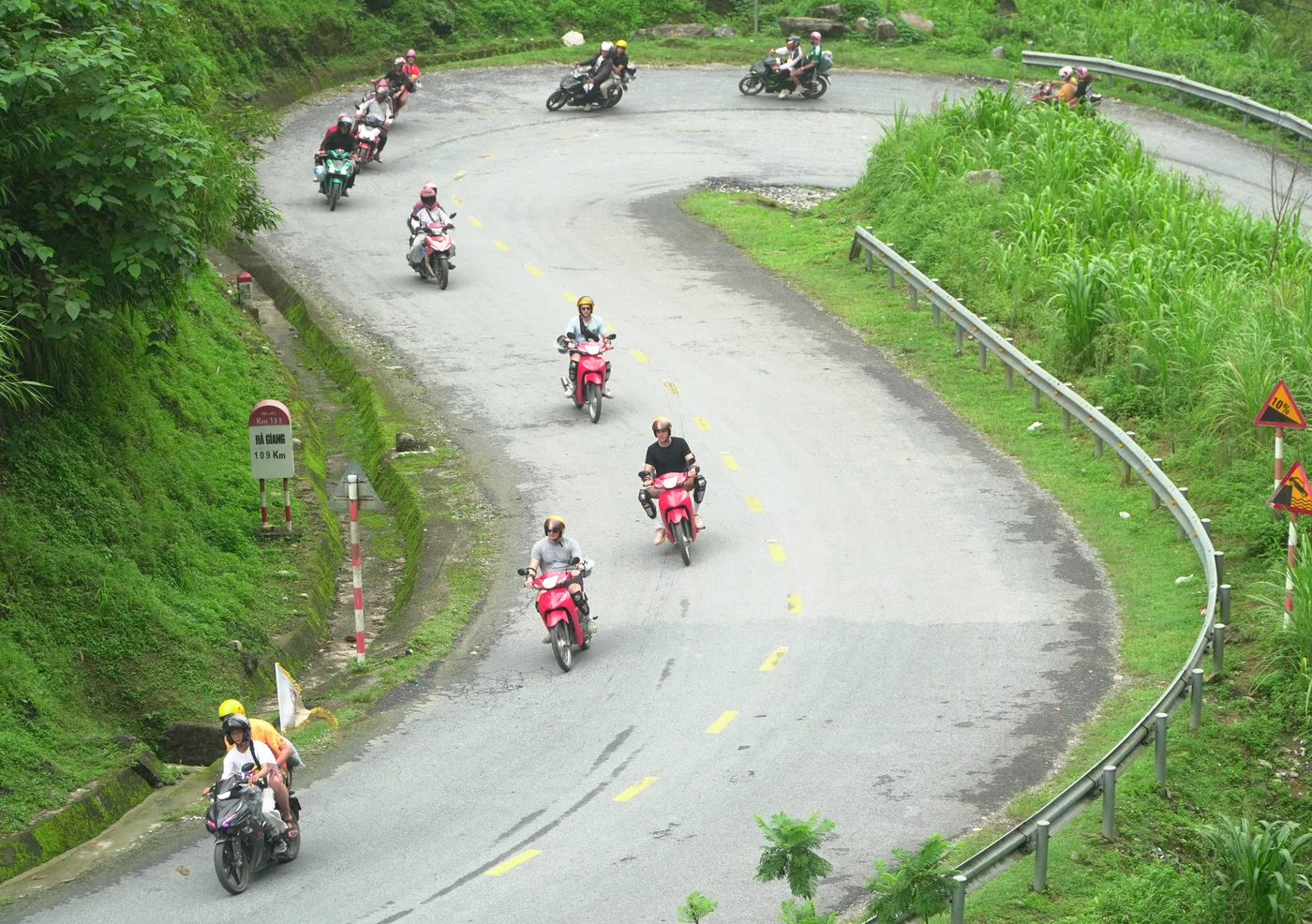
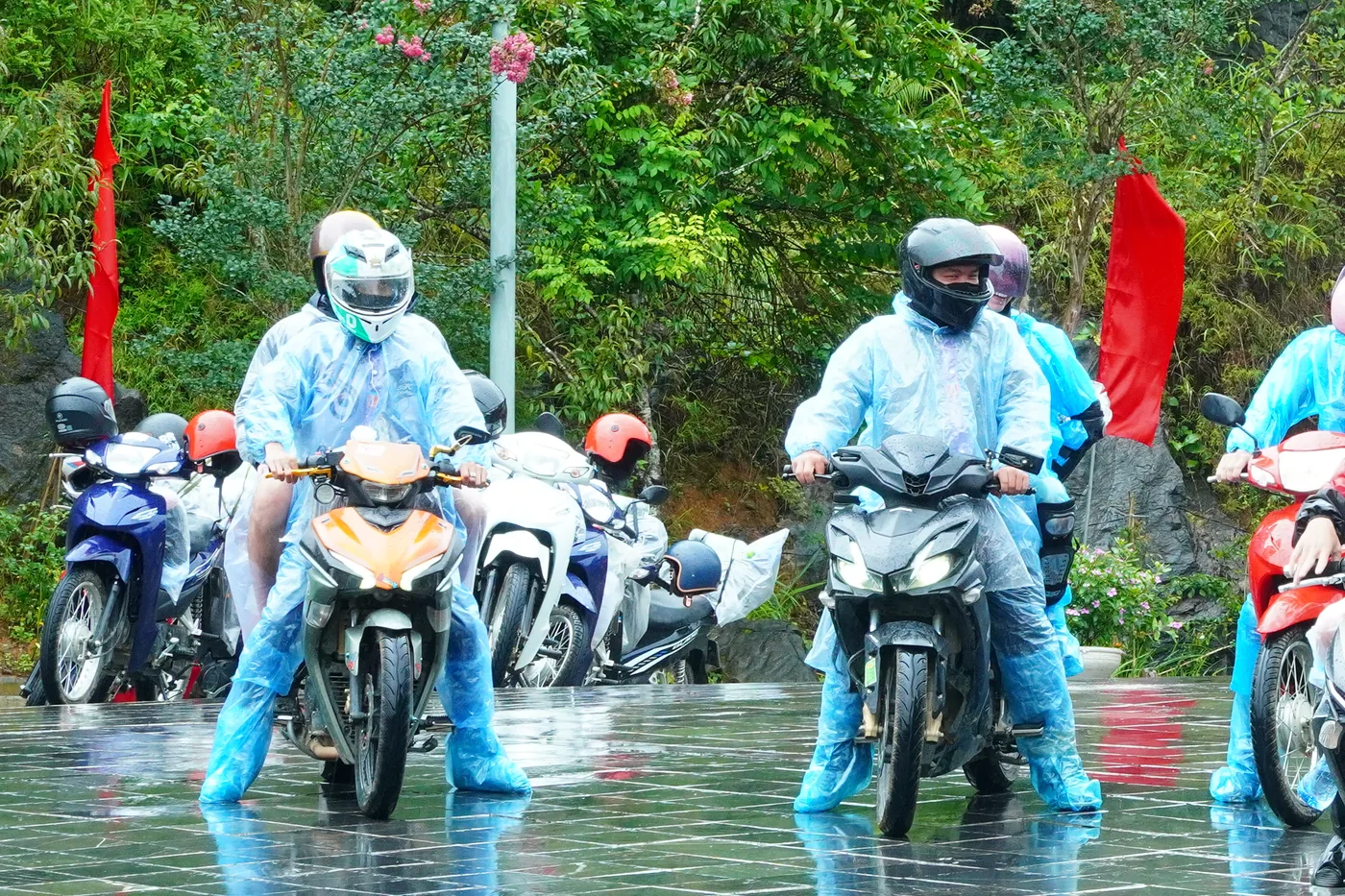
There’s no photograph of the Sa Pa road here for the same reason. Every frame in this site’s pool is from the loop, and captioning one as a road I haven’t ridden would be a small lie.
- Decide the order first — loop then Sa Pa, or Sa Pa then loop.
- Book the bus for the day after the loop ends. Not the same evening.
- Check the departure time against when your loop actually finishes.
- Ask your Hà Giang operator whether your permit covers where you go next.
- Between June and September, keep a spare day in hand.
- Want Sa Pa the same afternoon? Take the 07:30 and nothing later.
Items 1 to 4 are my own knowledge from working in Hà Giang, August 2026. Items 5 and 6 follow the FCDO and the Vexere listing cited above.
Common questions
How long does it take to get from Hà Giang to Sa Pa?
About six and a half hours by coach, on the timetable published in Vexere’s listing, read 4 August 2026. BestPrice Travel publishes 8-9 hours for buses; Full Moon Travel Asia gives 6 hours — both read 4 August 2026. Plan against the longer end.
How far is Hà Giang from Sa Pa?
Two published sources give roughly 235 km — BestPrice Travel and Full Moon Travel Asia — and BestPrice states the buses use that road. Vexere, the marketplace, lists 310 km. All three read 4 August 2026. I cannot explain the difference and won’t invent one.
Is there a direct bus from Hà Giang to Sa Pa?
Yes. Quang Nghị is listed with five daily — 07:30, 11:30, 16:00, 18:00 and 19:30 — in sleeper and limousine coaches, office to office. Vexere’s listing, read 4 August 2026. Vexere is the marketplace, not the carrier.
How much is the bus from Hà Giang to Sa Pa?
Vexere lists it from 332.500₫ (US$12.65), averaging 356.250₫ (US$13.55). Full Moon Travel Asia publishes US$19 per passenger (about 499.458₫), discounted from US$22 (about 578.320₫). Both read 4 August 2026, converted at 26.287,25₫ to the dollar on 3 August 2026. A four-seat private car is published at about 3.943.088₫ to 5.257.450₫ (US$150 to US$200) by BestPrice Travel, read 4 August 2026.
Should I do the Ha Giang Loop before or after Sa Pa?
Either works. Loop first means Sa Pa absorbs delay; Sa Pa first means a blocked road consumes loop days already paid for. Whichever you choose, don’t book this bus for the evening your loop ends — my own view, not a published rule.
Do I need a permit to travel from Hà Giang to Sa Pa?
The Hà Giang side carries a border-area permit requirement, and the clause includes a carve-out for designated tourist, service and economic zones. Whether the Lào Cai communes on this route sit on the schedule attached to Nghị định 299/2025/NĐ-CP, and whether Sa Pa is a designated khu du lịch, are both unestablished. Ask the company that sold your loop.
Which province is Sa Pa in now?
Lào Cai — a province which since 1 July 2025 also contains former Yên Bái, under Nghị quyết 202/2025/QH15 of 12 June 2025. Hà Giang belongs to Tuyên Quang. Sa Pa itself is now phường Sa Pa rather than a town, under Nghị quyết 1673/NQ-UBTVQH15.
A note on this page. Times, distances and fares come from named vendors’ own pages, read 4 August 2026 and rechecked 9 August: Vexere’s Quang Nghị listing, Full Moon Travel Asia’s booking page, BestPrice Travel’s guide. None of the three is the carrier. Seasonal wording is the UK Foreign, Commonwealth & Development Office. US$ figures convert at 26.287,25₫ = US$1, XE mid-market rate, 3 August 2026.
Merger clauses are quoted from Nghị quyết 202/2025/QH15, National Assembly, 12 June 2025 — the instrument enacting the reform, not the earlier Party resolution proposing it. Commune-level rearrangements are Nghị quyết 1684/NQ-UBTVQH15 and Nghị quyết 1673/NQ-UBTVQH15, read on the government policy portal 9 August 2026.
What is mine rather than sourced is marked where it appears: that the loop finishes mid-afternoon; that riders finish unfit for six hours aboard a coach; the recommendation about travel order; that Hà Giang has no railway; and that Sa Pa’s nearest railway station is in Lào Cai.
Three things deliberately unpublished: which highway numbers either route uses, whether the Lào Cai side needs a permit, and any photograph presented as the road west.