
You will not see a sign. That is the first thing to understand.
Somewhere in the first hour out of Hà Giang city you ride into an area where, as a foreign traveller, you are supposed to be carrying a permit. There’s no barrier, no gate, nothing that announces it. You find out at a checkpoint, or you don’t find out at all.
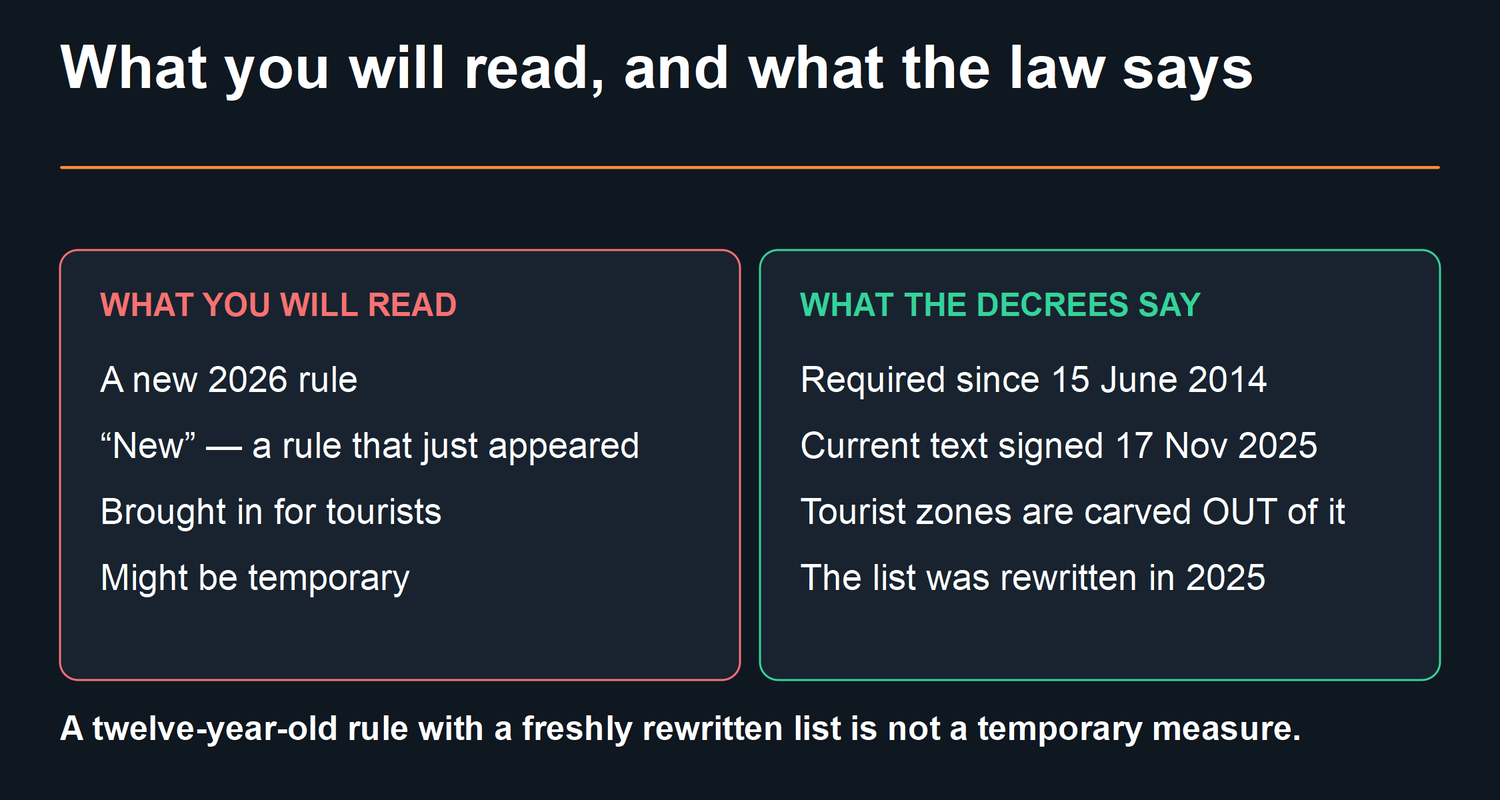
Almost everything written about this in the last few months calls it a new 2026 rule. It isn’t, and I’ll show you the dates.
The short version
- Yes, foreign travellers need a border area permit for most of the ground the loop crosses.
- It costs 260.000₫ — about US$10 at 26.287,25₫ to the dollar, 3 August 2026. That figure is mine, from working here in August 2026.
- If you book through a tour company, they buy and register it for you. If you travel independently, you buy it yourself. That is the whole distinction, and it has nothing to do with whether you ride or sit behind a driver.
- It is not a new rule. Vietnam has required it since 15 June 2014. The current text dates from 17 November 2025. What changed in 2026 was that people started being checked — and that last part is my own observation, not a date in any decree.
- The zone starts earlier than you think — by my reckoning around Minh Tân, about 21 km out of Hà Giang city.
- Entering is what requires it, not staying the night.
Do you need a border permit for the Ha Giang Loop?
If you are a foreign national, yes, for most of it.
The requirement isn’t about the loop, and that’s why it confuses people. It is about the land border area — a legal zone made of the communes and wards part of whose administrative boundary coincides with Vietnam’s land border. That is all of Vietnam’s land borders, 248 communes across 22 provinces; in Hà Giang’s case the border in question is with China. The loop runs through a great deal of that zone. It wasn’t designed around tourism and it doesn’t care that you’re on holiday.
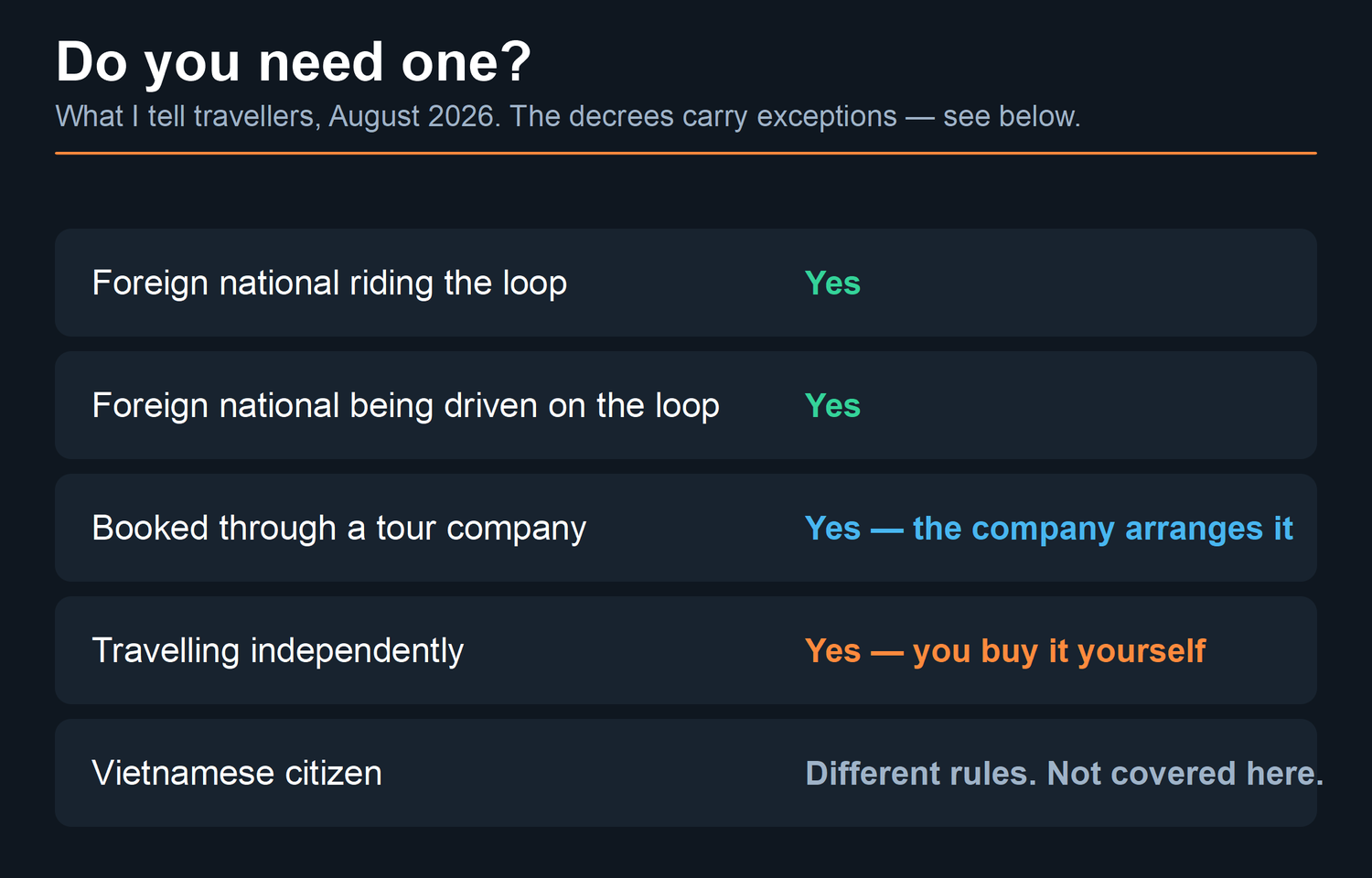
This page is written for foreign travellers, because that is who this site is for. The rules for Vietnamese citizens are different, and I’m not covering them here.
It is not a new rule, and the dates matter
Here is where nearly everything online is wrong, and it is worth getting right because the wrongness has a shape: if you believe this appeared in 2026, you’ll also believe it might disappear.
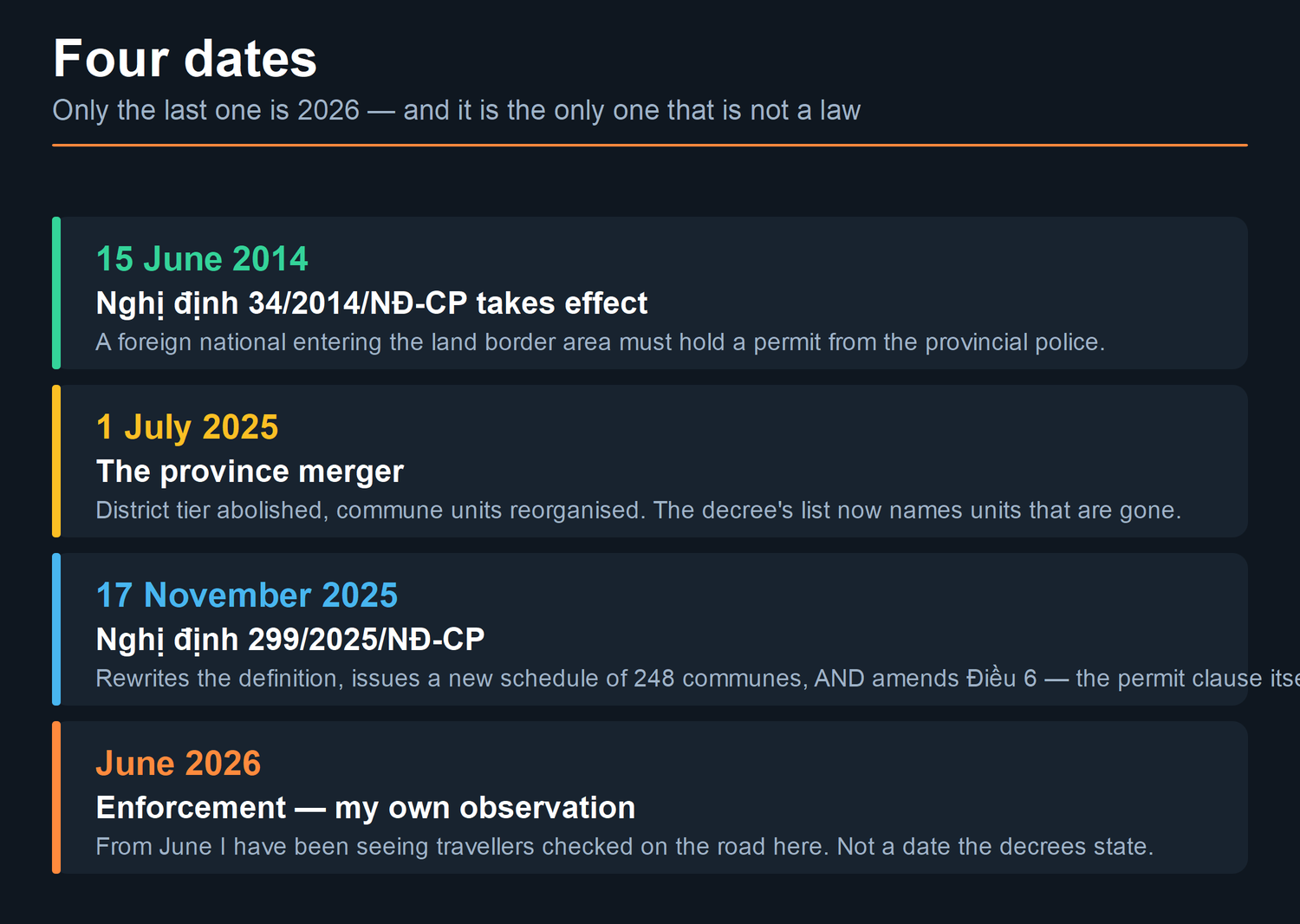
15 June 2014. Nghị định 34/2014/NĐ-CP comes into force. A foreign national entering the land border area must hold a permit from the provincial police. Twelve years ago.
1 July 2025. Hà Giang stops being a province — merged into Tuyên Quang — and the district tier is abolished nationwide. Commune units are reorganised in the same reform. The list of border communes attached to the 2014 decree is now describing units that don’t exist any more.
17 November 2025. Nghị định 299/2025/NĐ-CP is signed and takes effect the same day. It rewrites the definition of the land border area and issues a new schedule — 248 communes and wards across 22 provinces, replacing the older list.
June 2026. From June I have been seeing travellers checked on the road here. That one is my own observation, not a date any decree states.
So the honest sentence is: the requirement is twelve years old, the current legal text is from November 2025, and what changed in 2026 was that people started being checked.
Read that way, the useful conclusion is the opposite of “new rule, might blow over”. A twelve-year-old requirement with a freshly rewritten commune list behind it is not a temporary measure.
One thing worth correcting, because it is easy to get backwards. The new schedule lists 248 communes where the old one listed more. That’s not the border zone shrinking — commune units were merged in the 2025 reform, so there are fewer of them and each is larger. If anything the ground the schedule covers went up: merge a border commune with an inland neighbour and the whole enlarged commune is on the list. The province count fell from 25 to 22 for the same reason — provinces merged, not borders.
Where does the border zone actually start?
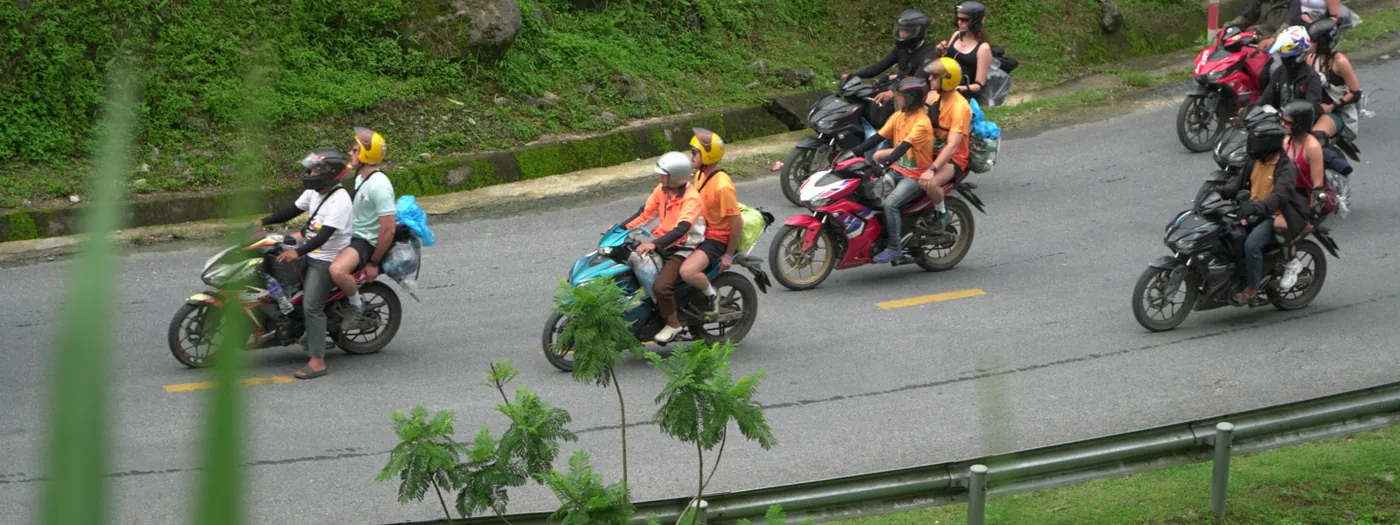
Earlier than almost everyone expects, and this is the practical heart of the page.
People assume the border zone means the far north — Đồng Văn, Lũng Cú, the flag tower, the bit that obviously touches China. Those are all inside it. But so is a lot of ground long before them, and that’s the bit nobody says.
By my own reckoning you are inside the zone by around Minh Tân, roughly 21 km out of Hà Giang city on QL4C. That is the first hour of an ordinary day one. It means the permit isn’t a thing you need if you go all the way north — it’s a thing you need more or less as soon as you leave town.
I want to be precise about what that sentence is. The decrees define the zone by naming communes in a schedule. The 21 km figure is mine, from working these roads — it is not a number the law states. If you want the legal boundary rather than my reckoning, it is the commune list attached to Nghị định 299/2025/NĐ-CP.
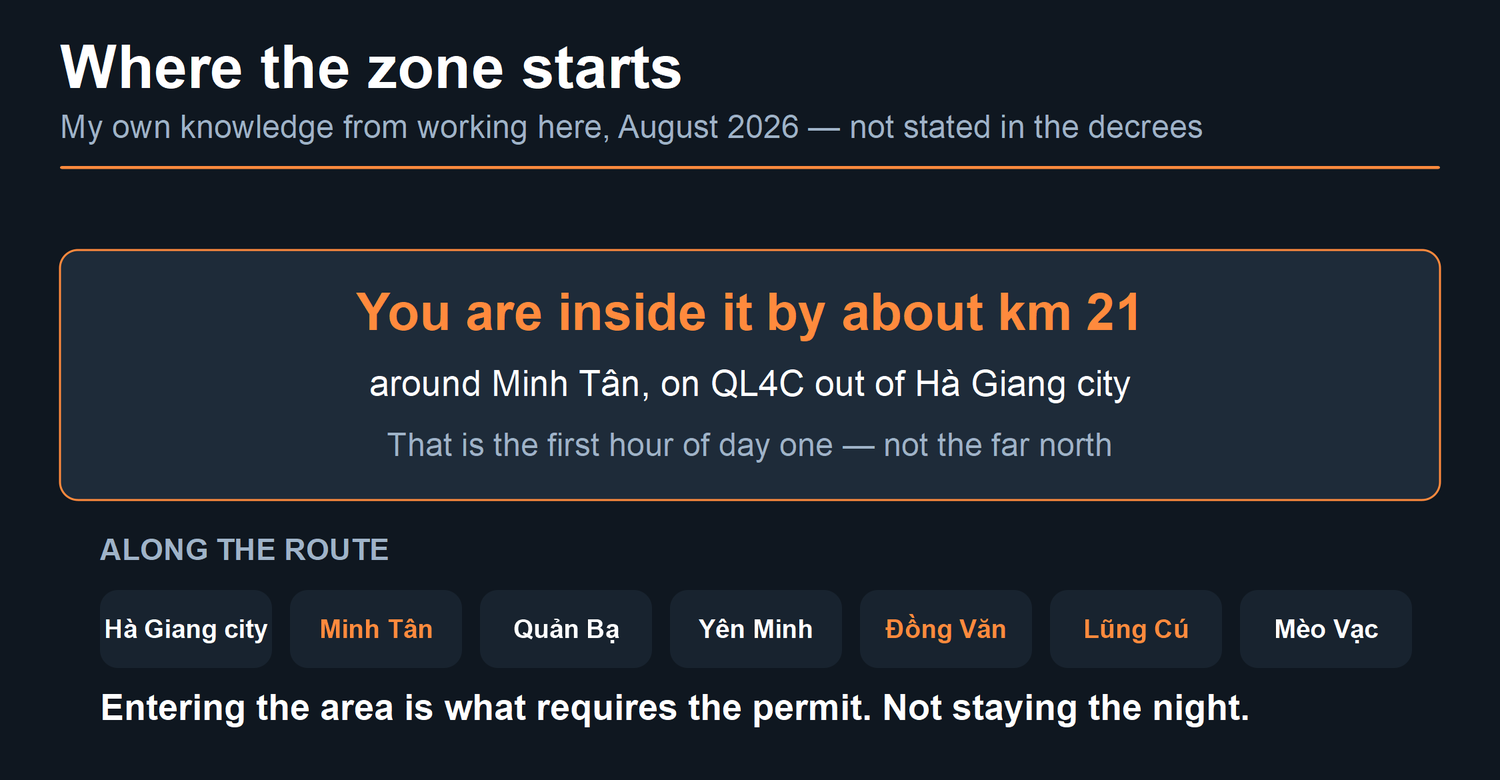
The other half of this, and it is the half that catches people out: it is entering the area that requires the permit, not sleeping in it.
That is not just my reading. The decree’s own verb is vào — to enter. The obligation attaches on the way in.
A lot of what you will read confuses this with a separate rule about registering where you stay overnight. They’re different things. You can ride in, take photographs, eat lunch, ride out the same afternoon and never unpack — and you were supposed to have the permit for all of it.
Who buys it — you or your tour company?
This is the question that actually decides what you have to do, and I had it wrong myself before I checked.

If you book through a tour company, the company buys and registers the permit for you. That’s what operators here do as a matter of course. You give them your passport details and it’s handled before you ride.
If you are travelling independently, you buy it yourself.
Now the part I want to be very clear about. I’ve seen it stated wrongly, and I stated it wrongly myself first. This has nothing to do with whether you drive or sit behind a driver.
A rider who self-drives as part of a tour group still has the permit arranged by the company. A traveller who hires a private car with a driver but books it independently still has to sort their own.
It’s the booking channel that decides it. Not the ride style.
If you are unsure which category you are in, the test is simple: is there a company whose name is on your booking and who knows your passport number? Then ask them, today, whether the permit is included. If the answer is vague, treat that as a no and go and buy one.
What does it cost, and what do you bring?
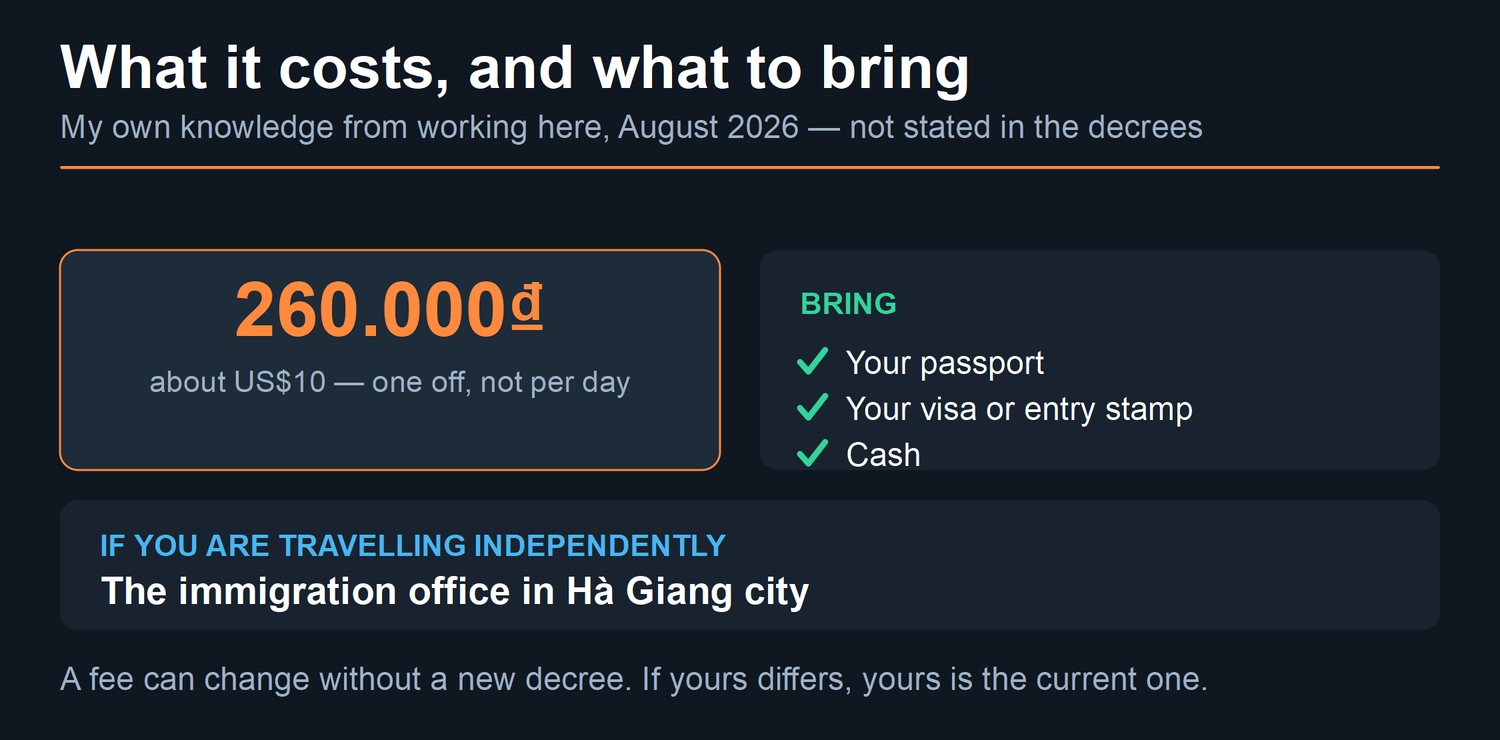
260.000₫, about US$10. A one-off fee, not a daily one. That’s it.
Bring your passport and your visa or entry stamp, and bring cash. Independent travellers get it at the immigration office in Hà Giang city.
That figure and that process are my own knowledge from working here, as at August 2026. They aren’t printed in the decrees, and a fee can change without a new decree being written. If yours differs, yours is the current one.
What happens if you don’t have one?
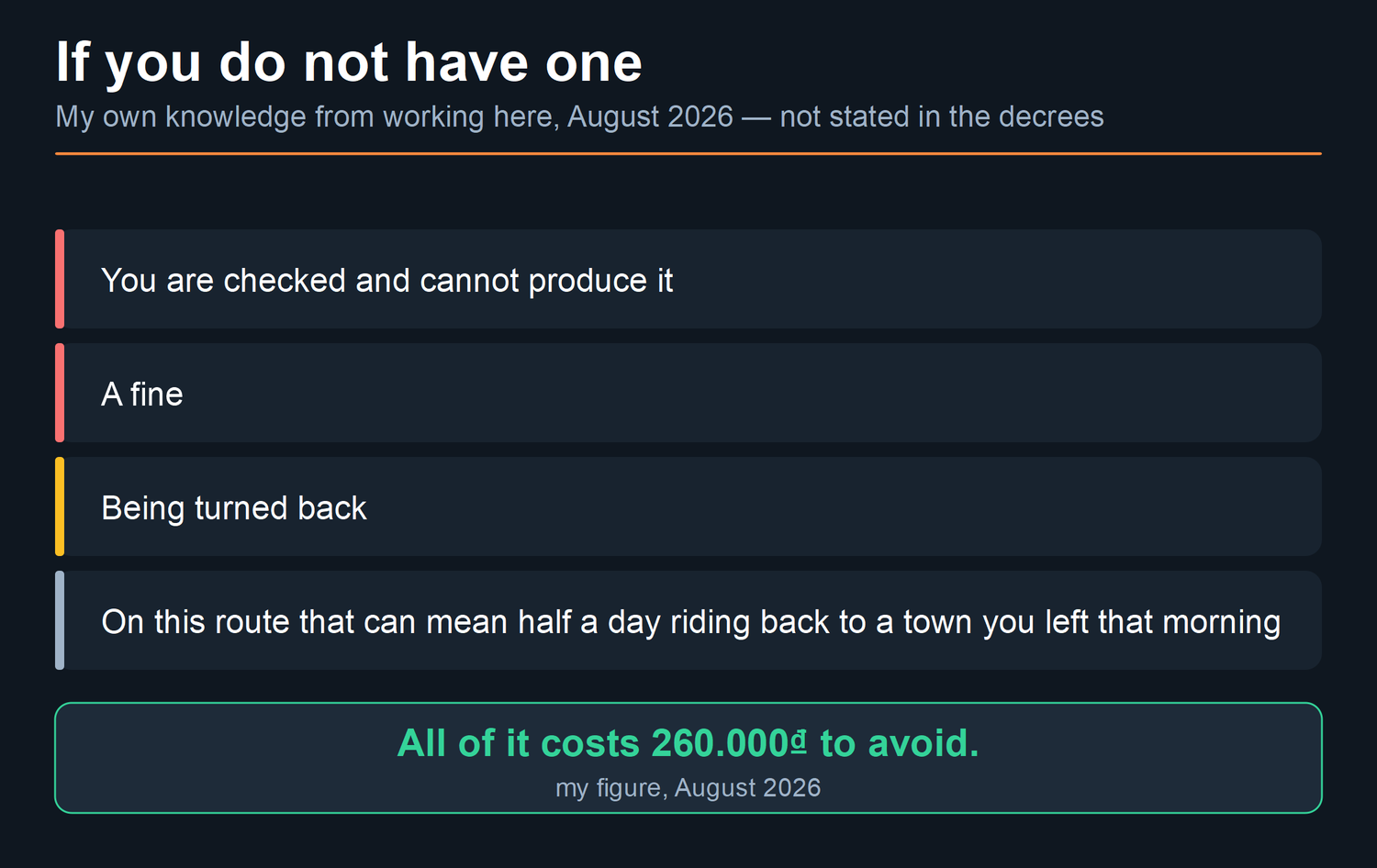
You get checked, and you can be fined. That is what I see here in August 2026 — the decrees set the requirement, not the enforcement practice.
I’m not going to dramatise this — nobody’s being dragged off a mountain. But being turned back on this route is not like being turned back on a motorway. The distances are long, the days are already tight, and losing half of one to ride back to a town you left that morning is a genuinely bad way to spend a holiday.
The trip is roughly 450 km over three or four days by my reckoning. The route has enough navigation problems on it already, and enough real hazards, without adding a paperwork one — and this one you could have solved in an office, for the price of two coffees.
What the law actually says
Two documents. I’m quoting them in Vietnamese because that’s what they’re written in, and paraphrases of legal text are how bad advice starts.
![Card headed "What the law actually says", quoted in full, accessed 4 August 2026. ĐIỀU 6 KHOẢN 2a, Nghị định 34/2014/NĐ-CP, in force 15 June 2014, as amended by Nghị định 299/2025/NĐ-CP, in force 17 November 2025: "Người nước ngoài thường trú, tạm trú ở Việt Nam vào khu vực biên giới đất liền (trừ khu du lịch, dịch vụ, khu kinh tế) phải có giấy phép của cơ quan Công an cấp tỉnh nơi người đó thường trú, tạm trú hoặc Công an cấp tỉnh biên giới đất liền nơi đến cấp theo quy định của pháp luật." Glossed: A foreign national entering the land border area — except tourist, service and economic zones — must hold a permit from the provincial police, issued where they are staying in Vietnam or by the border province they enter. Nghị định 299/2025/NĐ-CP, in force 17 November 2025: "Khu vực biên giới đất liền […] bao gồm xã, phường có một phần địa giới hành chính trùng hợp với đường biên giới quốc gia trên đất liền." Glossed: The communes and wards part of whose boundary coincides with the national land border. Footer: The carve-out and the issuing-authority tail were both added by the 2025 decree.](https://hagianglocal.com/wp-content/uploads/2026/08/ha-giang-border-permit-decrees.png)
Nghị định 34/2014/NĐ-CP, Điều 6 khoản 2a — in force 15 June 2014, as amended by Nghị định 299/2025/NĐ-CP. Both accessed 4 August 2026. (That first link carries the 2014 original, so the bracket and the tail are not on it — they come from the 2025 amendment, whose signed text is the PDF behind the Công báo link below.)
“Người nước ngoài thường trú, tạm trú ở Việt Nam vào khu vực biên giới đất liền (trừ khu du lịch, dịch vụ, khu kinh tế) phải có giấy phép của cơ quan Công an cấp tỉnh nơi người đó thường trú, tạm trú hoặc Công an cấp tỉnh biên giới đất liền nơi đến cấp theo quy định của pháp luật.”
A foreign national entering the land border area — except in designated tourist, service and economic zones — must hold a permit from the provincial police, issued either where they are staying in Vietnam or by the border province they are entering.
Two things in that sentence matter and almost nothing online quotes them.
The first is the bracket. There is a carve-out for designated tourist, service and economic zones — and it was added by the 2025 decree, which is why anyone reading only the 2014 original will miss it. I do not read the ordinary road and villages of the loop as one of those zones, but that is my reading, not the decree’s.
And read the words carefully. Khu du lịch means a formally designated zone — not simply anywhere tourists go. You cannot assume Đồng Văn or Mã Pí Lèng counts as one because they are full of visitors. If you think you are inside a designated zone, ask somebody; do not decide it yourself.
The second is the tail. The permit can be issued by the police where you are staying in Vietnam — it does not have to be the border province. If you are in Hanoi with time to spare, that is worth knowing.
Nghị định 299/2025/NĐ-CP — signed and in force 17 November 2025, published in Công báo — defines the area:
“Khu vực biên giới đất liền […] bao gồm xã, phường có một phần địa giới hành chính trùng hợp với đường biên giới quốc gia trên đất liền.”
The land border area consists of the communes and wards part of whose administrative boundary coincides with the national land border. The communes themselves are listed in an appendix to that decree — Phụ lục I, and that appendix is the only artefact that settles whether a particular village is inside.
One more thing 299/2025 did, and the article above would be incomplete without it: it also amended Điều 6 itself — the permit clause. The requirement survived the rewrite in substantially the same form, gaining the tourist-zone carve-out and the issuing-authority tail. That is the point. A rule that gets carried through a rewrite is not a rule on its way out.
I’m a guide, not a lawyer, and this page isn’t legal advice. What I can tell you is what the decrees say and what happens here in practice. If your situation is unusual — a long stay, a work visa, a route off the loop — ask your operator or ask at the immigration office rather than relying on me.
Common questions
Do foreigners need a permit for the Ha Giang Loop?
Yes, for most of the route. Nghị định 34/2014/NĐ-CP has required a foreign national entering the land border area to hold a permit from the provincial police since 15 June 2014, and much of the loop runs inside that area.
How much is the Ha Giang border permit?
260.000₫, about US$10, as a one-off fee. That is my own figure from working here in August 2026, not a number published in the decrees.
Is the Ha Giang permit a new 2026 rule?
No. The requirement dates from 2014 and the current legal text, Nghị định 299/2025/NĐ-CP, was signed on 17 November 2025. What changed in 2026 is that travellers started being checked — that last part is my own observation from working here in August 2026, not something the decrees state.
Does my tour company arrange the permit?
If you booked through one, normally yes — operators here buy and register it for their customers. That is what I see them do; it is not written in the decrees. If you are travelling independently you buy it yourself. Ask your company directly rather than assuming, and treat a vague answer as a no.
Do I need it if I’m only riding through and not staying overnight?
Yes. Entering the area is what requires the permit. The overnight registration rule is a separate thing, and confusing the two is where a lot of published advice goes wrong.
Where do I get it if I’m travelling independently?
The immigration office in Hà Giang city. Bring your passport, your visa or entry stamp, and cash. Note though that the decree lets the provincial police where you are staying in Vietnam issue it too — so if you are in Hanoi with time before you travel, that is an option.
What if I already booked and nobody mentioned a permit?
Ask the company today. It takes one message, and it is a great deal easier to sort before you ride than at a checkpoint.
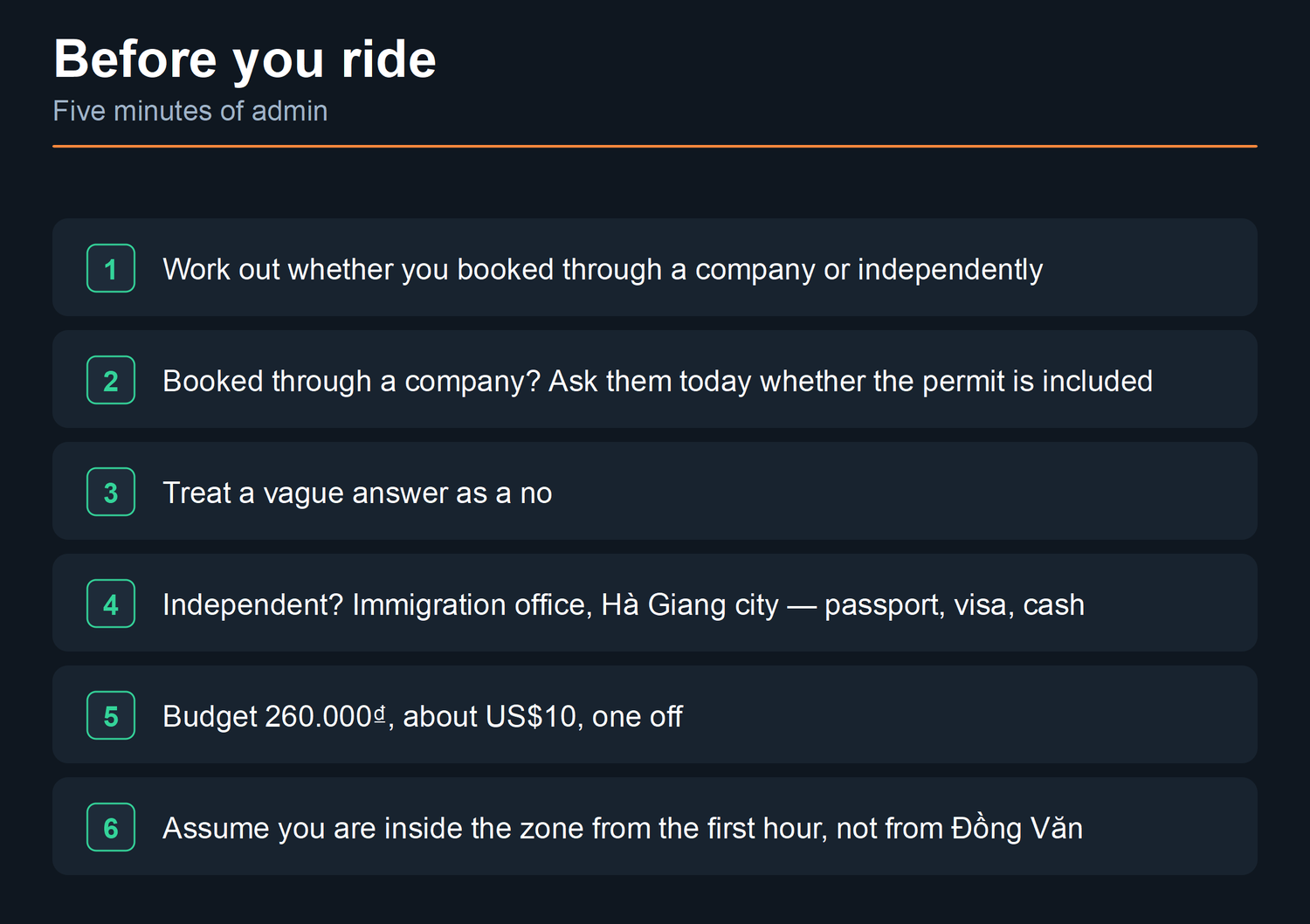
That’s the whole thing. It isn’t complicated, it’s just quiet — and quiet is exactly how people miss it.
A note on this page. The legal material is quoted from the Vietnamese decrees themselves — Nghị định 34/2014/NĐ-CP as amended by Nghị định 299/2025/NĐ-CP — in the original and in full, with my own translation beside it, and both are linked above. Accessed 4 August 2026. I have deliberately not cited another travel blog anywhere on this page; on a requirement that carries a fine, the decree is the only source worth having.
The fee, who arranges the permit, where the zone begins on QL4C, and what happens at a checkpoint are my own knowledge from working here, dated August 2026. They are not stated in the decrees, and each is marked as mine where it appears — in the prose, in the short version, in the FAQ and on the cards.
One thing I have not published: how long a permit is valid, and what the fine actually is. I have seen figures for both and I do not have a source I would stand behind, so they are not on this page.
I am not a lawyer and this is not legal advice. Enforcement practice can change faster than a decree does.