Something changed in May, and the search data is where you see it.
In the Australian figures (DataForSEO Labs, run 3 August 2026), easy rider Ha Giang Loop sat between 30 and 70 searches a month for the ten months before that — then went to 1,000 in May 2026 and 2,400 in June.
That isn’t people getting nervous about the road. The road hasn’t changed. My read is that it’s people finding out, late, that they aren’t allowed to drive.
So this page answers what an easy rider costs and what you get. But the part that matters more, and that I could not find set out anywhere else, is this: taking an easy rider doesn’t make the licence problem go away. It hands it to somebody else, and you should know who.
The short version
- An easy rider is a driver you hire. You sit on the back of his bike for the whole loop and never touch the controls.
- It costs about 1.373.760₫ more than driving yourself over three days — that is roughly US$52 at 26.179₫ to the dollar, 20 August 2026 — on Jasmine Tours’ published prices. Over four days the gap is 1.944.000₫ (about US$74).
- You need a 1968 International Driving Permit and your home licence to drive here. The UK Foreign Office says so plainly. Most people who turn up don’t have one.
- As a passenger, your medical cover can depend on your driver’s licence, not yours. One insurer writing about this exact route makes it a condition in so many words.
- There is no “passenger driver” licence to ask for. As far as I know no specific requirement has been issued for these drivers, most operators check your licence rather than their own driver’s, and the drivers largely work for themselves. So what separates operators isn’t a permit — it’s whether they train their drivers and pay their social insurance.
What an easy rider actually is
The term is used loosely all over Vietnam, so here is the plain version.
An easy rider is a local driver you pay to ride the loop with you on the back. Not a guide who rides alongside you on your own bike — a driver whose bike you are a passenger on. You carry nothing but a day bag. He carries the luggage, picks the lines through the bad surface, and decides when to stop.
That last part is worth sitting with. On roughly 450 km by my own reckoning, over three or four days at about eight hours a day door to door, somebody is making a few thousand small decisions about speed, overtaking and where to put the wheels. On an easy rider tour, that person is not you.
What does it cost over self-driving?
The prices below are our own listed figures. That’s our own tour — Jasmine Tours is the company behind this site.
They are on this page for one reason: they are the only two figures I can put side by side for the same trip, the same duration and the same inclusions, which is the only way to show the gap honestly. Read them as a seller’s numbers, because that is what they are.
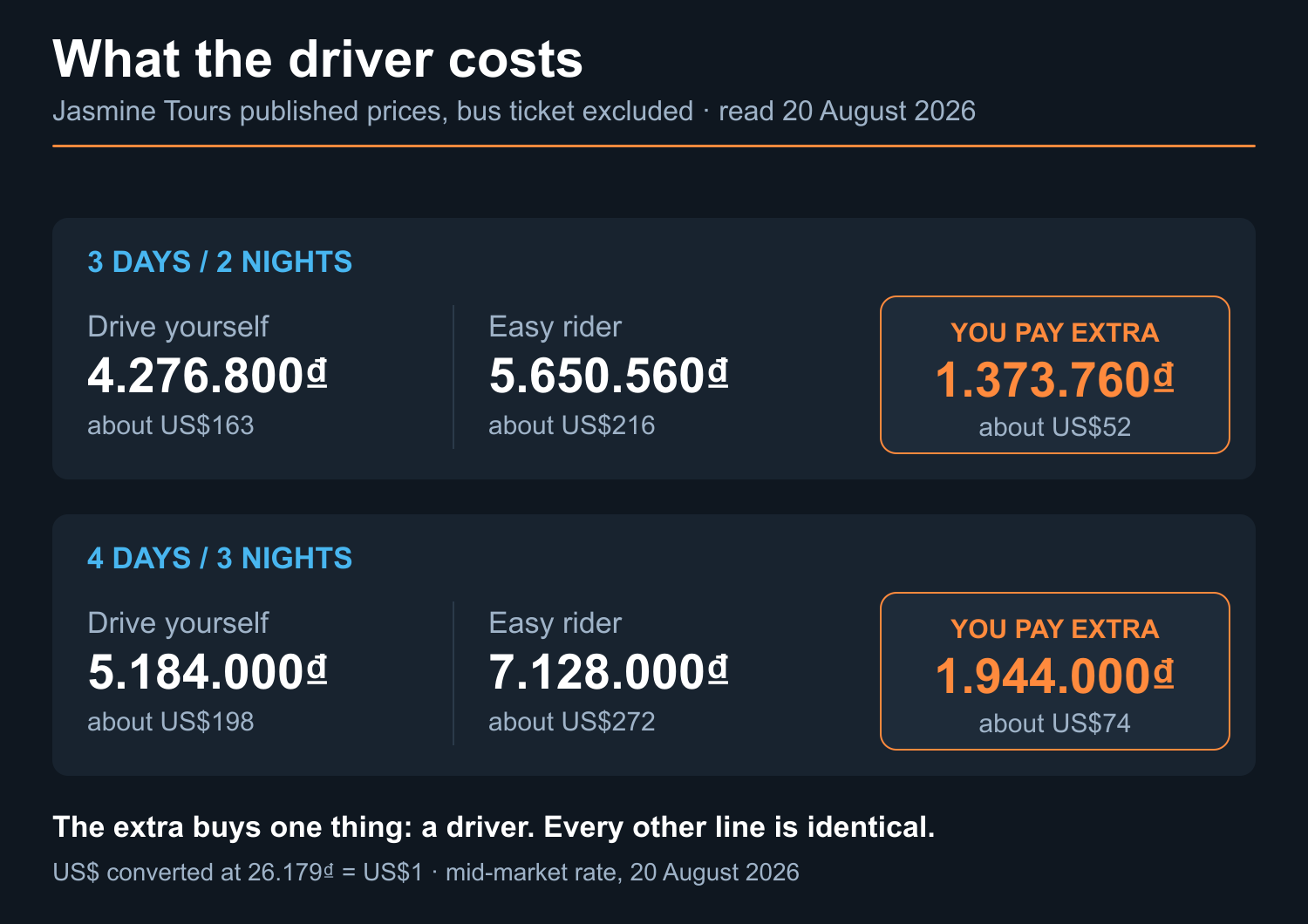
Three days, two nights: 4.276.800₫ to drive yourself, 5.650.560₫ to be driven. The gap is 1.373.760₫, about US$52. Four days, three nights: 5.184.000₫ against 7.128.000₫, a gap of 1.944.000₫, about US$74. Bus ticket excluded from all four, read 20 August 2026, converted at 26.179₫ to the dollar on that date.
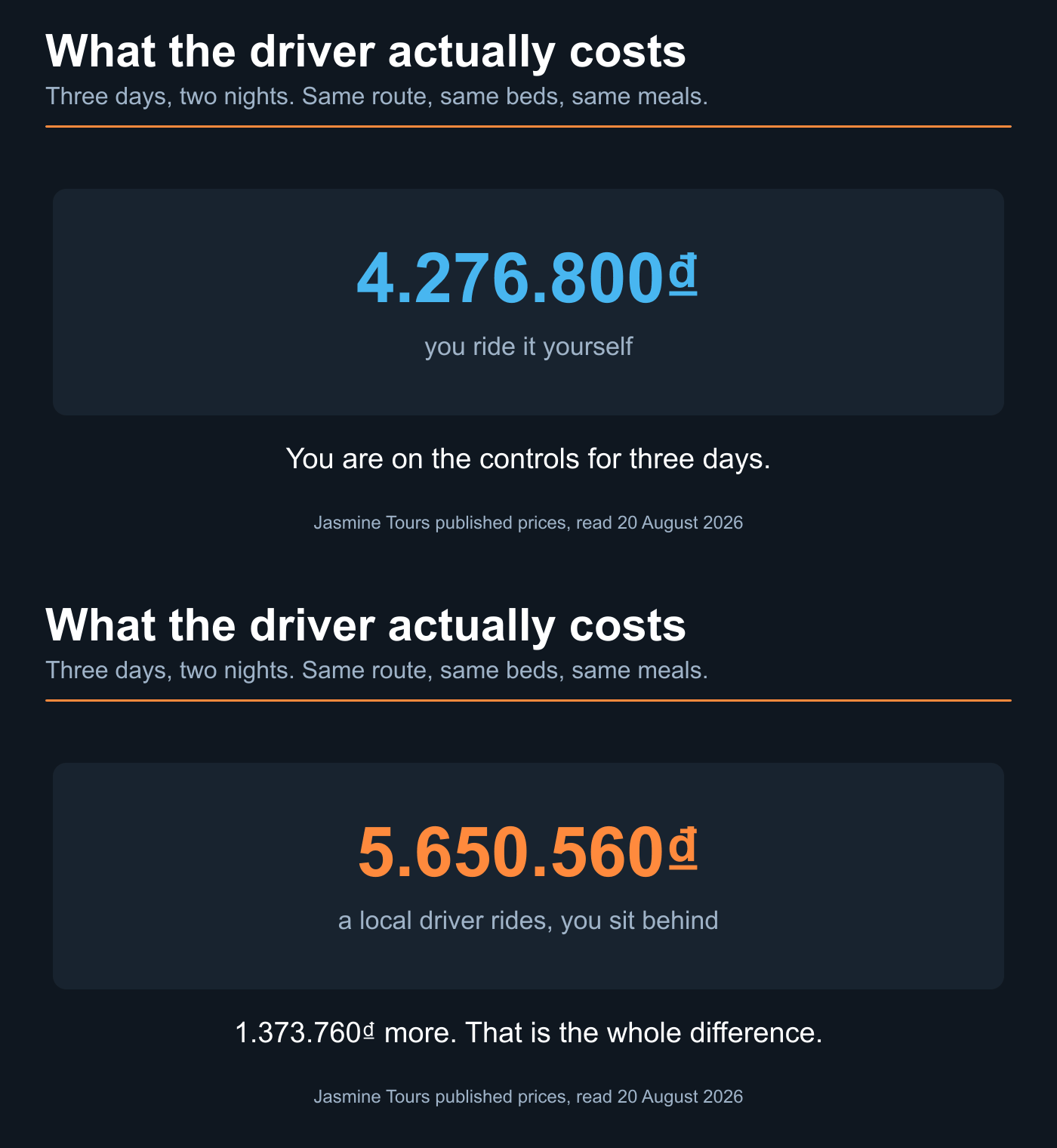
Now look at what that 1.373.760₫ is actually buying, because it is not the bike and it is not the bed.
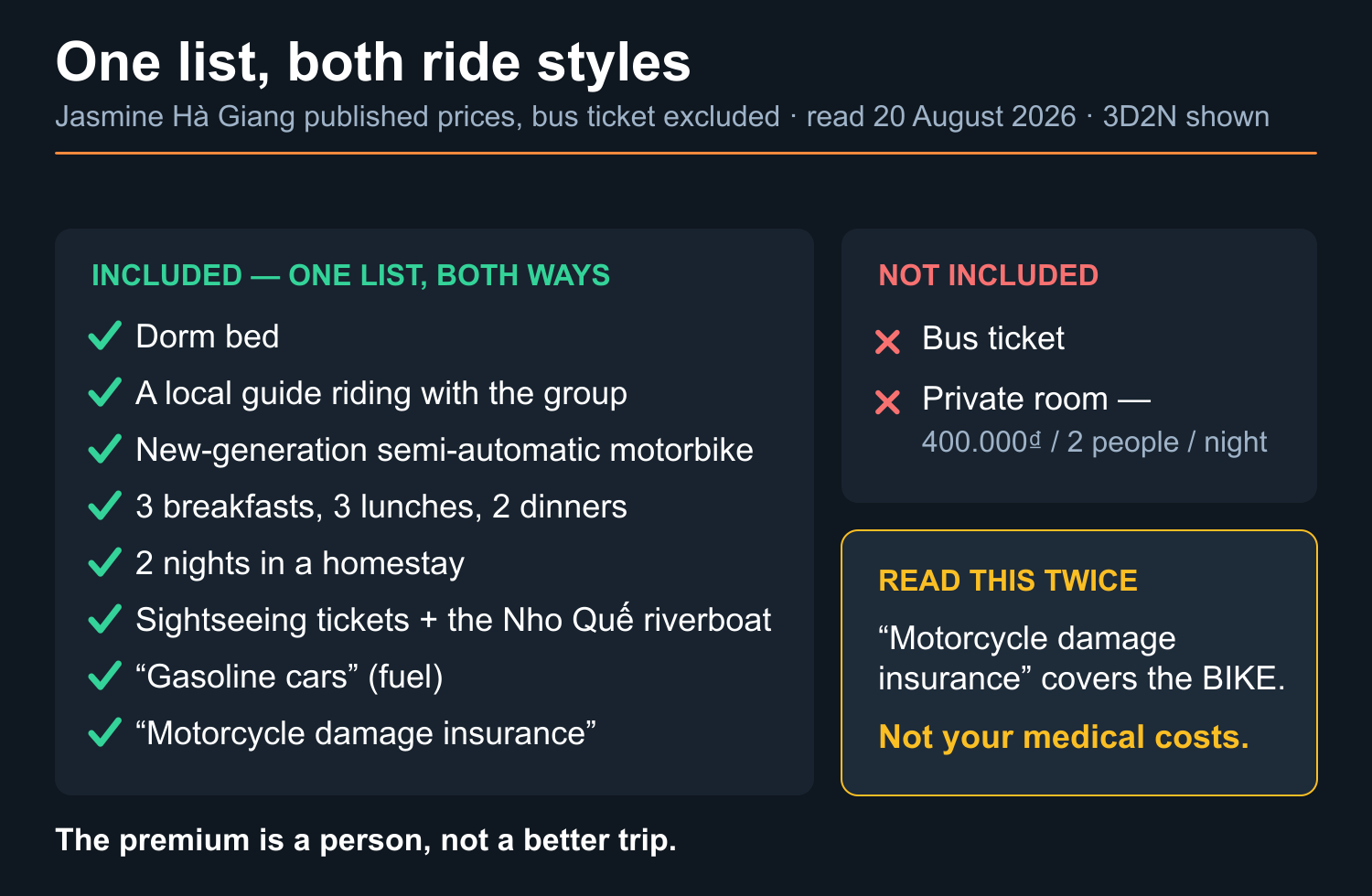
We publish a single inclusion list covering both ride styles: the dorm bed, the meals, the semi-automatic bike, the homestay nights, the sightseeing and Nho Quế riverboat tickets, and what the page calls “Gasoline cars” — fuel. A private room is extra either way, at 400.000₫ per two people per night (about US$15).
So the premium is one thing only: a man and his time. Whether that is good value is genuinely a matter of what you are like, and I’ll get to that. But you should not tell yourself you are buying a nicer trip. You are buying out of a job.
Why this is a licence decision, not a comfort one
Here is the sentence most people arrive not having read. The UK Foreign Office puts it like this:
“You’ll need to have both the 1968 version of the international driving permit and your UK driving licence with you whilst driving a car or motorbike in Vietnam.”
The same page adds that “It is illegal to drive without third-party insurance.”
Two documents, both of them, in your pocket. Not one. Not a licence from home on its own.
That is where the May and June spike comes from, I think. People book flights, then read that, then start looking for a way to see the loop without driving on it.
The Foreign Office is blunt about what follows a crash. Its words: “you could face criminal charges and may need to pay compensation to injured people, even if the injuries are minor.”
And then: “There is also the possibility of a travel ban while the investigation is carried out.”
A travel ban means you don’t fly home on the day your ticket says. That’s the exposure people are actually deciding about, and almost nobody names it.
An easy rider moves that exposure. You are not the driver, so you are not the one who was driving without a permit. I am not going to pretend that makes you legally weightless in a foreign country — I am not a lawyer and this page is not advice. But it is a different position, and it is the honest reason a lot of people should be taking one.
Does your insurance actually cover you?
This is the part most people miss, and it is why I put it above the price comparison.
Outbacker Insurance publishes a page about riding this exact loop. Its wording on being a passenger: “If you are a passenger (pillion), you are also covered, as long as: The driver has the correct licence for the bike. You wear a helmet.”
Read that twice. Your cover, as a passenger, is conditional on somebody else’s paperwork. Not on your care, not on your helmet alone — on whether the man in front of you holds the correct licence for the machine you’re both sitting on.
And you have very little way of checking it. There’s no passenger-carrying permit to ask to see, and in my experience it’s the customer’s licence that gets looked at, not the driver’s.
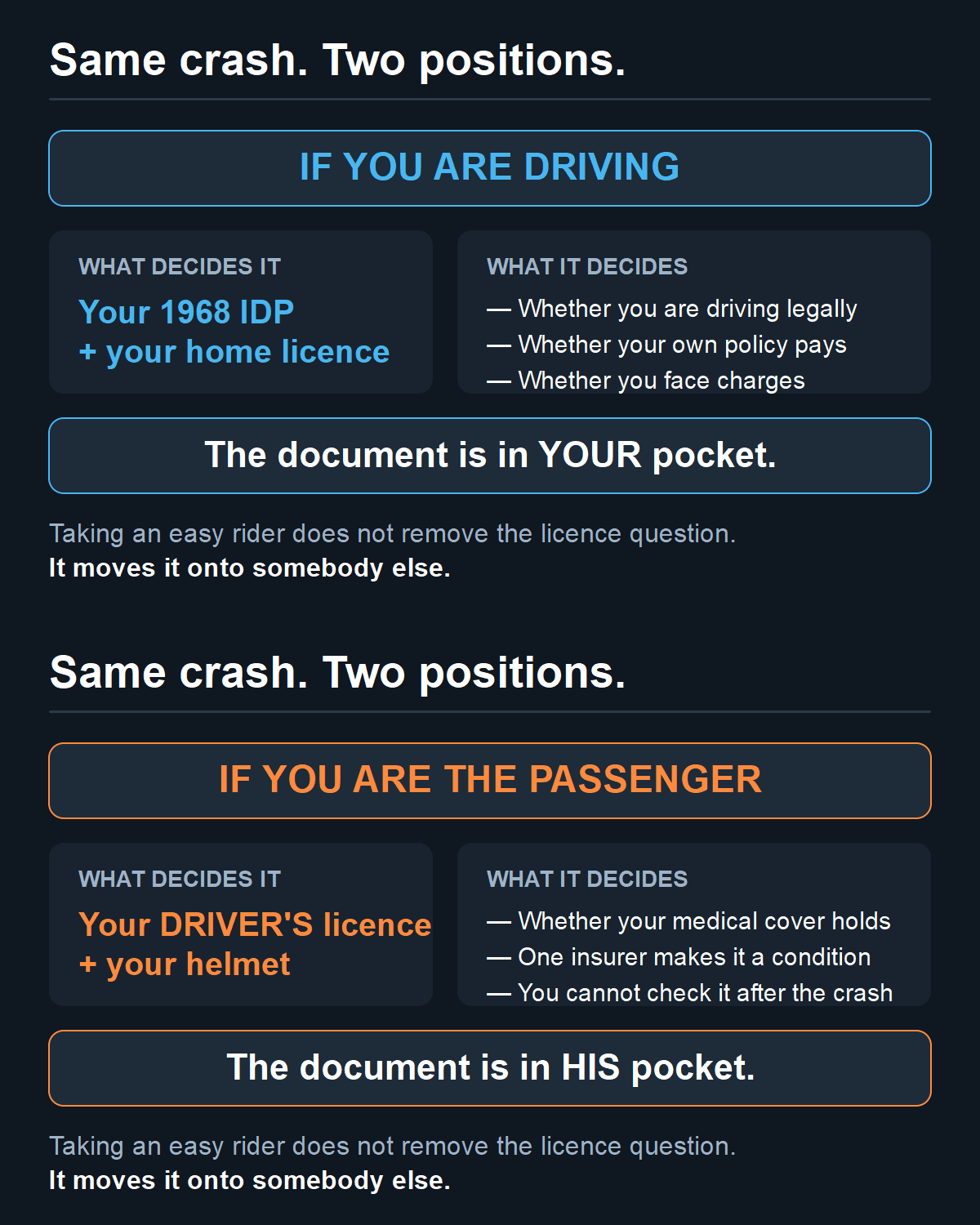
That is one insurer’s wording, not a rule that applies to every policy. Yours may say something different and you have to go and read it. But it establishes the shape of the thing, and the shape is what people miss.
One more, and it catches people every season. Our inclusion list has a line reading “Motorcycle damage insurance”. That is cover for the bike.
It is not medical cover for you. A tour that says “insurance included” has told you what happens to the machine, and nothing at all about what happens to your leg. Buy your own policy regardless of which way you ride.
Who should self-drive?
I would rather this site said this than pretended otherwise, because the whole niche concludes “take an easy rider” and the easy rider is the higher-margin product.
Drive yourself if the following are all true.
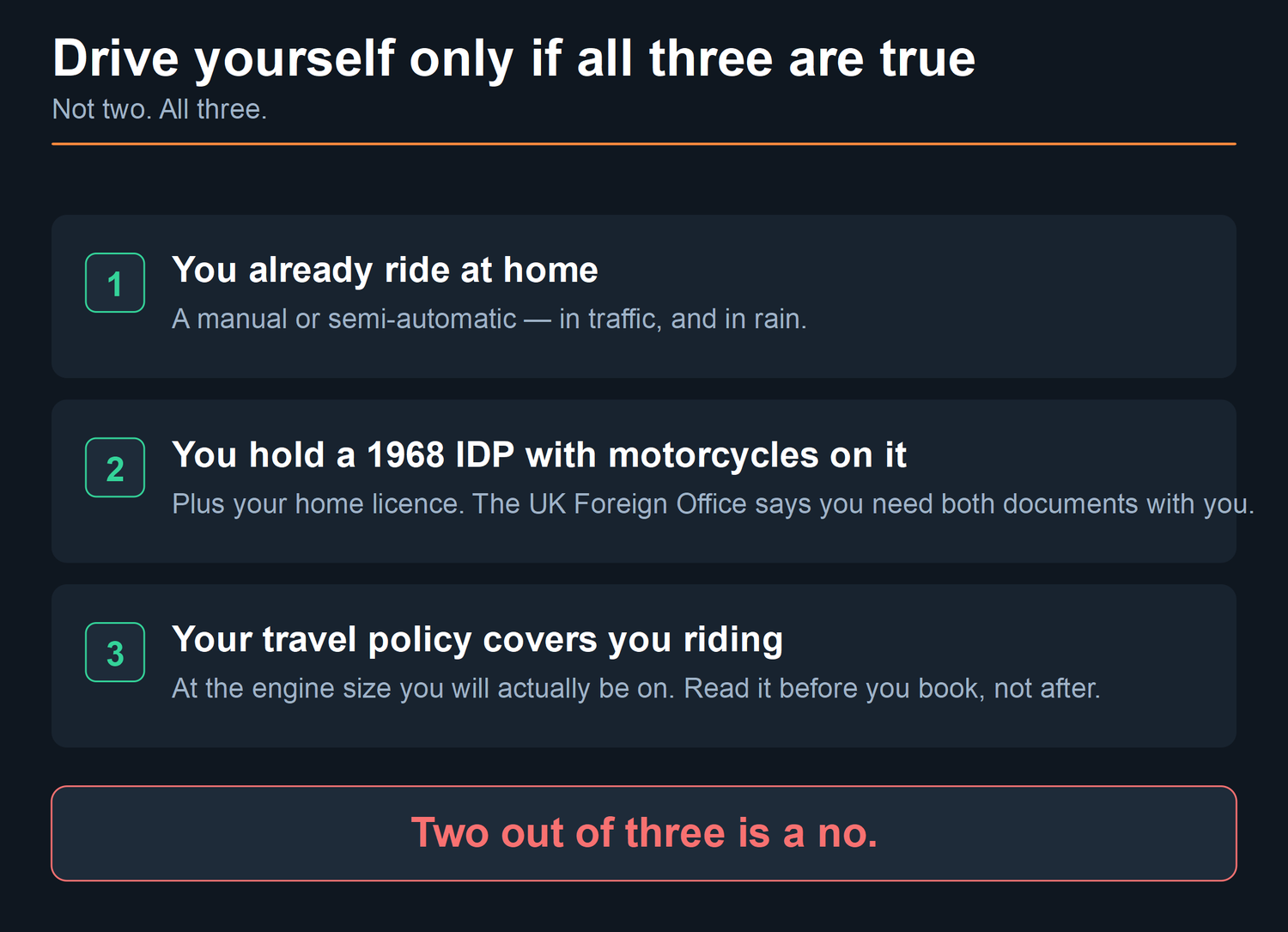
You already ride at home, on a manual or semi-automatic, in traffic and in rain — not once a summer on a friend’s scooter. You hold a 1968 IDP with the motorcycle category on it, and your home licence covers motorcycles. You’ve read your travel policy, and it covers you as a rider at the engine size you’ll be on.
If those are true, drive. The loop is one of the best roads I know, and being a passenger on it is a lesser version of the same days. You’ll also save 1.373.760₫ over three days, and you’ll be free to stop where you want — which on this route matters more than it sounds.
A semi-automatic — the usual rental here — has gears but no clutch lever. If you have only ever ridden a twist-and-go scooter, that is a real difference, and the first hour of learning it should not happen on a mountain pass. Ask to try one on the flat around Hà Giang city first. Any decent operator will let you.
Who should take an easy rider?
Take one if any single item on this list is true. Not all of them. Any one.
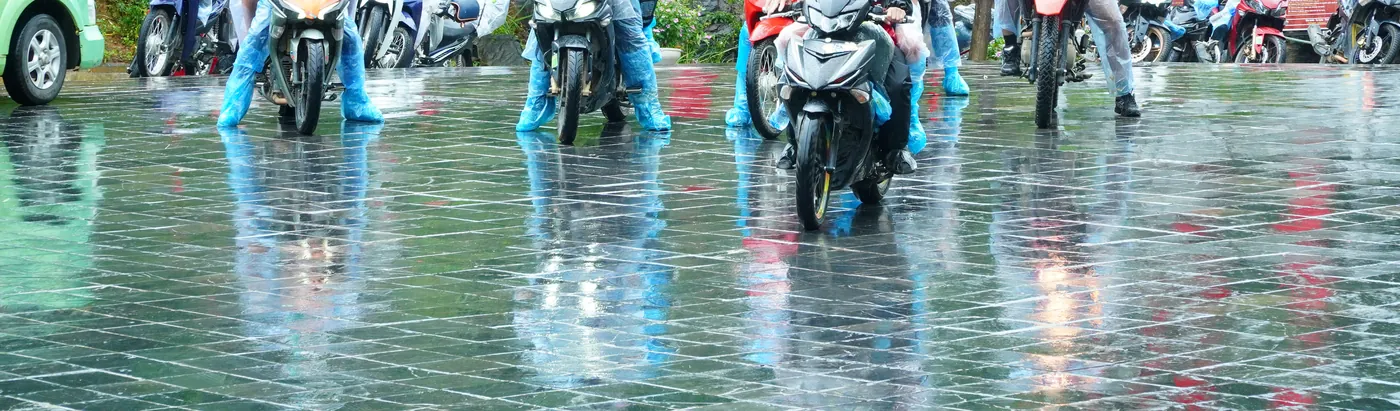
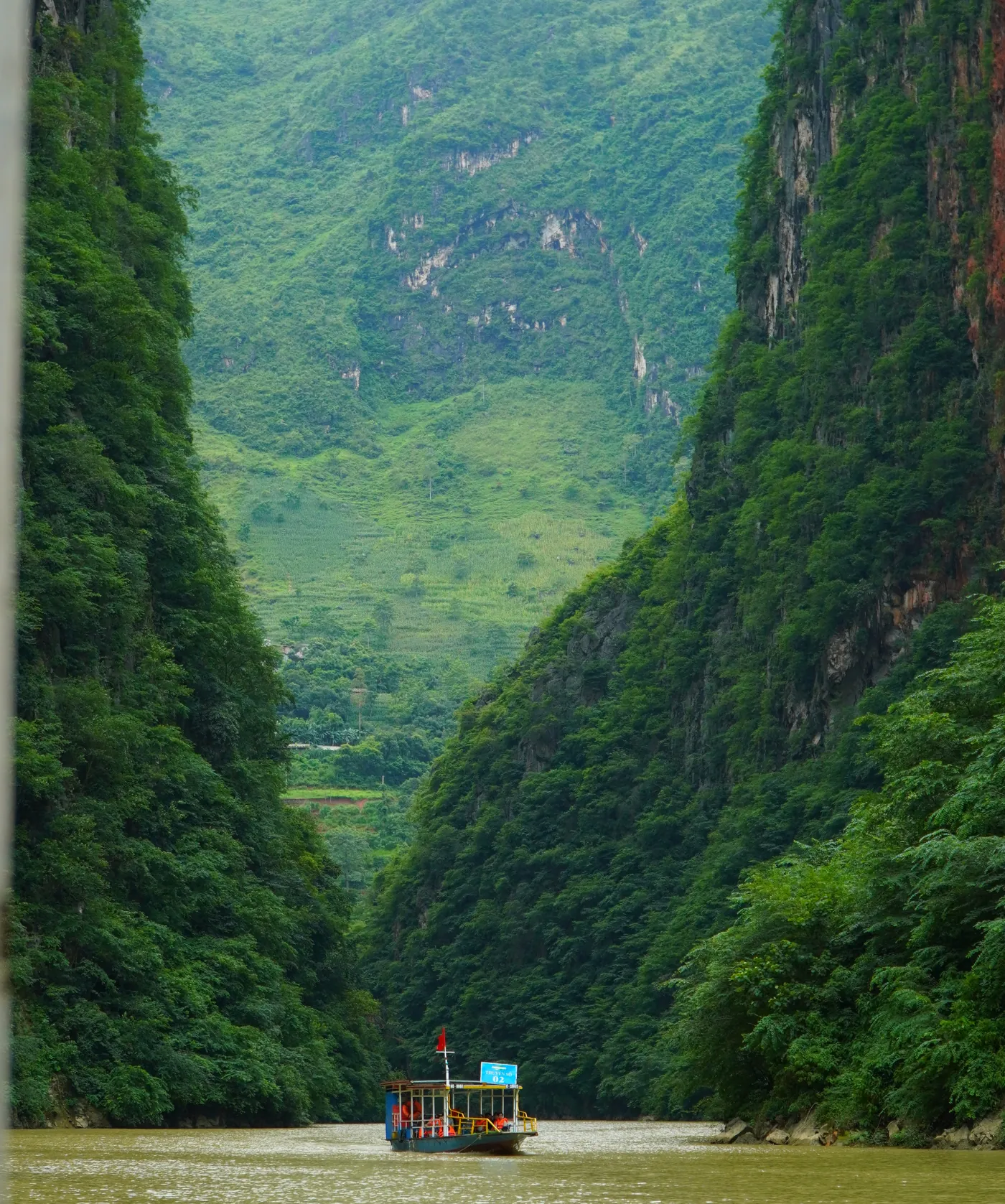
You do not hold a 1968 IDP. You have never ridden a geared bike. You are not confident in rain, and it will rain. You want to actually look at Mã Pí Lèng rather than at the two metres of road in front of your wheel. You are travelling with someone who is nervous about you riding, and you would rather not spend four days negotiating that.
And one more that people are embarrassed to say out loud: you have looked at photographs of the road above the Nho Quế and quietly thought no. Listen to that. It is the cheapest information you will get all trip, and 1.373.760₫ is a small price for acting on it.
You can also split it. Some people ride the flatter first day and take a driver for the Mã Pí Lèng section, or the reverse. Operators do arrange this. It costs more than either pure option and it is worth asking about if you are genuinely on the fence.
What to ask about the driver and the money
I have a fuller list of operator questions on the safety page. These are the ones about the driver and the money.
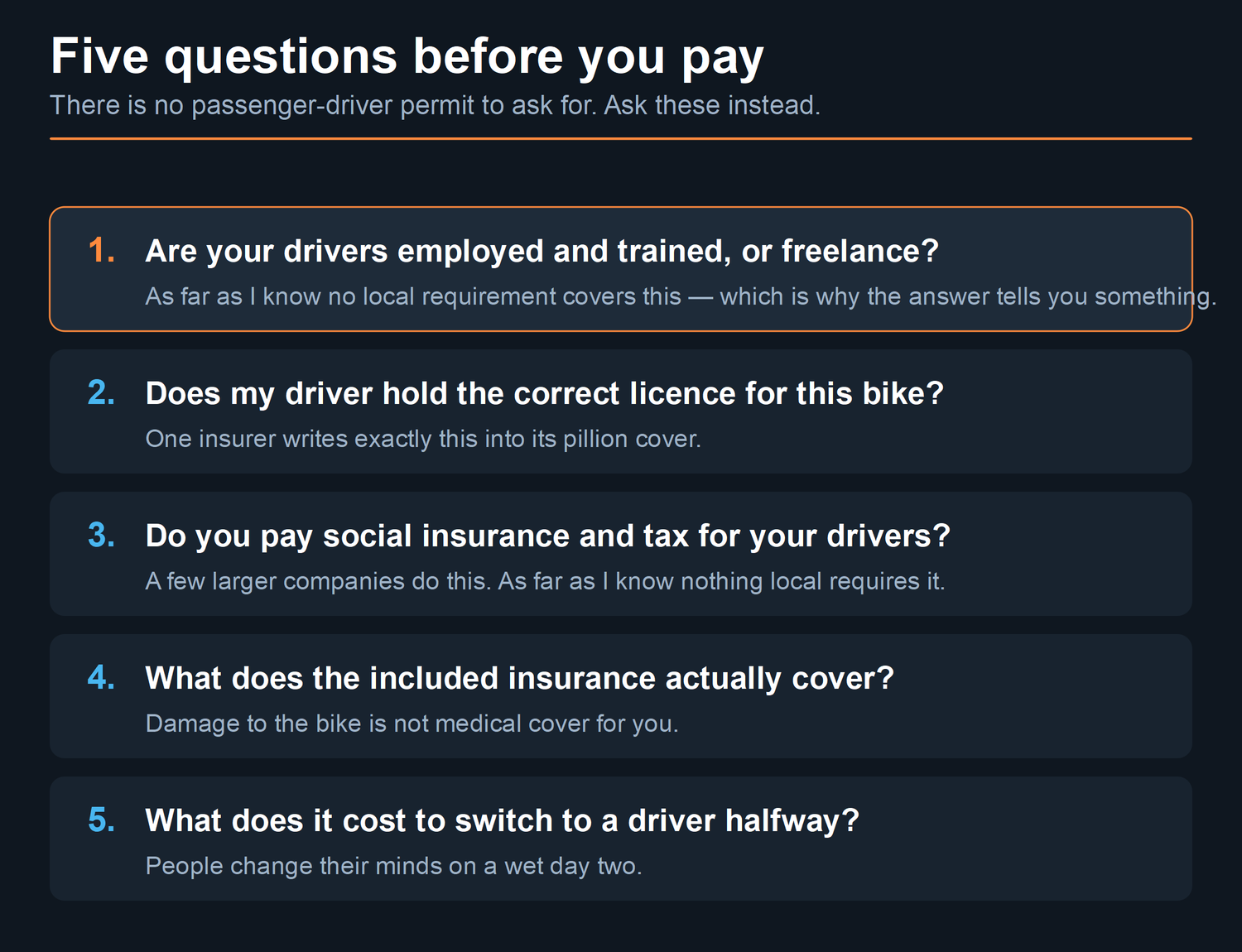
Start with the one almost nobody asks. It isn’t about a permit, because there isn’t one to ask for.
Are your drivers employed and trained, or are they working for themselves?
Here’s why that’s the question. From what I see here, the drivers largely work individually rather than as employees of whoever sold you the tour. Most companies appear to check your motorbike licence — the customer’s — and I’m not aware of any specific requirement having been issued for the drivers themselves. That’s my reading of common practice in the province, not a survey, and I’m not a lawyer.
Notice the shape of that. The paperwork gets checked in the direction that protects the company from you. Whether anyone has checked the man you’ll be sitting behind is a separate question, and it’s yours to ask.
Some of the larger companies do go further on their own initiative. They run driver training, pay social insurance for their drivers, pay tax, and keep the legal paperwork in order. As far as I know nothing here requires any of it, which is exactly why it tells you something when a company does it anyway.
I am deliberately not going to hand you a name here. I have not audited anybody’s payroll, and a list of “good operators” from a man who works in this industry is worth less than you think.
What is worth something is the question itself. Put it to whoever you are considering, and listen to whether the answer is specific — a company that does this can tell you how, and a company that doesn’t will change the subject.
Then the practical ones. Ask how many riders each driver is responsible for. Ask whether there’s a helmet that actually fits you — the Foreign Office notes it’s illegal for drivers and passengers to ride without one. Ask what the included insurance actually covers. And ask what it costs if you start out driving yourself and want to stop halfway.
That last one matters more than it looks. People do change their minds on day two, usually somewhere wet, and you want the price before you need it rather than after.
So which should you book?
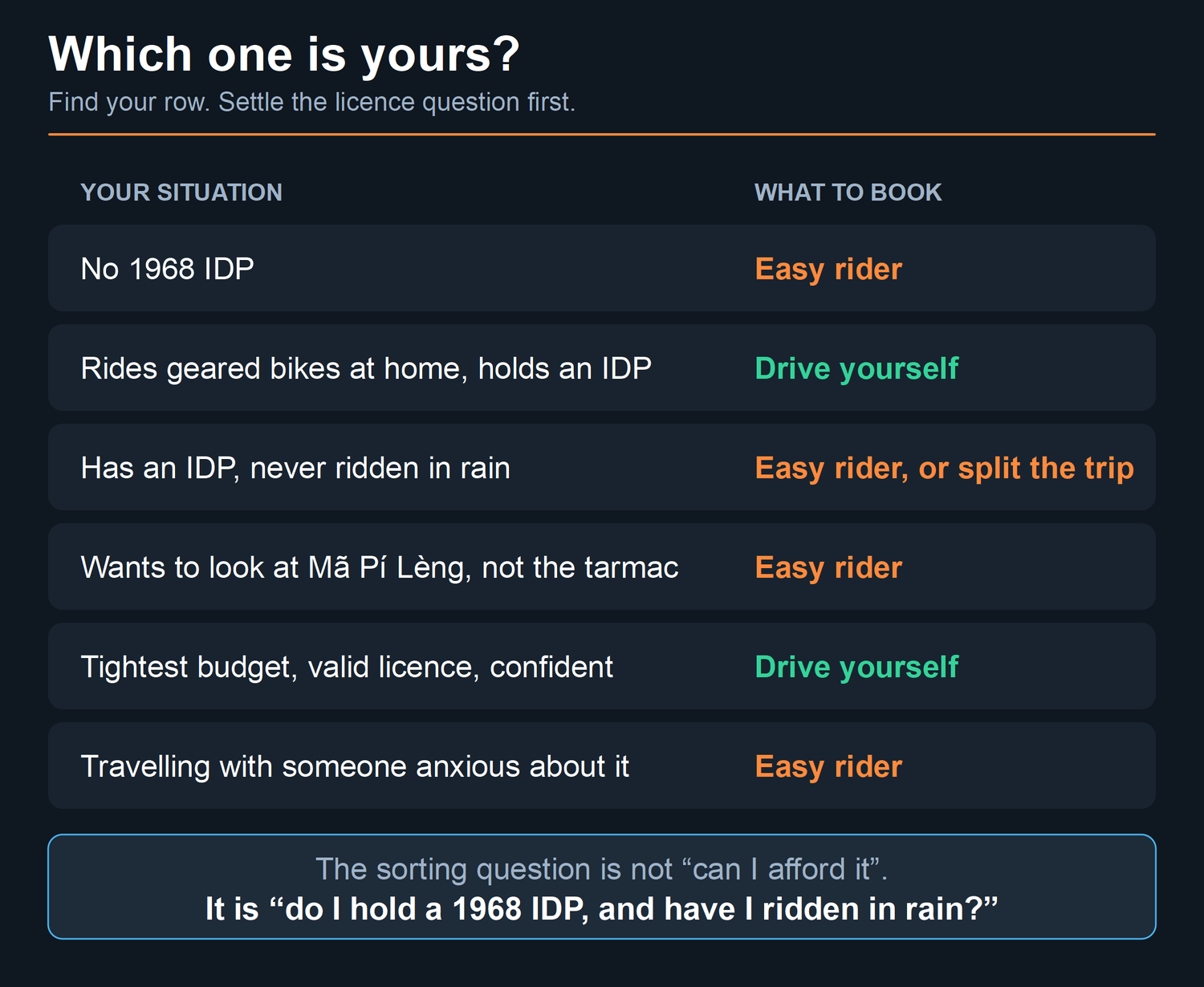
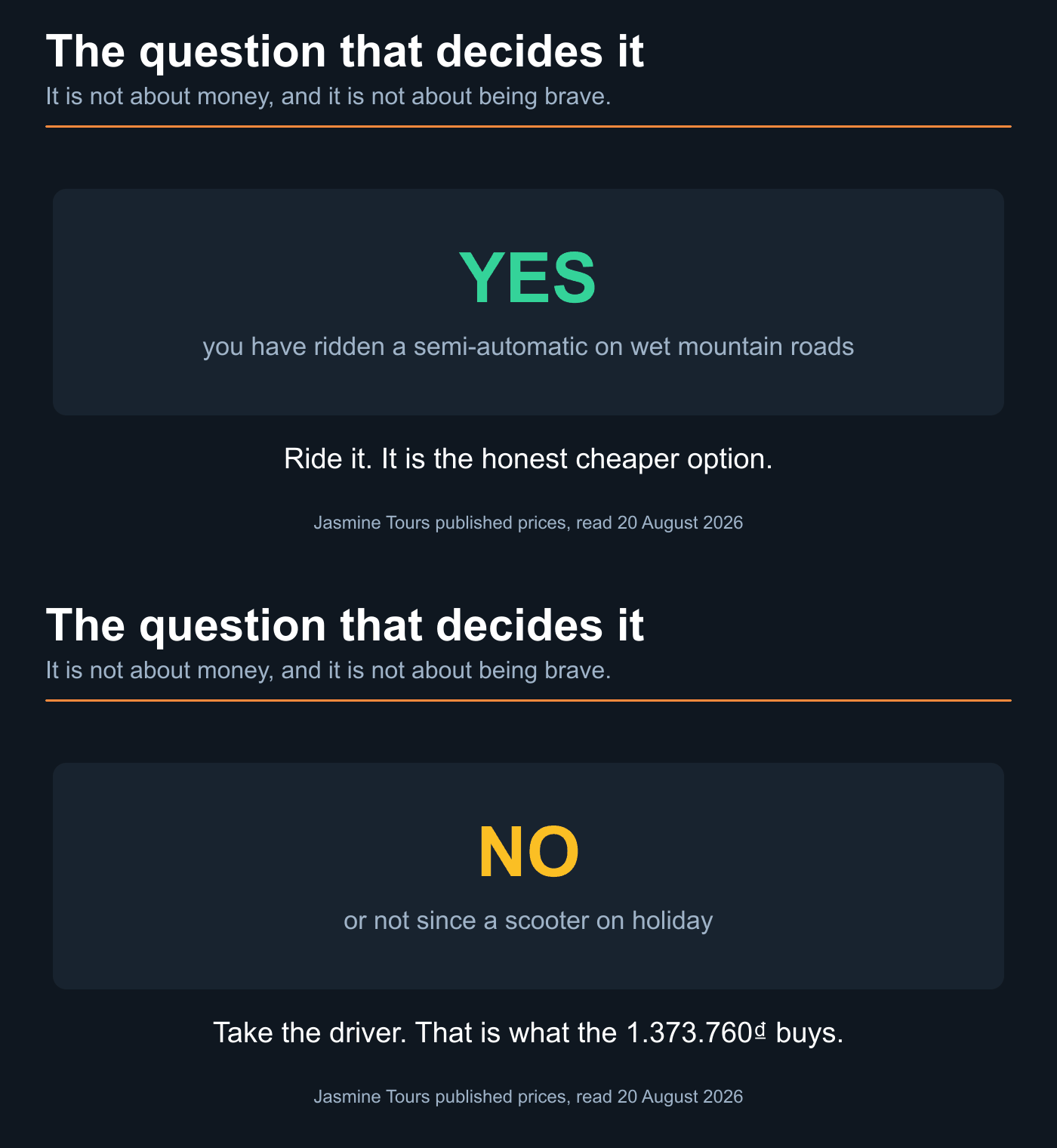
The sorting question is not “can I afford it” and it is not “am I brave”.
It is: do I hold a 1968 IDP with motorcycles on it, and have I ridden a geared bike in rain?
Two yeses, drive. You will have a better trip for less money, and you should stop reading comparison articles and go.
One yes, think about the split, or take the driver for the hard section.
No to either, take the easy rider and enjoy it without a shred of embarrassment. You’ll see more of the country from the back seat than you would have from the front. And you won’t be the person explaining a permit to a policeman on day two.
Whichever you pick, the road is the same road. The route itself is a separate problem — about 450 km all in with the Lũng Cú spur, about eight hours a day once you count stops and lunch. And if you are weighing the risk rather than the price, I have set out where risk on this loop actually concentrates, and how much of it you control either way.
Common questions
What is an easy rider on the Ha Giang Loop?
A local driver you hire for the whole loop. You ride as a passenger on the back of his motorbike and never drive. He handles the luggage, the route and the road conditions.
How much does an easy rider cost on the Ha Giang Loop?
On Jasmine Tours’ published prices, read 20 August 2026, a three-day two-night easy rider tour is 5.650.560₫ against 4.276.800₫ to drive yourself — a difference of 1.373.760₫, roughly US$52 at 26.179₫ to the dollar on that date. Over four days the difference is 1.944.000₫. Bus tickets are excluded from those figures.
Do I need a licence for the Ha Giang Loop?
To drive, yes. The UK Foreign Office states you need both the 1968 version of the International Driving Permit and your home driving licence with you when driving in Vietnam. It also states that driving without third-party insurance is illegal. As a passenger on an easy rider tour you’re not driving, so that requirement isn’t yours — but your insurance may still care about your driver’s licence.
Do easy rider drivers in Hà Giang need a special licence?
Not that I’m aware of. As far as I know no specific requirement has been issued for these drivers, and they largely work individually rather than as employees of the company selling the tour. In practice most operators check the customer’s motorbike licence rather than their own driver’s credentials. Some of the larger companies train their drivers, pay social insurance and tax, and keep the paperwork in order on their own initiative — worth asking about precisely because nothing compels it. This is my own reading of local practice in August 2026, not legal advice.
Is an easy rider safer than driving yourself?
It removes you as the decision-maker on a road you do not know, which is a real reduction in one kind of risk. It does not make the road, the weather or the lorries go away. Treat it as changing who is exposed, not as removing exposure.
Does travel insurance cover me as a passenger?
It depends on your policy and you must read it. One insurer writing about this route, Outbacker, states that a pillion passenger is covered as long as the driver has the correct licence for the bike and the passenger wears a helmet. Note also what a tour’s included “motorcycle damage insurance” actually is. It covers the bike. It says nothing about your medical costs.
Can I switch to an easy rider partway through?
Often yes, and people do, usually on a wet day two. Ask what it costs before you set off rather than when you want it.
A note on this page. The tour prices are our own published figures, read on 20 August 2026. Dollar figures are converted at the XE mid-market rate of 26.179₫ to US$1 on 20 August 2026, and will drift.
These are published prices, not prices I have paid. When I have my own receipts for easy rider tours, they will replace them here. The search-volume figures at the top are DataForSEO Labs data for the Australian market, run on 3 August 2026.
Photographs taken on our own trips between 27 and 31 July 2026; each caption carries its own date. Our own listed prices appear above, for the reason given in that section.
The licensing and insurance material is quoted from the UK Foreign, Commonwealth & Development Office and from Outbacker Insurance’s own published wording. What I say about how drivers here are engaged, what operators check, and what has or has not been required of them is my own observation of local practice as at August 2026 — not a survey, not a legal position, and not a substitute for reading your own policy.